

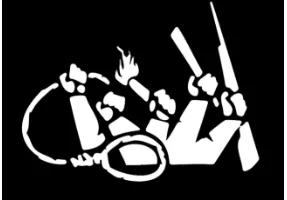
The brave new world of lynch mobs
For the past few weeks, I have been watching the news coming out of Donald Trump’s America with an endless fascination, and a growing unease (anxiety or discontent.). The fascination stems in part from the racist overtones in a country that is trying hard to wish away its history of hatred and bigotry; the unease from the striking parallels it holds to our own situation in India.Lynching was a word often heard in the America of the 19th century, when members of the Ku Klux Klan rounded up black people and hanged them from trees — a gruesome (causing repulsion or horror) outcome of slavery. Americans recently recalled the last lynching (kill (someone)) that happened almost a hundred years ago, with prayer, sadness and the fervent hope that it would never be repeated. In contrast, in India, less than 100 days ago, a 15-year-old Muslim was knifed to death in a crowded passenger train. But the incident brought no public outcry, no prayer, no such emotion. Lynching is now an Indian word, not just taken from the diction of American slavery, but actively used to attack Muslims, Christians and Dalits. Unlike the American lynchings, these don’t occur under the cover of darkness; neither are they carried out by hooded people unwilling to reveal their identity. They are perpetrated by ordinary, well-meaning citizens, who carry out the acts in full public view at busy road intersections or crowded markets. One person was lynched by his neighbours; another was stabbed in a train; more than 30 people were killed in Panchkula by mobs given a free reign by the state — such acts have begun to be considered normal.
Charlottesville and after
In the week after the neo-Nazi rally, almost every politician in the U.S. unequivocally (in a way that leaves no doubt.) denounced hate; members of Mr. Trump’s business council resigned; many Generals and Navy Admirals penned their messages on social media; and newspapers and television criticised the President for his racist stance in blaming ‘both sides’ for the violence. These public words and actions were directed not just at defusing a volatile situation, but righting a moral wrong. However, when India saw its own Charlottesville-type situations — be it following the killing of Mohammad Akhlaq by a mob in Dadri, or rioting by the followers of Gurmeet Ram Rahim Singh — it was business as usual. Neither the Prime Minister, nor any elected official unequivocally condemned the hate crimes.
In both countries, the preferential treatment meted out (given) to the majority may not fall within the standard references of Constitution and law, but scores on other ideological grounds. Mr. Trump refused to acknowledge that only the neo-Nazis were to blame at Charlottesville, thereby ensuring a friendly nod from the Alt-Right. Mr. Modi’s absence of clear reprimand (a formal expression of disapproval.) following the killings by the purported gau rakshaks ensured an equivalent approval from the RSS.
Similarities also exist in the manner in which the state deals with race in America and religion in India — but there are clear differences in perceptions. While African Americans may endure an undercurrent of racial tensions, the overt (open and clear) message in public life makes no allowance for discrimination. However, people belonging to the minority communities in India are made to tolerate indignities (treatment or circumstances that cause one to feel shame or to lose one's dignity.) and live in constant fear.
Perhaps, more troubling is that both the American President and the Indian Prime Minister value a private form of authoritarianism over democratic largesse (generosity in bestowing) . Mr. Trump has openly expressed his admiration for people like Vladimir Putin, and Rodrigo Duterte. Mr. Modi’s historical reach doesn’t go beyond the border, remaining enmeshed in a despotic strain of Hindu nationalism. His political agenda is infused with a form of patriotism not endorsed by everyone. Consequently, both of them use the symbolism behind the statue and the monument to further their ideological aims. Mr. Modi’s nationalist heroes are all Hindus, so, in his mind, they must be heroes to all Indians. Such reasoning finds echoes in Mr. Trump’s assertion that Confederate heroes of the civil war must be venerated (respected). While one proposes the erection of statues to Shivaji and Patel, the other balks at the removal of monuments to those southern heroes who promoted slavery. The incipient majoritarianism in both acts is visible and clear.
However, there is one stark difference. The American minority is shielded from the lynch mob by both the Constitution and a morality that relies on political correctness. The voices that reverberated out of Charlottesville were shrill (loud and forceful.) in their denunciation of hate. Here, by contrast, there is never any public outcry over a killing prompted by religion or caste. The Indian stand relies on the Constitution in name only, and condemnations never come, or — as with the Panchkula violence — come too late. For public justification, there is always the religious sentiment, something that gives a free reign to the lynch mob.
Who were the first settlers of india
Sep 06, 2017
Managing embankments
Sep 03, 2017

Is prasar bharati its master’s voice
Aug 28, 2017
Endgame for section 377
Aug 26, 2017
Recasting the steel frame
Aug 22, 2017





Stay updated with The Hindu Editorial Vocab24 app, your definitive source for breaking news and comprehensive coverage from India and around the globe. Whether it's political developments, business updates, sports highlights, the latest technology trends, or current events, The Hindu brings live, accurate, and reliable news directly to your device.
Don’t fall for sensationalized or fake news shared online. Read and share accurate updates with friends and family through The Hindu Editorial Vocab24 app. Download it today!
News Coverage in The Hindu Editorial Vocab24 App
Breaking News: Receive instant notifications on breaking news stories as they unfold. Stay informed about major events and developments in India and around the world with live blogs, news in shorts videos, and concise articles.
Politics: Get the latest updates on Indian politics, including elections, policy changes, government decisions, and political events that shape the nation.
Business and Economy: Stay ahead in the economic landscape with detailed business news and market analysis. Learn about stock market trends, financial reports, corporate news, and economic developments to make informed investment decisions.
Current Events: Follow stories on social issues, policy changes, global events, and daily current affairs, tailored for UPSC and other competitive exam preparations.
Technology: Keep up with the latest gadgets, innovations, and tech trends. Read expert reviews and analyses in short, concise updates on cutting-edge technology from India and beyond.
Sports: Never miss a moment of your favorite sports. Get live scores, match reports, and expert analysis on cricket, football, tennis, and more.
International News: Stay informed about global events and geopolitical developments, including the Russia-Ukraine war, Israel-Palestine conflict, and other key international stories.
Local News: Stay connected to your community with the latest updates on city events, issues, and local news. Coverage includes hyperlocal updates from cities like Bangalore, Chennai, Delhi, Hyderabad, Mumbai, Kolkata, and more.
Trending Topics: Discover what's trending today with the most talked-about stories and hot topics across India and the world.
Experience journalism that values integrity, accuracy, and reliability. Download The Hindu Editorial Vocab24 app today and stay connected with the world.
Subscribe to our newsletter!







