

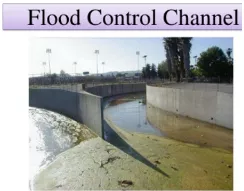
Managing embankments
Life had come to a standstill (a situation or condition in which there is no movement or activity at all.) in the Ganga-Brahmaputra floodplains where large tracts of land were reeling under (to suffer because of a burden.) floods. Everywhere there were submerged houses, broken bridges, and wasted railway tracks. The fury of the waters in the Kishanganj and Katihar districts of Bihar had cut off the road and rail services in north Bengal, and consequently Northeast India’s connectivity by rail with the rest of India. On such occassions, schools routinely turn into relief centres and schoolchildren are forced to take a “flood vacation”. Access to water and sanitation is difficult. Open defecation is common, and the use of contaminated water leads to a peak in water-borne diseases. Agricultural land is either covered with sand or remains waterlogged.No ‘safe’ area in the floodplains
Further accentuating (make more noticeable or prominent) the misery is the failure of embankments (a wall or bank of earth or stone built to prevent a river flooding an area.) — the gold standard for flood protection. An embankment is an uplifted earthen structure constructed along the river channel to artificially reduce the size of the floodplains by constricting floodwaters to a narrow stretch. The land outside the embankment is supposed to be safe from floods. However, embankment breach resulting in flooding the “safe” areas is routine. We need a paradigm shift in the way these embankments are managed. It is important to involve the community that is close to the embankment in its management. Only then can we break the build-and-forget mentality that currently rules the bureaucracy.
Our study of over 100 villages in the Ganga-Brahmaputra floodplains found that villages in these areas are exposed to diverse water-related hazards (a danger or risk.) depending on their location vis-a-vis an embankment. Those located inside the embankment are vulnerable to floods and riverbank erosion, and those outside, in the “safe” areas, are prone to extended periods of inundation (an overwhelming abundance) . This takes place when the construction of an embankment causes the drainage lines to be blocked, the regulators in the embankments become dysfunctional (not operating normally or properly.), or when there is a backflow of the larger river in spate. The people in these “safe” areas suffer from a perennial (lasting or existing for a long or apparently infinite time) fear of embankment breach, which is not entirely unfounded. In Bihar in 2008, there was a colossal embankment breach in the Kosi river basin. This year too, in parts of Assam, Bihar and West Bengal breaches have caused flooding. Only in a few cases have newly constructed embankments been able to protect villages located outside them from floods. Despite this, in flood-prone areas with no embankments, people still articulate the need for embankments. Till now, embankments have been managed by irrigation or flood-control departments. However, the communities near the embankments are best positioned to take care of them. The responsibility of embankment management could be devolved (transfer or delegate (power) to a lower level,) to the community, while the ownership right resides with the state. But this task of decentralisation will not be easy when society is fractured along the lines of caste, class, and religion. We must remember then that disaster is non-discriminatory and affects all.
To incentivize (motivate or encourage (someone) to do something) collective action from the community, the state has to create an enabling institutional environment. The community-based organisations (embankment management committees) should be empowered to earn revenue from the embankments through levying tolls (as most embankments are also used as roads), and undertake plantation activities (and sale of the harvest). In areas where villages exist both inside and outside the embankment, their interests conflict. In such cases, efforts could be made to ensure that the former has a greater share of the revenue. This will dissuade (persuade (someone) not to take a particular course of action.) them from causing a breach. While the irrigation or flood-control departments might issue tenders for periodic maintenance activity, the committees could act as a partner to partly implement the same, or act as a monitoring agency. Payment to contractors could be conditioned upon a joint inspection by the irrigation department and the embankment management committees.
Promoting decentralised management systems is yet to be tested for embankment management, even as participatory irrigation and joint forest management are established practices. But if the past teaches us something, it is that build-and-forget cannot be an option for embankments. If we have to shift from reactive flood protection to year-round flood governance, we must design ways of embankment management in flood-prone (likely or liable to suffer from) areas. Participatory embankment management could be the way forward.
Who were the first settlers of india
Sep 06, 2017
The brave new world of lynch mobs
Sep 04, 2017

Is prasar bharati its master’s voice
Aug 28, 2017
Endgame for section 377
Aug 26, 2017
Recasting the steel frame
Aug 22, 2017





Stay updated with The Hindu Editorial Vocab24 app, your definitive source for breaking news and comprehensive coverage from India and around the globe. Whether it's political developments, business updates, sports highlights, the latest technology trends, or current events, The Hindu brings live, accurate, and reliable news directly to your device.
Don’t fall for sensationalized or fake news shared online. Read and share accurate updates with friends and family through The Hindu Editorial Vocab24 app. Download it today!
News Coverage in The Hindu Editorial Vocab24 App
Breaking News: Receive instant notifications on breaking news stories as they unfold. Stay informed about major events and developments in India and around the world with live blogs, news in shorts videos, and concise articles.
Politics: Get the latest updates on Indian politics, including elections, policy changes, government decisions, and political events that shape the nation.
Business and Economy: Stay ahead in the economic landscape with detailed business news and market analysis. Learn about stock market trends, financial reports, corporate news, and economic developments to make informed investment decisions.
Current Events: Follow stories on social issues, policy changes, global events, and daily current affairs, tailored for UPSC and other competitive exam preparations.
Technology: Keep up with the latest gadgets, innovations, and tech trends. Read expert reviews and analyses in short, concise updates on cutting-edge technology from India and beyond.
Sports: Never miss a moment of your favorite sports. Get live scores, match reports, and expert analysis on cricket, football, tennis, and more.
International News: Stay informed about global events and geopolitical developments, including the Russia-Ukraine war, Israel-Palestine conflict, and other key international stories.
Local News: Stay connected to your community with the latest updates on city events, issues, and local news. Coverage includes hyperlocal updates from cities like Bangalore, Chennai, Delhi, Hyderabad, Mumbai, Kolkata, and more.
Trending Topics: Discover what's trending today with the most talked-about stories and hot topics across India and the world.
Experience journalism that values integrity, accuracy, and reliability. Download The Hindu Editorial Vocab24 app today and stay connected with the world.
Subscribe to our newsletter!







