

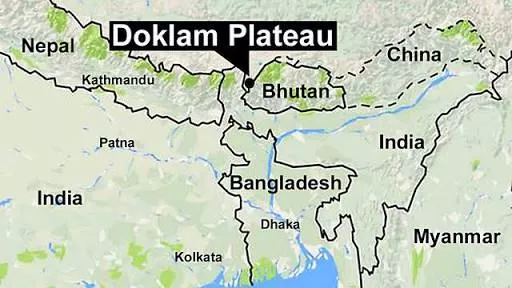
Doklam ushers in uneasy phase in india china ties
A major immediate fallout of the stand-off at Doklam is that what little trust there was in the China-India bilateral relationship has dropped to negligible levels.With the disengagement of military personnel at Doklam on 28 August 2017, tensions have temporarily receded, including in the region. There are already indicators, however, that China’s leadership plans to retrieve its hurt prestige.
The withdrawal of troops by both sides and India’s subsequent clarification that the bulldozer and earthmoving equipment had been removed were clear indications that China’s effort to construct a road through the Doklam plateau has been stopped. China has, however, each day since then declared its determination to safeguard its sovereignty and territory and resume construction of the road at an appropriate time, while avoiding direct mention that the withdrawal of troops was mutual. These assertions were elevated to the leadership level just days ago when Chinese Foreign Minister Wang Yi repeated them. Resultantly, both sides regard the present arrangement as temporary and maintain a watchful wariness. The border between India and China that stretches 4,057 kilometres is also disputed.
During the entire three-month-long stand-off at Doklam, the state-owned Chinese propaganda apparatus kept up a daily barrage of anti-India vitriol, including sharp personal attacks on Prime Minister Narendra Modi and External Affairs Minister Sushma Swaraj. It was insistent that India first withdraw its troops, who had “trespassed” into Chinese territory, before negotiations could commence. Over a hundred articles threatening India were published—a number of them in the state-owned English language Global Times. An article in People’s Daily, the Chinese Communist Party’s (CCP’s) official mouthpiece, on 14 August observed that till that date China had “officially laid out its position” 67 times with its Ministry of Foreign Affairs (MFA), reiterating its “firm stance” 54 times and the China’s Ministry of National Defence (MND) issuing four announcements.
China’s media warned India to remember the war of 1962 and threatened to dismember India and fan domestic ferment. It promised to “reverse” its position on Sikkim and create trouble; revive insurgency in India’s Northeast; launch an international campaign to sever the close ties between India and Bhutan; and send troops into Kashmir at the “behest” of Pakistan. With these threats and warnings, quite uncharacteristic of standard Chinese practice, Beijing effectively narrowed its room for manoeuvre and the scope for diplomatic negotiations.
The numerous threats against India, issued by China through its official media, were not only unprecedented but, quite uncharacteristically for the Chinese, exposed Beijing’s thinking about India and the China-India relationship. By laying its cards on the table, Beijing has ensured that suspicion of its intentions will henceforth be a factor in the Indian establishment’s approach to China. With its threat to revive insurgency in the Northeast, China has also put into cold storage any thinking on the Bangladesh-China-India-Myanmar (BCIM) corridor. In contrast to China’s propaganda offensive, India displayed quiet confidence and restraint. It, instead, emphasised its desire for a peaceful resolution and called for de-escalation of tensions.
There are many facets to the recent face-off between Chinese and Indian troops. In addition to demonstrating that India will not be cowed down by a larger country despite its threats, it emphasised India’s resolve to defend its sovereignty and national security interests. It made clear that India would not hesitate to assist a smaller neighbour, with whom it has a security relationship. These messages will undoubtedly resonate in the capitals of countries neighbouring India, including particularly Pakistan and Nepal. Neither of them, incidentally, expressed any support for China. Countries in the wider Indo-Pacific region and bordering the South China Sea too would have taken positive note of India’s stance. Japan’s, and subsequently United States’, publicly expressed support to India is demonstrative of this. By standing up to China at Doklam, India in effect challenged China and paused the seeming momentum Beijing had created to aggressively expand its strategic space and territory, thereby denting Beijing’s image.
There are, however, already indicators that this is a temporary lull. Beijing would not have wanted the face-off between Chinese and Indian troops, with its inherent potential for escalation, to mar the atmosphere during the BRICS Summit in early September or cast its shadow over the more important 19th Party Congress, now announced to open in Beijing on 18 October 2017. The latter, especially as Chinese President Xi Jinping could not risk China not being able to “teach India a lesson” by securing a decisive victory as the People’s Liberation Army (PLA) has not seen military action since 1979. In addition, the PLA is in the midst of unprecedented far-reaching restructuring and reform not witnessed since its inception 90 years ago, and which had, by March 2017, led to the arrest and dismissal of more than 4,800 officers, or over 30% of the PLA officer corps.
The stand-off has had repercussions inside China as well. On 30 August, the South China Morning Post quoted Yue Gang, a retired colonel of the PLA’s General Staff Department and frequent hardline commentator on military matters. He said “The event—where Chinese President Xi Jinping and Indian Prime Minister Narendra Modi are supposed to meet—has offered a way out of this unexpectedly tense stand-off, although there are different interpretations as to which side actually compromised more.” Significantly, he added, “Despite Beijing’s deliberate ambiguity, China has apparently made substantial concessions in order to end the dispute. India has got exactly what it has wanted. It was a humiliating defeat for China to cave in to pressure from India despite all the tough talk.”
Numerous comments on social media separately asked why there has been no apology from India. Some said, “India withdrawing troops is a fact, did we give up some legitimate rights such as building road, this is what citizens care about, our focus is whether India’s withdrawal is unconditional, hope there is a clear explanation.” Meanwhile, a rumour has spread in China claiming that China had purchased India’s acquiescence to the withdrawal by giving it a loan of US$20 billion! Revealing the concern this has caused China’s leadership, it was unusually denied. Denials were issued by the spokesman of China’s Ministry of National Defence Colonel Ren Guoqiang, the spokesperson of China’s Ministry of Foreign Affairs (MFA) and the CCP’s official mouthpiece, People’s Daily.
A major immediate fallout of the stand-off at Doklam is that what little trust there was in the China-India bilateral relationship has dropped to negligible levels. It heralds a new uneasy phase in relations between the two big Asian neighbours which could be interspersed with periods of tension as both countries seek to find new accommodation.






Stay updated with The Hindu Editorial Vocab24 app, your definitive source for breaking news and comprehensive coverage from India and around the globe. Whether it's political developments, business updates, sports highlights, the latest technology trends, or current events, The Hindu brings live, accurate, and reliable news directly to your device.
Don’t fall for sensationalized or fake news shared online. Read and share accurate updates with friends and family through The Hindu Editorial Vocab24 app. Download it today!
News Coverage in The Hindu Editorial Vocab24 App
Breaking News: Receive instant notifications on breaking news stories as they unfold. Stay informed about major events and developments in India and around the world with live blogs, news in shorts videos, and concise articles.
Politics: Get the latest updates on Indian politics, including elections, policy changes, government decisions, and political events that shape the nation.
Business and Economy: Stay ahead in the economic landscape with detailed business news and market analysis. Learn about stock market trends, financial reports, corporate news, and economic developments to make informed investment decisions.
Current Events: Follow stories on social issues, policy changes, global events, and daily current affairs, tailored for UPSC and other competitive exam preparations.
Technology: Keep up with the latest gadgets, innovations, and tech trends. Read expert reviews and analyses in short, concise updates on cutting-edge technology from India and beyond.
Sports: Never miss a moment of your favorite sports. Get live scores, match reports, and expert analysis on cricket, football, tennis, and more.
International News: Stay informed about global events and geopolitical developments, including the Russia-Ukraine war, Israel-Palestine conflict, and other key international stories.
Local News: Stay connected to your community with the latest updates on city events, issues, and local news. Coverage includes hyperlocal updates from cities like Bangalore, Chennai, Delhi, Hyderabad, Mumbai, Kolkata, and more.
Trending Topics: Discover what's trending today with the most talked-about stories and hot topics across India and the world.
Experience journalism that values integrity, accuracy, and reliability. Download The Hindu Editorial Vocab24 app today and stay connected with the world.
Subscribe to our newsletter!







