

Heartland churn
Foes turn friends in Uttar Pradesh bypolls.The toppling of Lenin's statue in the small town of Belonia, followed by copycat desecrations (spoil (something which is valued or respected)) of statues of other icons in different parts of the country, may have been the most visible fallout of the Bharatiya Janata Party's victory in Tripura this month. But another development took place in the victory's aftermath - something far less spectacular than vandalizing a statute, and far too low-key to grab national attention, and yet laden (carrying a load or burden) with political potential.
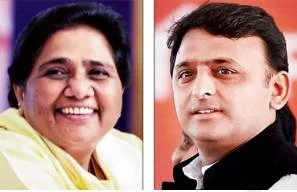
Last Sunday, while the media were still marvelling at the BJP's invincible election-winning machine, a small announcement came by way of a tweet. The spokesperson of the Samajwadi Party in Uttar Pradesh, Pankhuri Pathak, tweeted: “BSP to Support @samajwadiparty in the LS By-Polls in Phulpur & Gorakhpur. Much awaited decision by Mayawati ji. Looking forward to contesting together & creating a larger Bahujan secular alliance.”
For those who have followed the politics of the Hindi heartland, this was momentous news indeed. The Samajwadi Party and the Bahujan Samaj Party have been bitter enemies for long. The two parties had come together to form a coalition government in 1993 to keep out the BJP which had emerged as the single-largest party in the Uttar Pradesh assembly in the elections held after the demolition of the Babri Masjid.
That alliance proved short-lived and ended in a cloud of violence and abuse over the infamous “guest house incident” on June 2, 1995 when Mayavati accused SP supporters of locking her inside a guest house and manhandling her. Mulayam Singh Yadav became her sworn enemy after that. The BSP supped with different political forces over the years - allying with the Congress in 1996, and then heading the state government with Mayavati as chief minister three times with the backing of the BJP, before sweeping to power on its own in 2007.
After heading wobbly (tending to move unsteadily from side to side) coalitions, the Samajwadi Party, too, won a big majority of its own in the 2012 assembly elections. In 2017, in the face of a resurgent BJP, the SP was not averse to tying up with the BSP as well as the Congress in a replication of Bihar's mahagatbandhan. The SP was now headed by the youthful and affable Akhilesh Yadav, who referred to Mayavati as his bua (paternal aunt) and bore no personal hostility towards her. But Mayavati preferred to go it alone. The division of the secular vote between the SP-Congress and the BSP facilitated the BJP's huge victory in UP a year ago.
It is against this backdrop that the BSP's decision to openly back the candidates of its arch-rival in two crucial by-elections, with the avowed aim of defeating the BJP, assumes significance. But more significant, perhaps, is the manner in which leaders on both sides have tried to underplay the import of this historic rapprochement (the development of friendlier relations between countries or groups of people who have been enemies).
There was no joint press conference to announce the decision, no plans to hold joint rallies, and no promise of a “grand alliance” to take on the BJP. On the contrary, the BSP supremo, Mayavati, went out of her way to underline the limited, tentative and transactional nature of the deal.
Her party, she said, never contested by-elections, but her supporters did go out to vote. This time they had been asked to vote for the SP candidates since they were in the strongest position to defeat the BJP.
In exchange for the BSP's support, the SP would give its extra votes to help a BSP candidate win a Rajya Sabha seat, Mayavati said. This agreement did not mean they had formed an alliance yet. “If an alliance is to happen for the Lok Sabha elections, it won't be a secret matter. It will be very open,” she said.
The SP was also circumspect. Akhilesh Yadav did not issue any statement at all, his father kept silent, and local leaders echoed Mayavati to say that it was too early to talk about 2019; for the moment the focus would be on the elections that took place on March 11 in the two constituencies in eastern UP.
Given the complexity of caste equations in Uttar Pradesh, where the SP's Yadav support base has frequently clashed with the BSP's Dalit following, and the bitter relations between the two parties for the past two decades, such circumspection could well be a shrewd strategy. And it is all the more welcome for that.
Instead of a top down approach where the leaders announce an alliance and force the party rank and file to grudgingly implement it at the grassroots, the reverse seems to have happened in Gorakhpur and Phulpur. Reports indicate that it was the local leadership of both parties who were keen on a deal and Mayavati agreed to it.
The high-profile status of the two seats certainly played a role. Hindutva hothead (a person who is impetuous or easily becomes angry and violent), Yogi Adityanath, won five consecutive times from Gorakhpur and had to vacate the seat on becoming the chief minister.
Phulpur, famous for having been Jawaharlal Nehru's constituency, long ceased to be a Congress bastion (a fortified area or position) and was won by the BJP's Keshav Prasad Maurya in 2014. The seat fell vacant because of the appointment of Maurya as deputy chief minister of the state.
In 2014, the BJP won both seats by a huge margin. The combined vote share of the SP and BSP fell way short of the 51.8 per cent secured by Adityanath in Gorakhpur and the 52.4 per cent that Maurya got in Phulpur.
In the 2017 assembly elections, too, the BJP did phenomenally well again. But statistics show that in case there had been a Bihar-style SP-BSP-Congress alliance in place, then it would have defeated the BJP candidates in four of the five assembly segments in both Gorakhpur and Phulpur.
That does not mean, of course, that the mere fact of the BSP officially backing the SP candidates this time will result in their victory. For one, the Congress is not part of the equation and fought both seats on its own. Moreover, plain arithmetic seldom works in elections. Also, by-elections do not enthuse voters in the way a full-fledged election does - and in this case, the winning candidates will be MPs for barely a year before fresh elections take place.
The significance of the BSP-SP deal goes beyond arithmetic and lies in the realm of chemistry - which is by far more important in politics. The very fact that BSP workers actively canvassed for the SP candidates is remarkable. It could mark the first steps towards a genuine bahujan resistance to the Rashtriya Swayamsevak Sangh's Hindutva offensive.
The BSP founder, Kanshi Ram, envisioned the bahujan samaj as the majority of the labouring and downtrodden (without hope because of being treated badly by powerful people, governments, etc) castes and classes in India that included Dalits, adivasis, minorities and OBCs. Much before the British practised the divide-and-rule policy, the Hindu upper castes had honed (refine or perfect (something) over a period of time) it into a fine art by pitting the lower castes against one another; and the RSS-BJP has continued that tradition with aplomb (self-confidence or assurance, especially when in a demanding situation).
The RSS's goal of samajik samrasta (social harmony) is fundamentally at odds with the demand of samajik nyaya (social justice) espoused by Dalit and backward caste leaders. If the first hopes to preserve an unequal and unjust status quo, the second seeks to destroy it.
The forces of “social justice” that held sway (control or dominion) in North Indian politics in the aftermath of the Mandal agitation fractured over time - their leaders losing the fire in their belly after acquiring power and wealth that came to the likes of them for the first time. The BJP managed to take advantage of these fissures. Combined with the tactic of communal polarization, the division in the ranks of the bahujan has played a key role in the party's spread across the Indo-Gangetic plain.
But the Modi-Shah combine's unseemly haste and undemocratic zeal for an “Opposition- mukt” Bharat is bound to bring about a backlash. The pact in Gorakhpur and Phulpur - regardless of the result - is part of this backlash; as is the return of Jitan Ram Manjhi to Lalu Prasad's Rashtriya Janata Dal, and other realignments between erstwhile foes. A new churning has begun in the heartland and the by-elections yesterday only provided the first glimmer...

Prime minister on project spree in ne
Dec 17, 2017
Profiteer slur on hospital
Dec 17, 2017
The great smog lessons from the pollution meltdown
Dec 13, 2017
A mixed bag
Dec 11, 2017





Stay updated with The Hindu Editorial Vocab24 app, your definitive source for breaking news and comprehensive coverage from India and around the globe. Whether it's political developments, business updates, sports highlights, the latest technology trends, or current events, The Hindu brings live, accurate, and reliable news directly to your device.
Don’t fall for sensationalized or fake news shared online. Read and share accurate updates with friends and family through The Hindu Editorial Vocab24 app. Download it today!
News Coverage in The Hindu Editorial Vocab24 App
Breaking News: Receive instant notifications on breaking news stories as they unfold. Stay informed about major events and developments in India and around the world with live blogs, news in shorts videos, and concise articles.
Politics: Get the latest updates on Indian politics, including elections, policy changes, government decisions, and political events that shape the nation.
Business and Economy: Stay ahead in the economic landscape with detailed business news and market analysis. Learn about stock market trends, financial reports, corporate news, and economic developments to make informed investment decisions.
Current Events: Follow stories on social issues, policy changes, global events, and daily current affairs, tailored for UPSC and other competitive exam preparations.
Technology: Keep up with the latest gadgets, innovations, and tech trends. Read expert reviews and analyses in short, concise updates on cutting-edge technology from India and beyond.
Sports: Never miss a moment of your favorite sports. Get live scores, match reports, and expert analysis on cricket, football, tennis, and more.
International News: Stay informed about global events and geopolitical developments, including the Russia-Ukraine war, Israel-Palestine conflict, and other key international stories.
Local News: Stay connected to your community with the latest updates on city events, issues, and local news. Coverage includes hyperlocal updates from cities like Bangalore, Chennai, Delhi, Hyderabad, Mumbai, Kolkata, and more.
Trending Topics: Discover what's trending today with the most talked-about stories and hot topics across India and the world.
Experience journalism that values integrity, accuracy, and reliability. Download The Hindu Editorial Vocab24 app today and stay connected with the world.
Subscribe to our newsletter!







