

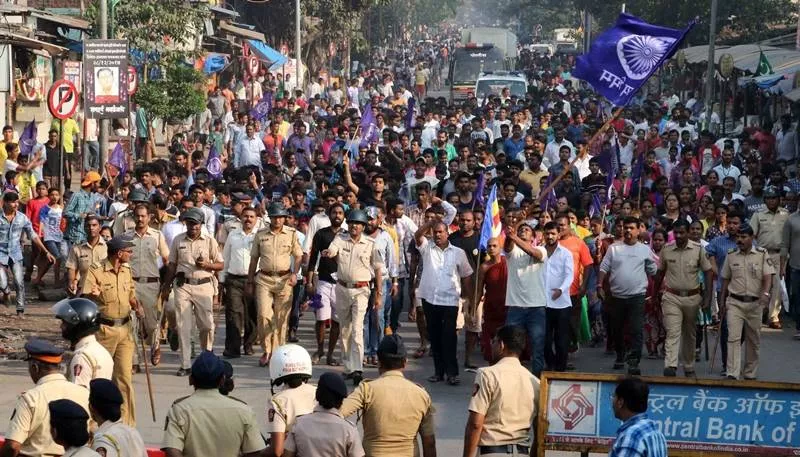
The battle of koregaon is still being fought in maharashtra
The battle of Koregaon begun in 1818 is still being fought two hundred years later in Maharashtra. Ideologues of the Hindu Right like Sambhaji Bhide and Milind Ekbote were charged with inciting violence against Dalits when they gathered on New Year's day at the colonial obelisk that commemorates the victory of a detachment of East India Company troops over the soldiers of Peshwa Baji Rao II. This gathering has become an annual Dalit pilgrimage to mark the valour of the Mahar soldiers who helped the East India Company hold off a much larger Peshwa force at Koregaon. The symbolism of Dalit troops defeating the armies of that arch-Brahmin, the Peshwa, resonates with Dalits and provokes Brahmins like Bhide. Some Marathas, members of Maharashtra's dominant peasant caste, resent the celebration of a colonial victory over the Peshwa-led Maratha confederacy which they see as a historical patria or homeland.Bhide and Ekbote lead private militias that have achieved notoriety through violent protest. Bhide, an RSS pracharak and retired physics teacher, led protests against the screening of Jodhaa Akbar where his followers vandalized cinema halls. Ekbote, who has a dozen cases of rioting and criminal intimidation lodged against him, leads the Samast Hindu Aghadi, a band of cow-protection vigilantes. It isn't hard to tell which side of this conflict the Bharatiya Janata Party is on. Both Narendra Modi and the Maharashtra chief minister, Devendra Fadnavis, are great admirers of Bhide's ideas and methods and have been known to visit him in Sangli to take his counsel and court his support. It's not surprising that Bhide hasn't been arrested for his alleged part in the violence at Koregaon.
There is, however, a difference in the attitude of Hindutva leaders towards violence against Dalits and violence against Muslims. It is essential for politicians of the Hindu Right to be able to claim Dalits as their constituents if they are to make good their claim to an akhand Hindu rashtra. This concern, not to be seen as hostile to Dalits, to refuse ownership of the violence, is evident in Bhide's and Ekbote's denials, in Fadnavis's promises to act against the culprits and his attempt to reach out to Ambedkar's political heirs in Maharashtra.
Fadnavis and his party have to walk a tightrope here. The BJP is the ruling party in Maharashtra and the Marathas are a hugely important political constituency. The BJP has to discourage Dalit self-assertion where it steps on other Hindu toes without alienating them. The party's strategy is to present the agitation as the handiwork of anti-national mischief-makers, misleading Dalits into making common cause with colonial rulers against a proto-national Maratha homeland.
It would, however, be a mistake to see the argument over Koregaon through a narrowly partisan lens. The BJP is not the first party and it won't be the last to try to deflect caste-based self-assertion by invoking 'larger' solidarities like the nation or class. Every Indian political party with pan-Indian ambitions in colonial and republican India has used this rhetorical manoeuvre. As Shraddha Kumbhojkar puts it in her essay, Politics, caste and the remembrance of the Raj: the Obelisk at Koregaon, "[t]he story of Koregaon is...not just about a straightforward struggle between a colonial power and native one; there is another important but largely ignored dimension to it - caste."
In a postcolonial country like India, this leads to an argument about the nature of colonialism and nationalism. Is anti-colonial nationalism emancipatory by definition? Jawaharlal Nehru and M.K. Gandhi said yes. The suppression of caste or class conflict in the broad cause of the emerging nation and till such time as the greater enemy, colonialism, was defeated used to be the stock-in-trade of the Indian National Congress. The most famous example of this was Gandhi's opposition to separate electorates for 'Depressed Classes' or Dalits in the early 1930s and the stand-off against B.R. Ambedkar.
It wasn't just the Congress that saw a radical politics based on caste as a distraction from its political goals, so did sections of the Left. In the jargon of the nationalist left at the time, the opposition between nationalism and colonialism was the 'primary contradiction'; all else, including the iniquities of caste, were secondary conflicts that had to yield to the struggle for political liberation. In republican India, the communist left has been famously unwilling to make the oppressive hierarchies of caste central to its political concerns, preferring instead the 'universality' of class analysis. The Left's critique of caste-aware or caste-conscious politics was that a focus on caste would hamstring a broad struggle for emancipation. Class was the better category because it side-stepped the trap of identity politics: to fetishize caste was to seal people up into silos of subalternity, instead of encouraging them to make common cause with one another.
It might be useful here to compare the status of caste and race in the lexicon of progressive politics. The journalist and essayist, Ta-Nehisi Coates, was recently accused by the academic, Cornel West, of focusing too narrowly on white supremacy, of fetishizing race, of placing too much importance on the symbolism of a black presidency when the real task was to see the American Empire entire: predatory capitalism as embodied by Wall Street, militarism, wealth inequality, a lying corporate media and so on. If the two poles of the politics of black emancipation were the institutional optimism of Martin Luther King and the radical pessimism of Malcolm X, West was accusing Coates of deludedly believing that Barack Obama's time in office vindicated in some substantial way King's optimism.
In the context of caste in India, Ambedkar was both Martin Luther King and Malcolm X. He was at once the great constitutionalist, looking to create a charter of citizenship based on affirmative action, emancipation and equality and also a subaltern saviour who came to see Hindu society as irredeemable and seceded from it. Just as Malcolm X saw white society as a malignant freemasonry designed to exclude a black underclass, Ambedkar came to see 'Hinduism' as an ideology dedicated to perpetuating the hegemony of caste. Caste-hierarchy and caste-exclusion wasn't an optional extra: it was the thing itself.
It was Ambedkar's visit to Koregaon in 1927 that inspired the annual commemoration of the valour of 'untouchable' Mahar soldiers against the army of a Peshwa whose rule constantly rehearsed their inferiority. The challenge that Koregaon throws down to non-majoritarian parties is this: how to include Dalits and their aspirations in a broad coalition without co-opting them, as the BJP does?
The Marathas constitute perhaps a fourth of the electorate in Maharashtra, they are the province's principal landowners and their community has supplied more than half of all Maharashtra's chief ministers. No party that hopes someday to hold office in Maharashtra wants to drop its Maratha parcels even as it tries to mobilize Dalit support.
This is true in different ways of nearly every state in India. Successful parliamentary politics in a country as diverse as ours demands the forging of social coalitions. In Gujarat, the Congress tried to accommodate Hardik Patel, the young Patidar leader, and Jignesh Mevani, the young Dalit leader, under its umbrella with modest success. But such success as the Congress achieved seemed to stem from impatience with the BJP rather than an ideologically coherent platform of its own. The BJP offers Dalits the swagger of Hindu nationalism and the promise of economic opportunity; what is the Congress's calling card? Likewise, what does the Bahujan Samaj Party stand for in Uttar Pradesh? At one point, its promise of a broad coalition anchored by Dalits won it political power, but that sort of social arithmetic stopped working in the absence of a unifying ideological purpose or governing achievement.
If subaltern caste identity is to be one of the drivers of a secular, pluralist politics, how is this to be reconciled with the anxieties of Patidars, Marathas and Jats? Without some support from these dominant castes, political power will be hard to achieve in the states that they dominate. To enjoy the discomfiture of the BJP over Koregaon is one thing but to turn progressive support for the Dalit side of this argument into electoral success is the real challenge for those who would stop the juggernaut of the Hindu Right.
Author : Mukul Kesavan
Heartland churn
Mar 13, 2018
Prime minister on project spree in ne
Dec 17, 2017
Profiteer slur on hospital
Dec 17, 2017
The great smog lessons from the pollution meltdown
Dec 13, 2017
A mixed bag
Dec 11, 2017





Stay updated with The Hindu Editorial Vocab24 app, your definitive source for breaking news and comprehensive coverage from India and around the globe. Whether it's political developments, business updates, sports highlights, the latest technology trends, or current events, The Hindu brings live, accurate, and reliable news directly to your device.
Don’t fall for sensationalized or fake news shared online. Read and share accurate updates with friends and family through The Hindu Editorial Vocab24 app. Download it today!
News Coverage in The Hindu Editorial Vocab24 App
Breaking News: Receive instant notifications on breaking news stories as they unfold. Stay informed about major events and developments in India and around the world with live blogs, news in shorts videos, and concise articles.
Politics: Get the latest updates on Indian politics, including elections, policy changes, government decisions, and political events that shape the nation.
Business and Economy: Stay ahead in the economic landscape with detailed business news and market analysis. Learn about stock market trends, financial reports, corporate news, and economic developments to make informed investment decisions.
Current Events: Follow stories on social issues, policy changes, global events, and daily current affairs, tailored for UPSC and other competitive exam preparations.
Technology: Keep up with the latest gadgets, innovations, and tech trends. Read expert reviews and analyses in short, concise updates on cutting-edge technology from India and beyond.
Sports: Never miss a moment of your favorite sports. Get live scores, match reports, and expert analysis on cricket, football, tennis, and more.
International News: Stay informed about global events and geopolitical developments, including the Russia-Ukraine war, Israel-Palestine conflict, and other key international stories.
Local News: Stay connected to your community with the latest updates on city events, issues, and local news. Coverage includes hyperlocal updates from cities like Bangalore, Chennai, Delhi, Hyderabad, Mumbai, Kolkata, and more.
Trending Topics: Discover what's trending today with the most talked-about stories and hot topics across India and the world.
Experience journalism that values integrity, accuracy, and reliability. Download The Hindu Editorial Vocab24 app today and stay connected with the world.
Subscribe to our newsletter!







