

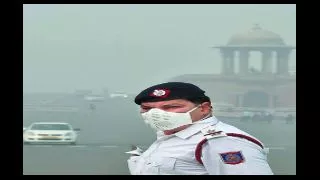
The great smog lessons from the pollution meltdown
Luckily, I missed the peak of the Delhi pollution crisis. I'd spent a couple of days in the city in early November and then left before the Great Smog hit; now, I was back under a reasonably blue and sharpish winter sunlight with little sign of the bad pollution. Everyone I spoke to agreed that this was just a lucky hiatus (a pause or break in continuity in a sequence or activity.) and the problem isn't going away any time soon. In the meantime, it was noted that several things happened in Delhi across November that could no longer be ignored or shoved under the carpet of but-what-can- I-do indifference.Political parties, all of them, the whole sorry bunch that between them rules Delhi-NCR, Punjab, Haryana and Uttar Pradesh, used the crisis to squabble (spar) and play musical chairs in the Blame Game. None of them, or no two of them, could rise above the petty finger-pointing and address the very real horror their citizens were facing. In the satellite photographs, the lesion of the suffocating cloud from the harvest residue burning stretched from Lahore to almost Patna (yes, even in this, the Foreign Hand of Pakistan was involved - alternatively, those poor fools across the border are as clueless as us fools). Children were suffering badly, and the ones below the height of three feet suffering the most. The AAP was saying it hadn't bought new buses because the Centre hadn't given it the parking space required. The Cong-I CM in Punjab and his RSS-BJP counterpart in Haryana both refused to stop farmers from burning the chaff (the husks of corn or other seed separated by winnowing or threshing.). The various party spokesmen equivocated (use ambiguous language so as to conceal the truth or avoid committing oneself.) on TV in a sickening ping-pong of tu-tu-main-main. The man in the prime minister's post said not a word, yet again earning his nickname - Maunendra - as if this was some local quarrel he couldn't deign to enter. While the Captain of the Cabinet went off to hug and do aador to Donald Trump, Test players began to vomit on the Feroz Shah Kotla ground. At first it was just the wussy (weak) Sri Lankans, them from that overly clean southern air, and we sneered (smile or speak in a contemptuous or mocking manner.) . Then the Pishach Particulate Matter grabbed one of our own lads and we had to shut the expletive (अपशब्द/दुर्वचन) deleted up.
Perhaps this breakdown of our favorite sporting spectacle was a hinge moment, perhaps not. In the late 1980s, liberal South Africans spoke of how the sports boycott aided in breaking the back of apartheid (segregation on grounds other than race.) but people forget the boycott had to last for nearly a couple of decades for it to bite properly. There was a similar hope when international cricket was suspended in Pakistan, that the country's larger public would now turn against the fundo- jihadis. It hasn't happened yet. Likewise, the guessing is that the ordinary Bhartiya nagarikwill soon forget about this disaster and passively accept the air quality situation. In their daily lives, the north Indian rich will hopscotch (travel from place to place.) from island to air-purified island, from home to car to office/ school/ shopping mall and back, while the less fortunate Indian will literally have to suck it up like a long-suffering sponge.
While the north Indian metro-archipelago may be the worst affected, especially in the winter months, the fact is that most of our cities have atrocious (of a very poor quality; extremely bad or unpleasant.) air quality. Besides all the different kinds of pollution and environmental degradation we face across our landscape, the very basic thing that keeps us alive, air, is getting increasingly dysfunctional and we are doing stupidly little about it. Every major city in India has somewhat different kinds of pollution and different calendars of pollution. For instance, cars contribute comparatively little to winter time pollution in north India, the major villain in that season being the burning of various organic materials, either on the farms or for warmth. But in the warmer months it is the automobile engine that takes on the role of the main culprit. Similarly, in Mumbai, Chennai and Calcutta there is the administrative smugness (excessive pride in oneself or one's achievements.) you get from the proximity of the sea – “oh, we don't need to worry, we have a daily natural clean-up” goes the line - but between the cars, the factories and the psychotically ceaseless construction the air in all three of these metros is horrible. Maybe not as bad as Agra or Kanpur in December but awful nevertheless.
Now, we can all play at being ostriches burying our heads in the sand. Oh, it's not that bad, really. Oh, but we need progress and this is a small price to pay for it. Oh, 'someone' will think of 'something', some new technology will come along, at least by the time our kids grow up. And again, the what-can-I-do syndrome: it's the politicians' job, the duty of the authorities to deal with this - what can one person, or one family, or one company do alone?
If there's one thing this November's north Indian pollution meltdown has shown us it is this: all the 'thinking' listed above is nothing but us, we the people, lying to ourselves. These lies we are telling ourselves don't even have the saving grace of being self-serving, this b******t we are bathing in is actually toxic for us. Things are, indeed, that bad, in fact, they are worse than you think, and they are going to get even worse before (if) they (ever) get better - the question is how much worse do we want them to get? We have to change our definition of progress, we cannot have, or aim for, the 'progress' of say post-war Western Europe and America, and no, the price a majority of our people are paying and will pay is not acceptable; how close we are to the current and constant wellbeing of the majority of our population is the only marker of progress. People are thinking of new technological tricks all the time, sure, but any new technology takes time to develop and to be implemented; any new technology has to run the gauntlet (to endure a series of problems) of vested business interests, skewered political agendas and social prejudice before coming through to widespread deployment; in the meantime we are sinking deeper into the hole.
Lastly, one of the chief lessons of 2017's Narak-November is this: there are almost no politicians who have the courage to rise above selfish power-goals to start doing what desperately needs to be done. Almost no elected politician will risk his or her sattaa to take hard decisions, to make and impose tough laws that might initially be unpopular. The only way most Indian politicians and parties - and this goes equally for the ones currently in power and the ones out of office - will act is if they see some direct and immediate benefit for themselves, either monetary (for self and/or party) or through the approval and applause of a large vote-chunk. Neither monetary profit nor vote-bank profit through populist edicts are good advisors for morally correct decisions. There are many things we can do ourselves, without waiting for any government or authority and we need to start talking about that. Clean breathable air has gone missing from our urban areas, it has been kidnapped by a cabal of various forces and we need to identify ways of getting it back.
Heartland churn
Mar 13, 2018

Prime minister on project spree in ne
Dec 17, 2017
Profiteer slur on hospital
Dec 17, 2017
A mixed bag
Dec 11, 2017





Stay updated with The Hindu Editorial Vocab24 app, your definitive source for breaking news and comprehensive coverage from India and around the globe. Whether it's political developments, business updates, sports highlights, the latest technology trends, or current events, The Hindu brings live, accurate, and reliable news directly to your device.
Don’t fall for sensationalized or fake news shared online. Read and share accurate updates with friends and family through The Hindu Editorial Vocab24 app. Download it today!
News Coverage in The Hindu Editorial Vocab24 App
Breaking News: Receive instant notifications on breaking news stories as they unfold. Stay informed about major events and developments in India and around the world with live blogs, news in shorts videos, and concise articles.
Politics: Get the latest updates on Indian politics, including elections, policy changes, government decisions, and political events that shape the nation.
Business and Economy: Stay ahead in the economic landscape with detailed business news and market analysis. Learn about stock market trends, financial reports, corporate news, and economic developments to make informed investment decisions.
Current Events: Follow stories on social issues, policy changes, global events, and daily current affairs, tailored for UPSC and other competitive exam preparations.
Technology: Keep up with the latest gadgets, innovations, and tech trends. Read expert reviews and analyses in short, concise updates on cutting-edge technology from India and beyond.
Sports: Never miss a moment of your favorite sports. Get live scores, match reports, and expert analysis on cricket, football, tennis, and more.
International News: Stay informed about global events and geopolitical developments, including the Russia-Ukraine war, Israel-Palestine conflict, and other key international stories.
Local News: Stay connected to your community with the latest updates on city events, issues, and local news. Coverage includes hyperlocal updates from cities like Bangalore, Chennai, Delhi, Hyderabad, Mumbai, Kolkata, and more.
Trending Topics: Discover what's trending today with the most talked-about stories and hot topics across India and the world.
Experience journalism that values integrity, accuracy, and reliability. Download The Hindu Editorial Vocab24 app today and stay connected with the world.
Subscribe to our newsletter!







