

Crossing paths where corruption meets terrorism
Even as a host of corruption cases in high places within our political, administrative, security and corporate systems wind their way through the labyrinthine (complex) legal process, new ones continue to make headlines with regularity, soon to fade from memory. The latest one making news relates to the civil aviation sector where an agent is suspected to have, over many years, influenced government policy to benefit his clients at the cost of public interest in the sector and the national carrier.Those implicated in all such cases involve political, bureaucratic, military and corporate leaderships among sundry (of various kinds; several.) others co-opted. In short, the list covers the entire spectrum of senior leadership of the country; indeed its very leadership backbone. Considering that there is international recognition of linkage between corruption and terror, this does not augur (portend an outcome.) well for the future of our security landscape, faced as we are with an increasingly adverse terror environment.
Counter-terrorism was a topic of discussion at the July meeting of the Group of 20 where the prime minister had made a plea (appeal) to member states to collectively crack down on terror. The concluding statement of the G20, among other issues, resolved to make the international financial system hostile to terrorist financing through international cooperation and information exchange and called upon (to ask formally for someone to do something) countries to address alternative sources of financing terrorism by dismantling connections between terrorism and transnational organized crime.
Following this, a paper of the Organisation for Economic Co-operation and Development, titled "Terrorism, Corruption and the Criminal Exploitation of Natural Resources", looks at the intersecting world of terrorism and corruption and makes the point that "terrorist organisations use corruption to both finance and perpetrate terrorism and use the same grey areas in legal systems and porosity of the financial sector to channel their financing". The paper says that "state institutions weakened by engrained and deep seated corruption are not only less effective in fighting terrorism but are also vulnerable to exploitation by terrorist groups". It terms corruption the "enabling technology" that makes terrorist crimes possible, quoting an example of two hijackers of 9/11 who had obtained driving licences through fraud, which were then used as identity proof to board the ill-fated aircraft.
Of the various avenues where terror and corruption intersect, the paper includes two, which also find resonance with current events here, as later examples show. These are the twin issues of corruption in defence purchases and the use of shell companies to handle funds involving corrupt practices. Unfortunately, debate in such cases here remains limited to the ethical, legal or political dimensions with little effort to explore possible links to terror.
According to the paper, defence purchases have historically been vulnerable to corruption of foreign public officials by major defence exporting companies, with issues like single source contracts and unaccountable and overpaid agents posing unique corruption risks and being commonplace. Significantly this is not limited to sales commissions only, but may extend to compromised equipment for security forces, thus weakening their operational capability. It mentions a 2015 Transparency International report indicating that two-thirds of defence companies world-wide show little or no evidence of having programmes to combat corruption.
The second issue flagged is the use of anonymous shell companies by traffickers, corrupt politicians and terrorists to raise, move, conceal and spend money. It defines such a company as one “that is formally registered, incorporated, or otherwise legally organised in an economy but which does not conduct operations in that economy other than in a 'pass-through' capacity”.
In a recent interview, Jaya Jaitley, a senior leader and close associate of George Fernandes, reveals that Christian Michel, a British national and an arms middleman, had offered to help “make a pile of money” for her party and told her about various defence dealers operating in India who had various bureaucrats in their pockets. On the advice of Fernandes, then the defence minister, she immediately informed the defence secretary in writing.
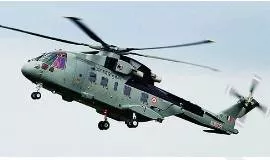
That Michel's were not idle boasts now stands vindicated (prove to be right, reasonable, or justified.) with the exposure of the AgustaWestland helicopter scandal where he is considered by Indian investigators to be a crucial person to link bribery to politicians and bureaucrats and against whom an Interpol red corner notice now stands issued. One wonders why the then defence minister himself failed to act and why Jaitley remained silent for so long.
That the AgustaWestland investigations have covered individuals at the highest levels of political, civil and military leaderships perhaps speaks of the influence of unaccountable and overpaid agents like Michel, of whom there are dozens openly operating in the corridors of Lutyens' Delhi. How many of their corrupt operations intersect the world of terrorism may not even be known to some of them, so complex is this web. The Agusta Westland case also demonstrates how the Indian air force's staff requirements of altitude were compromised at the altar of corruption, thus denying Indian air force the needed operational capability.
As part of a special drive conducted by a special task force to oversee suspected shell companies, the ministry of corporate affairs has deregistered over two lakh such companies along with some three lakh of their directors. Even if operations of a minuscule number among them intersect the world of terror, it is one too many for the good of national security. For this reason alone each needs deeper scrutiny.
Writing a comment on his recently released book titled Why Scams Are Here to Stay, N. Ram states: “The past decade-and-a-half has seen a spectacular outbreak of corruption scandals, big-ticket, medium-sized, and relatively small. With its tentacles (an insidious spread of influence and control.) spreading to virtually every branch of the Indian state and to key sectors of the economy, and to the news media, corruption's salience (the quality of being particularly noticeable or important) in India's political economy and public policy discourse has never been higher.” In August 2008, the then national security adviser had confirmed as many as 800 terrorist cells to be operating in the country with external support. Taken together, these statements only point to a high probability that India is a victim of the intersection of corruption and terror and cannot remain sanguine (optimistic or positive).
India's standing at 79 out of 176 in the Transparency International's Corruption Perception Index should be of concern to both our political leadership and the national security establishment. The fight against terror cannot be won without a fight against corruption. Corruption in high places irrespective of the form it takes, must involve anti-terror investigative agencies in parallel with others. Alongside, grey areas in legal systems and porosity of the financial sector need to be identified and plugged also, keeping terrorism in mind.
Finally, this battle can only be won if it is led by example, as indeed the United States of America displayed after 9/11, when there was bipartisan Congressional support and urgent legislative action towards prevention of terrorist actions, which, with hindsight (understanding of a situation or event only after it has happened or developed.), has yielded dividends (a benefit from an action or policy.) .
The challenge for our fractured polity is, for once, to shed partisanship and use its collective wisdom to act in unison to support urgent reforms that will pay similar dividends. Since charity begins at home, a good start would be to act immediately on the apex court's direction to frame a scheme for setting up special courts to deal expeditiously (with speed and efficiency.) with criminal cases pending against our worthy lawmakers and, alongside, endorse the Election Commission's suggestion of a lifetime electoral ban on convicted netas.
Heartland churn
Mar 13, 2018

Prime minister on project spree in ne
Dec 17, 2017
Profiteer slur on hospital
Dec 17, 2017
The great smog lessons from the pollution meltdown
Dec 13, 2017





Stay updated with The Hindu Editorial Vocab24 app, your definitive source for breaking news and comprehensive coverage from India and around the globe. Whether it's political developments, business updates, sports highlights, the latest technology trends, or current events, The Hindu brings live, accurate, and reliable news directly to your device.
Don’t fall for sensationalized or fake news shared online. Read and share accurate updates with friends and family through The Hindu Editorial Vocab24 app. Download it today!
News Coverage in The Hindu Editorial Vocab24 App
Breaking News: Receive instant notifications on breaking news stories as they unfold. Stay informed about major events and developments in India and around the world with live blogs, news in shorts videos, and concise articles.
Politics: Get the latest updates on Indian politics, including elections, policy changes, government decisions, and political events that shape the nation.
Business and Economy: Stay ahead in the economic landscape with detailed business news and market analysis. Learn about stock market trends, financial reports, corporate news, and economic developments to make informed investment decisions.
Current Events: Follow stories on social issues, policy changes, global events, and daily current affairs, tailored for UPSC and other competitive exam preparations.
Technology: Keep up with the latest gadgets, innovations, and tech trends. Read expert reviews and analyses in short, concise updates on cutting-edge technology from India and beyond.
Sports: Never miss a moment of your favorite sports. Get live scores, match reports, and expert analysis on cricket, football, tennis, and more.
International News: Stay informed about global events and geopolitical developments, including the Russia-Ukraine war, Israel-Palestine conflict, and other key international stories.
Local News: Stay connected to your community with the latest updates on city events, issues, and local news. Coverage includes hyperlocal updates from cities like Bangalore, Chennai, Delhi, Hyderabad, Mumbai, Kolkata, and more.
Trending Topics: Discover what's trending today with the most talked-about stories and hot topics across India and the world.
Experience journalism that values integrity, accuracy, and reliability. Download The Hindu Editorial Vocab24 app today and stay connected with the world.
Subscribe to our newsletter!







