

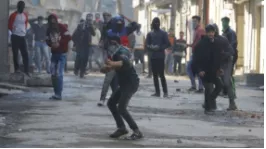
Why kashmir remains disturbed
Whether stone pelting in Kashmir is at the behest (आदेश) of Pakistan or is a response to fundamentalists’ call, the fact remains that the valley is disturbed. Scores of schools have been burnt and there is a fear in the mind of students that they would be punished if they were to attend classes. The separatists are said to be leading a movement to boycott (बहिष्कार करना) studies. The result is that students are finding it hard to prepare and appear in exams which the rest of the country is holding peacefully. The separatists should realize that a political movement cannot and should not make students helpless and make them suffer. The fallout of the agitation is that the tourists’ inflow has reduced. So much so, Syed Ali Shah Geelani has led processions through the streets of Srinagar to assure tourists that they would be protected in all eventualities. Still whatever the assurance, the tourists have come to prefer different hill stations to Kashmir. It is understandable from the tourists’ point of view but in the process the Dal Lake shikaras and Nagin Bagh dongas are not getting business. An ordinary Kashmiri is suffering. Even otherwise, the state’s economy has been badly hit. Chief Minister Mehbooba Mufti does not seem to have any clue to the situation. She has said many a time that Prime Minister Narendra Modi is the only person who can solve the crisis in Kashmir. She is probably underlining the alliance between her People’s Democratic Party and the BJP which is ruling at the Centre. New Delhi should, however, analyse why a person like Shabbir Shah, once pro-India, has turned himself to be pro-azadi. Probably, he does not find the space which he direly needs to direct his affairs in the valley. The BJP has had no contact with persons like him. The same is the case with Yasin Malik who wanted a solution within the Indian Union. But New Delhi has stretched Article 370 in such a way that the power has come to be concentrated at New Delhi. Kashmir also feels strongly about New Delhi’s step-motherly treatment meted out to the Urdu language. And it is generally believed that Urdu is languishing (lose or lack vitality) in neglect because it is considered the language of Muslims. If New Delhi were to own and encourage Urdu, it would give the Kashmiris at least one less reason to feel aggrieved (असंतुष्ट) . People are generally poor like in the rest of India and they want jobs which they realise would come only through development, including tourism. Till recently, the Kashmiris were opposed to picking up the gun to defy (विरोध करना/अवज्ञा करना) New Delhi. Home Minister Rajnath Singh has been relentlessly pursuing some method to help Kashmir return to normalcy. But, unfortunately, the Kashmiris have a feeling that what the militants are trying to do gives them identity. Therefore, the criticism that there is no resistance to the militants from within the valley should be understood as a part of alienation. It is unfortunate that New Delhi did not give the package which it had announced after the devastation through floods in Kashmir a couple of years ago. There was no criticism by the media or political parties. No leader has pointed out to New Delhi that it had reneged (मुकरना) on the promise. All these are interpreted in Kashmir as deliberate signs of a cursory (लापरवाह) attitude. I still believe that the 1953 agreement which gave India the control of defence, foreign affairs and communications can improve the situation in the state. The Kashmiri youth who are angry over the state’s status as well the situation can be won over by the assurance that the entire Indian market would be available to them for business or services. But this alone may not do. New Delhi will have to withdraw all the acts relating to fields other than defence, foreign affairs and communications. The Armed Forces (Special Powers) Act which was promulgated some 26 years ago to meet the extraordinary situation in the state is still in operation. Were the government to withdraw the act, it would placate the Kashmiri on the one hand and make the security forces more responsible on the other. The National Conference waged (जारी रखना) a long war to get rid of Maharaja Hari Singh and had an icon like Sheikh Abdullah to provide secular and democratic rule to the state. But the party suffered defeat in the assembly polls due to its proximity (नजदीकी) to New Delhi. The PDP won because its founder, Mufti Mohammad Sayyed, kept his distance from New Delhi, without alienating it. The Kashmiris have voted for the untried PDP-BJP alliance because the combination gave them a feeling of identity. Omar Farooq Abdullah had to pay the price of National Conference’s image of being pro-Delhi. Kashmir’s links with India are too close to challenge it beyond a point. Still the opposition, however small, gives the Kashmiris a vicarious (स्थानापन्न) satisfaction of defying New Delhi. Lord Cyril Radcliffe did not attach any importance to Kashmir. He was a judge in London who drew the line between India and Pakistan to establish two separate countries. He told me many years later during an interview that he never imagined that Kashmir would assume as much importance as it did. I recalled this instance when I was in Srinagar a couple of years ago to preside over (संचालन करना) the first anniversary of an Urdu magazine. Urdu has been unceremoniously ousted from all the states, including Punjab where it was the main language until some years ago. In fact, the language lost its importance in India soon after Pakistan made it the national language. Normalcy is also a state of mind. The Kashmiris must feel themselves that their identity is not under attack and that New Delhi realises the importance of what the Kashmiris desire. What New Delhi has to appreciate is that the Kashmiris' desire to distance themselves from India may not be considered any meaningful transfer of power from New Delhi to Srinagar. Yet the impression that the Kashmiris rule themselves has to be sustained whatever the cost.Behest (noun)
An authoritative order आदेश
Synonyms: Command, Decree, Dictate, Directive, Imperative, Instruction, Order
Example: At the president’s behest, the prisoner will be pardoned for his crimes.
Boycott (verb)
To engage in a concerted refusal to have dealings with (a person, a store, an organization, etc.) usually to express disapproval or to force acceptance of certain conditions. बहिष्कार करना
Synonyms: Refuse, Reject, Proscribe
Example: Since the employees have had their insurance demands met, they have ended the boycott and are now returning to work.
Aggrieved (adjective)
Feeling resentment at having been unfairly treated. असंतुष्ट
Synonyms: Resentful, Affronted, Indignant, Disgruntled, Discontented
Example: After his boss yelled at her for not finishing the work on time, the nature of his tone would aggrieve any employee who knew that nobody else could have gotten the work done by that deadline.
Defy (verb)
Appear to be challenging/ openly resist or refuse to obey. विरोध करना/अवज्ञा करना
Synonyms: Disobey, Flout, Challenge, Throw Down The Gauntlet
Example: To defy her odds of getting cancer, she decided to eat a vegetarian diet rich in antioxidants.
Cursory (adjective)
Rapidly and often superficially performed or produced लापरवाह
Synonyms: Casual, Hasty, Inattentive, Careless
Example: After doing a cursory head count, Claire realized that two of the students were not in the tents.
Renege (verb)
Go back on a promise, undertaking, or contract. मुकरना
Synonyms: Welsh, Reverse, Back Out
Example: The property buyers will be sued if they renege on the terms of the contract.
Wage (verb)
Carry on (a war or campaign). जारी रखना
Synonyms: Engage In, Carry On, Conduct, Execute, Undertake, Practise, Proceed With
Example: The soldiers waged the combat until they won it.
Proximity (noun)
Nearness in space, time, or relationship. नजदीकी
Synonyms: Closeness, Nearness, Juxtaposition, Propinquity
Example: Because of the town’s proximity to the market, its property values are very high.
Vicarious (adjective)
Experienced in the imagination through the feelings or actions of another person. स्थानापन्न
Synonyms: Indirect, Surrogate, Substitute, Be Proxy
Example: As my daughter was crowned the winner of the beauty pageant, I felt vicarious excitement.
Preside over (Phrasal verb)
To occupy the place of authority or control संचालन करना
Synonyms: Administer, Direct, Supervise, Conduct, Officiate
Example: The vice-president presided over the committee meeting because the president was absent.
Successful operations raise hopes in kashmir
Aug 08, 2017
Mining penalty
Aug 07, 2017
Let asean nations use the hague ruling
Aug 07, 2017
Did you say privacy it has already been violated
Jul 28, 2017
Pilgrimage that builds bridges
Jul 21, 2017
Aadhaar ambivalence
Jul 02, 2017





Stay updated with The Hindu Editorial Vocab24 app, your definitive source for breaking news and comprehensive coverage from India and around the globe. Whether it's political developments, business updates, sports highlights, the latest technology trends, or current events, The Hindu brings live, accurate, and reliable news directly to your device.
Don’t fall for sensationalized or fake news shared online. Read and share accurate updates with friends and family through The Hindu Editorial Vocab24 app. Download it today!
News Coverage in The Hindu Editorial Vocab24 App
Breaking News: Receive instant notifications on breaking news stories as they unfold. Stay informed about major events and developments in India and around the world with live blogs, news in shorts videos, and concise articles.
Politics: Get the latest updates on Indian politics, including elections, policy changes, government decisions, and political events that shape the nation.
Business and Economy: Stay ahead in the economic landscape with detailed business news and market analysis. Learn about stock market trends, financial reports, corporate news, and economic developments to make informed investment decisions.
Current Events: Follow stories on social issues, policy changes, global events, and daily current affairs, tailored for UPSC and other competitive exam preparations.
Technology: Keep up with the latest gadgets, innovations, and tech trends. Read expert reviews and analyses in short, concise updates on cutting-edge technology from India and beyond.
Sports: Never miss a moment of your favorite sports. Get live scores, match reports, and expert analysis on cricket, football, tennis, and more.
International News: Stay informed about global events and geopolitical developments, including the Russia-Ukraine war, Israel-Palestine conflict, and other key international stories.
Local News: Stay connected to your community with the latest updates on city events, issues, and local news. Coverage includes hyperlocal updates from cities like Bangalore, Chennai, Delhi, Hyderabad, Mumbai, Kolkata, and more.
Trending Topics: Discover what's trending today with the most talked-about stories and hot topics across India and the world.
Experience journalism that values integrity, accuracy, and reliability. Download The Hindu Editorial Vocab24 app today and stay connected with the world.
Subscribe to our newsletter!







