

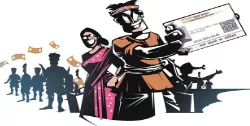
What exactly is a money bill
The Supreme Court will begin hearing final arguments next month on a writ petition challenging the validity of the Aadhaar (Targeted Delivery of Financial & Other Subsidies, Benefits & Services) Act, 2016 — or the Aadhaar Act. The proceeding, initiated by Jairam Ramesh, a Member of Parliament in the Rajya Sabha, primarily questions the legality behind the Union government’s move in introducing the Aadhaar Act as a money bill. Through this categorisation, the government had the law enacted by securing a simple majority in the Lok Sabha while rendering redundant any opposition to the legislation in the Upper House of Parliament. Imperils liberties During preliminary hearings, the Supreme Court has suggested that it isn’t entirely convinced of the merits of Mr. Ramesh’s petition. But a closer examination will only show that the introduction of the Aadhaar Act as a money bill contravenes (अवहेलना करना/उल्लंघन करना) the bare text of the Constitution. In this case, the breach is particularly disturbing, because the legislation imperils (खतरे या संकट में डालना) our core liberties (स्वतंत्रता) , in manners both explicit and insidious (आतंरिक रूप से (हानिकारक)) . Originally, Aadhaar was conceived as a scheme to provide to every Indian a unique identity number, with a purported view to enabling a fair and equitable distribution of benefits and subsidies. There is little doubt that the scheme’s introduction, with no prior legislative backing, was a flagrant ((of an action considered wrong or immoral) conspicuously or obviously offensive.) wrong, and was completely unjustifiable as a measure of democratic governance. For this Mr. Ramesh’s party, the Congress, must take full responsibility. But, when a draft of a statute (अधिनियम/क़ानून) was eventually introduced in the Rajya Sabha, in December 2010, it was done so as an ordinary bill. This meant that both Houses of Parliament had to provide their imprimatur (authoritative approval.) to the bill for it to become law. Nonetheless this draft legislation contained serious misgivings (आशंका/संदेह) , so much so that a parliamentary standing committee released a detailed report differing with the government of the time over critical aspects of the bill, particularly its treatment of concerns over privacy and protection of data security. In the meantime, given that the Aadhaar project was being implemented even without statutory support, public interest petitions were filed in the Supreme Court challenging the project’s legitimacy. In these cases, the court issued a series of interim orders prohibiting the state from making Aadhaar mandatory, while permitting its use only for a set of limited governmental schemes. In March 2016, the Union government withdrew the earlier bill, and introduced, in its place, as a money bill, a new draft legislation, titled the Aadhaar (Targeted Delivery of Financial & Other Subsidies, Benefits & Services) Bill, 2016. This categorisation was extraordinary because a money bill, under India’s constitutional design, requires only the Lok Sabha’s affirmation for it to turn into law. Right on cue, within days of the bill’s introduction, the Lower House, in complete disregard of the Rajya Sabha’s protestations, passed the legislation, as Act No. 18 of 2016. This law, Mr. Ramesh now argues, is patently illegal, because its classification as a money bill infringes the Constitution’s mandates. A money bill is defined by Article 110 of the Constitution, as a draft law that contains only provisions that deal with all or any of the matters listed therein. These comprise a set of seven features, broadly including items such as the imposition or regulation of a tax; the regulation of the borrowing of money by the Government of India; the withdrawal of money from the Consolidated Fund of India; and so forth. In the event a proposed legislation contains other features, ones that are not merely incidental to the items specifically outlined, such a draft law cannot be classified as a money bill. Article 110 further clarifies that in cases where a dispute arises over whether a bill is a money bill or not, the Lok Sabha Speaker’s decision on the issue shall be considered final. Flawed counterpoint The government’s response to Mr. Ramesh’s claim is predicated (स्थापित होना /प्रतिपादित) on two prongs: that the Speaker’s decision to classify a draft legislation as a money bill is immune from judicial review, and that, in any event, the Aadhaar Bill fulfilled all the constitutional requirements of a money bill. A careful examination of these arguments will, however, show us that the government is wrong on both counts. To be fair, the assertion that the Speaker’s decision is beyond judicial review finds support in the Supreme Court’s judgment in Mohd. Saeed Siddiqui v. State of UP (2014). Here, a three-judge bench had ruled, in the context of State legislatures, that a Speaker’s decision to classify a draft statute as a money bill, was not judicially reviewable, even if the classification was incorrect. This is because the error in question, the court ruled, constituted nothing more than a mere procedural irregularity. But there are significant problems with this view. Chief among them is the wording of Article 110, which vests no unbridled discretion (विवेक/कार्य स्वाधीनता) in the Speaker. The provision requires that a bill conform to the criteria prescribed in it for it to be classified as a money bill. Where a bill intends to legislate on matters beyond the features delineated in Article 110, it must be treated as an ordinary draft statute. Any violation of this mandate has to be seen, therefore, as a substantive constitutional error, something which Siddiqui fails to do. There are other flaws too in the judgment. Most notably, it brushes aside the verdict of a Constitution Bench in Raja Ram Pal v. Hon’ble Speaker, Lok Sabha (2007), where the court had ruled that clauses that attach finality to a determination of an issue do not altogether oust the court’s jurisdiction. That is, the bench held, there are numerous circumstances where the court can review parliamentary pronouncements. These would include instances where a Speaker’s choice is grossly illegal, or disregards basic constitutional mandates, or, worse still, where the Speaker’s decision is riddled with perversities, or is arrived at through dishonest intentions. What Aadhaar Act shows A simple reading of the Aadhaar Act would show us that its contents go far beyond the features enumerated in Article 110. If anything, it is the provisions in the legislation that pertain to the Consolidated Fund and its use that are incidental to the Act’s core purpose — which, quite evidently, is to ensure, among other things, the creation of a framework for maintaining a central database of biometric information collected from citizens. Ordinarily, a draft legislation is classified as a money bill when it provides for funds to be made available to the executive to carry out specific tasks. In the case of the Aadhaar Act, such provisions are manifestly absent. The Speaker’s decision to confirm the government’s classification is, therefore, an error that is not merely procedural in nature but one that constitutes, in substance, an unmitigated flouting of Article 110. In many ways, Aadhaar has brought out to plain sight the worryingly totalitarian (सर्वाधिकारवादी) impulses of our state. The government has argued, with some force, that Indian citizens possess no fundamental right to privacy. This argument, however, is predicated on judgments of the Supreme Court that have little contemporary relevance, and that have, in any event, been overlooked in several subsequent cases where the court has clarified the extent of the liberties that the Constitution guarantees. Right to privacy Privacy is important not merely because it advances the cause of equality and freedom but also because it is, in and of itself, a treasurable value. A failure to protect privacy adequately can have disastrous consequences that affect our abilities to determine for ourselves how we want to live our lives. And the Aadhaar Act hits at the core of this value. It permits the creation of a database of not only biometric information but also various other private data, without so much as bothering about safeguards that need to be installed to ensure their security. We scarcely need to stretch our imaginations to wonder what the government — and other agencies to which this information can be shared without any regulatory checks — can do with all this material. That a statute so pernicious (हानिकारक/नुक़सानदेह) in its breadth can be enacted after being introduced as a money bill only makes matters worse. It has the effect of negating altogether the Rajya Sabha’s legislative role, making, in the process, a mockery (उपहास) of our democracy. It is imperative, therefore, that the court refers the present controversy to a larger bench, with a view to overruling Siddiqui.Contravene (verb)
Offend against the prohibition or order of (a law, treaty, or code of conduct). / to act against a rule or law. अवहेलना करना/उल्लंघन करना
Synonyms: Break, Breach, Fail to comply with, Violate, Infringe
Example: Because your actions contravene school policy, you're being suspended for ten days.
Imperil (verb)
Put at risk of being harmed, injured, or destroyed. खतरे या संकट में डालना
Synonyms: Endanger, Jeopardize, Risk, Leave Vulnerable
Example: The quick-spreading wildfires imperil the citizens of the city since they are trapped by the fire in their homes.
Liberty (noun)
The state of being free within society from oppressive restrictions imposed by authority on one's behavior or political views./ a right or privilege, especially a statutory one. स्वतंत्रता
Synonyms: Independence, Freedom, Autonomy, Sovereignty, Self Government, Self Rule
Example: In democracy the liberty may be endangered by the abuses of power.
Insidious (adjective)
Something that is slowly and secretly causing harm/ proceeding in a gradual, subtle way, but with very harmful effects. (आतंरिक रूप से (हानिकारक))
Synonyms: Stealthy, Subtle, Surreptitious, Cunning, Crafty, Machiavellian
Example: Because I was so trusting, I did not realize the insidious man was using me to get information about the bank where I worked.
Misgiving (noun)
A feeling of doubt or apprehension about the outcome or consequences of something. आशंका/संदेह
Synonyms: Qualm, Scruple, Apprehension
Example: James overlooked his misgiving about the new job because he really needed to pay his rent.
Predicate (verb)
Found or base something on/affirm or declare as an attribute or quality of. स्थापित होना /प्रतिपादित
Synonyms: Base, Found, Establish, Build, Ground
Example: The appraisal of an employee is totally predicated on his performance.
Discretion (noun)
The freedom to decide what should be done in a particular situation. विवेक/कार्य स्वाधीनता
Synonyms: Choice, Option, Judgment, Preference, Disposition, Volition
Example: As you are not hosting the party, you should not feel free to invite guests at your discretion.
Totalitarian (adjective)
Relating to a system of government that is centralized and dictatorial and requires complete subservience to the state. / associated with a system of governance in which the government controls everything. सर्वाधिकारवादी
Synonyms: Authoritarian, Autocratic, Autarchic, Dictatorial, Tyrannical
Example: Under the dictator’s totalitarian rule, the citizens of the country had no say in how their nation was governed.
Pernicious (adjective)
Having a harmful effect, especially in a gradual or subtle way. हानिकारक/नुक़सानदेह
Synonyms: Harmful, Damaging, Injurious, Hurtful, Detrimental, Unfavorable, Bad, Malign
Example: Violence in the workplace is pernicious to an employee’s need for safety.
Mockery (noun)
An absurd misrepresentation or imitation of something. उपहास
Synonyms: Travesty, Charade, Farce, Parody, Burlesque
Example: Everyone knew the police officer would not be charged so the investigation was simply a mockery of justice.
Flagrant (adjective)
Noticeably bad/of an action considered wrong or immoral) conspicuously or obviously offensive. खराब/बदनाम
Synonyms: Blatant, Egregious, Notorious
Example: After the basketball player committed a flagrant foul, he was kicked out of the game.










Stay updated with The Hindu Editorial Vocab24 app, your definitive source for breaking news and comprehensive coverage from India and around the globe. Whether it's political developments, business updates, sports highlights, the latest technology trends, or current events, The Hindu brings live, accurate, and reliable news directly to your device.
Don’t fall for sensationalized or fake news shared online. Read and share accurate updates with friends and family through The Hindu Editorial Vocab24 app. Download it today!
News Coverage in The Hindu Editorial Vocab24 App
Breaking News: Receive instant notifications on breaking news stories as they unfold. Stay informed about major events and developments in India and around the world with live blogs, news in shorts videos, and concise articles.
Politics: Get the latest updates on Indian politics, including elections, policy changes, government decisions, and political events that shape the nation.
Business and Economy: Stay ahead in the economic landscape with detailed business news and market analysis. Learn about stock market trends, financial reports, corporate news, and economic developments to make informed investment decisions.
Current Events: Follow stories on social issues, policy changes, global events, and daily current affairs, tailored for UPSC and other competitive exam preparations.
Technology: Keep up with the latest gadgets, innovations, and tech trends. Read expert reviews and analyses in short, concise updates on cutting-edge technology from India and beyond.
Sports: Never miss a moment of your favorite sports. Get live scores, match reports, and expert analysis on cricket, football, tennis, and more.
International News: Stay informed about global events and geopolitical developments, including the Russia-Ukraine war, Israel-Palestine conflict, and other key international stories.
Local News: Stay connected to your community with the latest updates on city events, issues, and local news. Coverage includes hyperlocal updates from cities like Bangalore, Chennai, Delhi, Hyderabad, Mumbai, Kolkata, and more.
Trending Topics: Discover what's trending today with the most talked-about stories and hot topics across India and the world.
Experience journalism that values integrity, accuracy, and reliability. Download The Hindu Editorial Vocab24 app today and stay connected with the world.
Subscribe to our newsletter!







