

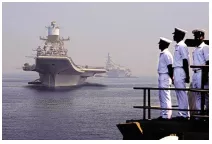
Indo us naval cooperation steady as she goes
In the ever-expanding universe of Indo-US cooperation, perhaps the brightest and most alluring star is the deepening partnership between the Indian and US navies. Consider two recent pronouncements: First, admiral Harry Harris, the commander of the Hawaii-based Pacific Command (Pacom), revealed, that both navies are engaged in “sharing...information regarding Chinese maritime movement in the Indian Ocean,” especially submarines. Second, Reliance Defence and Engineering Ltd announced that it had won a contract to service ships of the US Seventh Fleet. The latter comes in the wake of the Logistics Exchange Memorandum of Agreement (Lemoa), followed by the master ship repair agreement, between India and the US. Both these developments underline a degree of mutual trust, confidence and growing cooperation on shore and at sea, which was previously unimaginable. But is this cooperation likely to sustain? The answer, according to a new report of the Center for Naval Analyses (CNA), a Washington research organization, is a guarded “yes.” The report is upbeat about the state of cooperation. It notes the US-India joint strategic vision for the Asia-Pacific and the Indian Ocean, Lemoa, the recognition of India as a “Major defense partner”, the joint working group on aircraft-carrier technology cooperation, and the trilateral Malabar exercise (including Japan as a permanent participant) as evidence that the relationship has “soared to new heights.” However, it also identifies several strategic and operational factors that could limit or enhance this cooperation. Among the strategic factors are the role of China and Pakistan and Washington’s response to them; Indian party politics, particularly the return of coalition politics dependent on left parties; personalities, especially of people at the helm; and black swan events, such as a major terrorist attack on Indian soil. While none of these directly relate to the navies, they are likely to affect the overall prospects and pace of Indo-US cooperation, including naval cooperation. Even if the strategic factors are conducive for enhancing cooperation, there are several operational factors that could stymie deeper relations. Top among them is the intransigence of the Indian bureaucracy, which “have historically reined in the military services in terms of… freedom of action”. Similarly, the lack of progress on foundation agreements, such as the Communication Interoperability and Security Memorandum Agreement and the Basic Exchange and Cooperation Agreement for satellite-based intelligence, “will affect the pace of defence engagement.” Another operational factor where the US and India diverge is the so-called freedom of navigation operations (Fonops), which the US is particularly keen to exercise through the South China Sea. India is uncomfortable with joint Fonops for several reasons. First, it sees the Indian Ocean as its primary area of interest, not the South China Sea. Second, such cruises are bound to antagonize China, which India does not consider to be in its national interest. Third, India is also opposed, in principle, to military ships traversing through its Exclusive Economic Zone (EEZ) and seeks prior consent for military exercises or manoeuvres in its EEZ. This position is similar to that of China and some other maritime countries. Were India to participate in the US-led Fonops, it would have to rescind on this principle and also accept the possibility of other navies—especially Chinese navy—being present in its EEZ. Finally, the CNA report is also concerned about the “capacity constraints” on the Indian Navy, particularly the limited budget afforded to it. In particular, it worries that Indian warships “are being decommissioned faster than they are being replaced.” The report also accurately notes India’s westward focus both overland and by sea to the Gulf region and East Africa and how this is out of the area of responsibility of the primary driver of US-India naval cooperation—Pacom. However, the report fails to note the contradictory US views on how it deals with China in the Pacific and the South China Sea and the Arabian Sea and the Gulf region. While Washington is mostly attuned towards a containment of China in the Pacific, the South China Sea and the Indian Ocean, it is leaning towards co-opting China in the Gulf and Africa. The latter is evident in Washington’s cooperation with Beijing on Afghanistan and the benign US view of the China-Pakistan Economic Corridor. In contrast, New Delhi views China’s role with concern. Against this backdrop, the report recommends a minimalist, business-as-usual, and maximalist approach to sustaining and building the cooperation. At the very least, the US and Indian navies could carry out “benign naval and maritime activity” during periods of diplomatic strain. These could range from maritime domain awareness and information sharing to maritime peacekeeping operations and humanitarian assistance and disaster relief. In the business-as-usual scenario the two could incrementally deepen cooperation. Assuming that the strategic and operational factors remain conducive, this scenario is likely to prevail. Were the strategic and operations factors to improve dramatically, a maximalist scenario could be envisaged. This might include US-India naval exercises and, perhaps, anti-piracy operations, with both US Central Command (responsible for the Gulf region) and the US Africa Command, in addition to Pacom. Which of these scenarios will come to fruition is dependent on the Trump administration. And that remains a black hole that even this report cannot illuminate.





Stay updated with The Hindu Editorial Vocab24 app, your definitive source for breaking news and comprehensive coverage from India and around the globe. Whether it's political developments, business updates, sports highlights, the latest technology trends, or current events, The Hindu brings live, accurate, and reliable news directly to your device.
Don’t fall for sensationalized or fake news shared online. Read and share accurate updates with friends and family through The Hindu Editorial Vocab24 app. Download it today!
News Coverage in The Hindu Editorial Vocab24 App
Breaking News: Receive instant notifications on breaking news stories as they unfold. Stay informed about major events and developments in India and around the world with live blogs, news in shorts videos, and concise articles.
Politics: Get the latest updates on Indian politics, including elections, policy changes, government decisions, and political events that shape the nation.
Business and Economy: Stay ahead in the economic landscape with detailed business news and market analysis. Learn about stock market trends, financial reports, corporate news, and economic developments to make informed investment decisions.
Current Events: Follow stories on social issues, policy changes, global events, and daily current affairs, tailored for UPSC and other competitive exam preparations.
Technology: Keep up with the latest gadgets, innovations, and tech trends. Read expert reviews and analyses in short, concise updates on cutting-edge technology from India and beyond.
Sports: Never miss a moment of your favorite sports. Get live scores, match reports, and expert analysis on cricket, football, tennis, and more.
International News: Stay informed about global events and geopolitical developments, including the Russia-Ukraine war, Israel-Palestine conflict, and other key international stories.
Local News: Stay connected to your community with the latest updates on city events, issues, and local news. Coverage includes hyperlocal updates from cities like Bangalore, Chennai, Delhi, Hyderabad, Mumbai, Kolkata, and more.
Trending Topics: Discover what's trending today with the most talked-about stories and hot topics across India and the world.
Experience journalism that values integrity, accuracy, and reliability. Download The Hindu Editorial Vocab24 app today and stay connected with the world.
Subscribe to our newsletter!







