

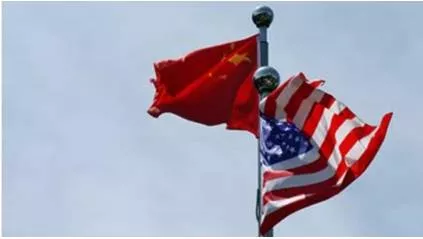
Us ‘shaking up’ marine corps shows its laser focus on china india shouldn’t lag behind
The ICET agreement goes the whole hog in joint cooperation between US and India. But there is a greater need to focus on how the defence budget is spent.The spectre of a Chinese threat is not simply a hot-air balloon but one that deeply disturbs equations across the Indo-Pacific. Unlike the balloon that went ‘astray’, the rumbling dragon causes deep discomfort among the near and distant neighbours. So much so that the threat from China is leading to the emergence of newer alliances. Unlike in India, where the top leadership skips mentioning the ‘C’ word, there is no hesitation in Washington to point fingers directly. A series of deeply significant events preceded the latest salvo from United States President Joe Biden at the annual State of the Union address on 7 February.
The most far-reaching event was the announcement of the remaking of an American icon — the Marine Corps in March 2020. Essentially, the proposal is to make a Marine Corps unit smaller, more flexible with easier deployability, and equipped with new artillery and enhanced anti-shipping missile capability. Heavy tanks will be gone, and aviation assets, manned as well as unmanned, will be increased. Called Force Design 2030, the initiative is the brainchild of Marine Corps Commandant General David H. Berger. And as with the World War II Pacific campaign that even made Marine Corps a Hollywood favourite, the new force is driven by only one threat—China.
Although plenty of Marine Corps veterans and puritans decry the changes, which are underway already, there is no going back as developments suggest. In fact, the first few changes are already being implemented, most significantly in operational areas adjoining Taiwan. It is evident that Taiwan has only one threat, and that is across the strait. According to American officials, the US marines stationed at Japan’s Okinawa islands near Taiwan will undergo a ‘shake-up’.
US completing the arc
The reshaping of the US Marine Corps is complemented by another announcement.
After more than 30 years, America is returning to the Philippines, having secured an agreement to use four additional military bases. The deal, signed under the 2014 Enhanced Defence Cooperation Agreement, emerged when US Secretary of Defense Lloyd Austin met with Philippines President Ferdinand Marcos Jr. in Manila on 2 February. This move closes a gap for the US military, which has access to South Korea, Japan, and Australia. Just as it closes a sorry chapter in the US-Philippines relationship, where the latter jettisoned its colonial occupier in 1991. There seems to be a laser focus on China alone.
The statement Issued by Washington in Manila had all the necessary diplomatic niceties referring to humanitarian and climate-related deployment during crises. After all, the Pacific is annually buffeted by typhoons and occasional tsunamis too. But what really unveils the real driving force is plain in this line: “And respond to other shared challenges.” There is, after all, only one shared challenge that requires a military presence in the Philippines, and that is across the sea. It is this sea that the Philippines calls the ‘West Philippine Sea’, Vietnam refers to as the ‘East Sea’, and the rest of the world calls the South China Sea.
So, the new-look US Marine Corps, capable of occupying smaller islands with lighter combat units, will be supported by more lethal firepower in the Pacific region. China is the only current and future threat in the region — the issue was given as much importance as Russia-Ukraine, democracy, and education in Biden’s State of the Union address. The US President spent more time on it than even the Federal Deficit, clearly underlining why the additional bases in the Philippines are so crucial.
India won’t stand behind either
Despite its timidity in pointing fingers and taking names in high places, India won’t be left behind in working on future threat perceptions. This was amplified by the agreement between the US and India when their respective National Security Advisors met in Washington on 30 January. It is signed under the umbrella of the Initiative on Critical and Emerging Technologies (iCET) dialogue, through which India and the US see a convergence of interests in containing the most significant continental challenge with high-end equipment, civilian or military. When NSA Ajit Doval met Jake Sullivan, his US counterpart, mutual interests were driven by a Himalayan threat.
The ICET agreement goes the whole hog in covering all technology-driven spheres where the two countries could, and must, cooperate. From quantum technology to high-performance computing, artificial intelligence to telecom, and space to defence, joint cooperation is stressed. Given the world’s fears about intrusive Chinese technology for 5G systems, India and US will work together on emerging 6G systems. A recent proposal from American multinational conglomerate General Electric to jointly produce jet engines for the Tejas light combat aircraft is likely to be first off the block from this agreement. It is clear that the motivation is to ‘tech-mate’ China.
It Is certain that all of China’s neighbours are feeling the heat. Some, of course, more so than others. Each needs to deal with the threat as per its perceptions and capabilities on the basis of agreements reached with like-minded partners. On this score, India is an outlier, for it has no defence protection pact with any major military power. Which, in any case, is alien to the Indian system of defence management and was underlined by Chief of Army Staff, General Manoj Pande, recently.
There is a greater need to focus on defence budgeting and how it is spent.
Manvendra Singh is a Congress leader, Editor-in-Chief of Defence & Security Alert and Chairman, Soldier Welfare Advisory Committee, Rajasthan. He tweets @ManvendraJasol. Views are personal.











Stay updated with The Hindu Editorial Vocab24 app, your definitive source for breaking news and comprehensive coverage from India and around the globe. Whether it's political developments, business updates, sports highlights, the latest technology trends, or current events, The Hindu brings live, accurate, and reliable news directly to your device.
Don’t fall for sensationalized or fake news shared online. Read and share accurate updates with friends and family through The Hindu Editorial Vocab24 app. Download it today!
News Coverage in The Hindu Editorial Vocab24 App
Breaking News: Receive instant notifications on breaking news stories as they unfold. Stay informed about major events and developments in India and around the world with live blogs, news in shorts videos, and concise articles.
Politics: Get the latest updates on Indian politics, including elections, policy changes, government decisions, and political events that shape the nation.
Business and Economy: Stay ahead in the economic landscape with detailed business news and market analysis. Learn about stock market trends, financial reports, corporate news, and economic developments to make informed investment decisions.
Current Events: Follow stories on social issues, policy changes, global events, and daily current affairs, tailored for UPSC and other competitive exam preparations.
Technology: Keep up with the latest gadgets, innovations, and tech trends. Read expert reviews and analyses in short, concise updates on cutting-edge technology from India and beyond.
Sports: Never miss a moment of your favorite sports. Get live scores, match reports, and expert analysis on cricket, football, tennis, and more.
International News: Stay informed about global events and geopolitical developments, including the Russia-Ukraine war, Israel-Palestine conflict, and other key international stories.
Local News: Stay connected to your community with the latest updates on city events, issues, and local news. Coverage includes hyperlocal updates from cities like Bangalore, Chennai, Delhi, Hyderabad, Mumbai, Kolkata, and more.
Trending Topics: Discover what's trending today with the most talked-about stories and hot topics across India and the world.
Experience journalism that values integrity, accuracy, and reliability. Download The Hindu Editorial Vocab24 app today and stay connected with the world.
Subscribe to our newsletter!







