

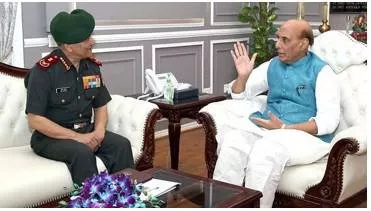
Theatre commands to defence university why indian security interests need a political push
Reforms are the children of the government in power. PMO should nudge the defence ministry and hold the defence minister accountable.Prime Minister Narendra Modi’s clarion call for Atmanirbhar Bharat in May 2020 made self-reliance a policy goal for the Ministry of Defence. Despite decades of effort, India’s defence industrial ecosystem has failed to achieve substantive progress and indigenous research, development and production capabilities remain a challenge.
Time will reveal whether the slogan has been matched by accomplishment. However, even if Atmanirbhartha is accomplished to any acceptable degree, India’s military effectiveness will require the fulfilment of two other crucial reform initiatives – defence university and theatre commands. Both reforms have the potential to provide massive doses of energy to advance India’s military effectiveness through the improvement of leadership and achieving jointness among the three Services through organisational restructuring.
These initiatives lie primarily within the defence ministry ambit and yet they do not seem to attract the urgency they demand. Perhaps in many ways, they are being sidelined in terms of focus on Atmanirbhartha, which, in comparative terms, would remain a perpetual and long-term quest.
Both the reforms eventually relate to what really matters in terms of achieving military effectiveness: Prudence in development, and the application and conversion of military capabilities toward the realisation of India’s political goals.
Indian Defence University: A stillborn reform
In 1967, the Chiefs of Staff Committee first mooted the need to establish a defence university in India. Post the Kargil conflict in 1999, the report of the Group of Ministers (GOM) on National Security recommended its establishment. The recommendation was approved by the Cabinet Committee on Security in 2002. Several Committees and studies followed, but IDU appears stillborn.
In 2013, former Prime Minister Manmohan Singh laid the foundation stone for the Indian National Defence University (INDU) at Binola, in Gurugram. In 2016, a draft INDU Bill was put online for public consultation and revised in 2017. Thereafter, the bill moved between PMO (Cabinet Secretariat), MoD and the armed forces. One of the main sticking points has been disagreement on eligibility criteria for the university’s president and vice president. It is learnt that the bureaucracy wanted to keep the door open for all bureaucrats for both positions. This proposition was unacceptable to the armed forces, who preferred a serving three-star General as president and an Indian Foreign Service (IFS) officer as vice president. There could be some verve in the argument that, considering the larger trend of institutions being infiltrated with majoritarian ideologies, the freeze in establishing IDU would delay its seepage into military institutions: A subject written about last week.
Conceptually, in IDU’s absence, the intellectual feeder and platform for evolving a common doctrinal glue to foster jointness among the three Services and civil-military elements remains suboptimal in realisation. A fact that may have impacted the creation of the theatre commands – the second imperative reform of recent origin.
Stalling theatre commands
While the creation of the post of Chief of Defence Staff (CDS) was initially recommended by the Report of the GOM, post-Kargil, there was no reform initiated for the creation of the Integrated Theatre Command, till it was politically mandated along with the creation of the post of CDS and the Department of Military Affairs (DMA) in the MoD. The existence of 17 Commands among the three Services reflected the structural distortion that demanded the reform since it was not conducive to jointness, integrated planning, operational functioning, and optimal use of scarce national resources.
Once mandated, the ball was in the court of the three Services. It has remained there for three years, primarily because of irreconcilable views between the Services. It has also been impacted by the tragic death of the first CDS, General Bipin Rawat, followed by the CDS chair remaining vacant for nearly ten months.
Some indication of the theatre commands’ progress was given by the Chief of Naval Staff (CNS) Admiral R. Hari Kumar during a media interaction on 3 December. He confirmed that studies ordered by the first CDS had been completed and that the three Services were working on the basic principles of theatrerisation and on the way forward.
There is no doubt that the creation of theatre commands is a complex process—it also has to be undertaken in an ambience of growing geopolitical threats. But if even the first step—the ideation process—has not been finalised in three years, it means that disagreements between the three Services are unlikely to be resolved after the recent appointment of the new CDS, Lt General Anil Chauhan (retired). Only a firm intervention can push the reform forward, and that push has to come from the political class.
As a policy, Atmanirbhartha faces many challenges, especially in terms of means and strategy. But no such constraints exist for creating the IDU and theatre commands. Yet, both seem stalled.









Stay updated with The Hindu Editorial Vocab24 app, your definitive source for breaking news and comprehensive coverage from India and around the globe. Whether it's political developments, business updates, sports highlights, the latest technology trends, or current events, The Hindu brings live, accurate, and reliable news directly to your device.
Don’t fall for sensationalized or fake news shared online. Read and share accurate updates with friends and family through The Hindu Editorial Vocab24 app. Download it today!
News Coverage in The Hindu Editorial Vocab24 App
Breaking News: Receive instant notifications on breaking news stories as they unfold. Stay informed about major events and developments in India and around the world with live blogs, news in shorts videos, and concise articles.
Politics: Get the latest updates on Indian politics, including elections, policy changes, government decisions, and political events that shape the nation.
Business and Economy: Stay ahead in the economic landscape with detailed business news and market analysis. Learn about stock market trends, financial reports, corporate news, and economic developments to make informed investment decisions.
Current Events: Follow stories on social issues, policy changes, global events, and daily current affairs, tailored for UPSC and other competitive exam preparations.
Technology: Keep up with the latest gadgets, innovations, and tech trends. Read expert reviews and analyses in short, concise updates on cutting-edge technology from India and beyond.
Sports: Never miss a moment of your favorite sports. Get live scores, match reports, and expert analysis on cricket, football, tennis, and more.
International News: Stay informed about global events and geopolitical developments, including the Russia-Ukraine war, Israel-Palestine conflict, and other key international stories.
Local News: Stay connected to your community with the latest updates on city events, issues, and local news. Coverage includes hyperlocal updates from cities like Bangalore, Chennai, Delhi, Hyderabad, Mumbai, Kolkata, and more.
Trending Topics: Discover what's trending today with the most talked-about stories and hot topics across India and the world.
Experience journalism that values integrity, accuracy, and reliability. Download The Hindu Editorial Vocab24 app today and stay connected with the world.
Subscribe to our newsletter!







