

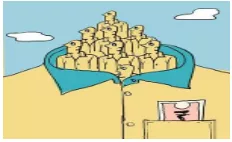
The hidden agenda of benevolence
The growing chorus for a universal basic income is a ruse (चाल) to eliminate or roll back significantly the public distribution system and signature welfare programmes. The idea of a universal basic income (UBI) has been gaining ground globally. While Switzerland held a referendum (जनमत) on it last year (it was voted down), Finland introduced it earlier this month. Media reports suggest that the government of India’s flagship Economic Survey this year is likely to endorse the UBI, setting the stage for its introduction. On the face of it, an unconditional basic income for everyone seems a great idea. In the West, the UBI is being discussed as a solution to two problems: unemployment due to automation; and growing social unrest caused by extreme inequality and precarity (अनिश्चितता) . It is expected to solve the unemployment problem by decoupling subsistence from jobs, freeing human beings to realise their true potential, preferably through entrepreneurship. It would address the second by supplying monetary resources to access the necessities of life. This, in a nutshell (संक्षेप में), is the popular understanding of the UBI. The reality, however, is not so rosy. The UBI debate in India has been a narrow one — restricted, for the most part, to financial viability (विकास क्षमता) . Its advocates argue that it is a more efficient way of delivering welfare, while its opponents hold that the fiscal burden would be too much. What hasn’t received adequate attention is the politics behind the UBI: who is pushing the idea? To what end? And why? The UBI evangelists The most eloquent (सुवक्ता/वाग्मी) advocates of UBI today are free-market enthusiasts — the same lot branded as neo-liberals for their advocacy of deregulation, privatisation, and cuts in welfare spending. Their guru, Milton Friedman, was an early advocate of basic income. Outside the academic realm, the biggest champion of UBI is the global tech sector. Silicon Valley billionaires such as Elon Musk, the founder of Tesla Motors, and Facebook co-founder Chris Hughes have publicly backed the idea. Could it be possible that the global financial elite have finally sprouted (उत्पन्न करना/विकसित होना) a conscience? The reports of the UBI pilot projects conducted so far offer a clue. Invariably, they all present the same conclusion: giving cash to the poor is better than traditional welfare. Of course, it would be wonderful if the problem of inequality and poverty were solved for us by a sudden moral awakening of the rich. Unfortunately, the current enthusiasm for the UBI is not the product of such a momentous development. Not an add-on benefit The biggest myth about the UBI, partly responsible for sections of the Left endorsing it, is that it is a redistributive policy that would reduce inequality. It is indeed possible to have a redistributive UBI. But it would need to fulfil two conditions: it must be funded by taxing the wealthy; and the existing entitlements to the poor must not be taken away. Such a UBI would actually be a socialist measure that would increase the bargaining power of the working classes by giving them an income cushion. But neither of these conditions is met by any of the UBI designs being promoted today, either globally or in India. The much-touted (much talked about (something or someone) as being very good, effective, skillful, etc.) Finnish experiment is restricted to the unemployed. It does not cover all working individuals. And it only replaces the already existing basic unemployment allowance and labour market subsidy — it is not an add-on benefit. In India, too, the UBI is not an add-on. On the contrary, it is about giving in a different form (cash), and under one umbrella, what is already being given (in-kind and cash benefits) via different channels. Back in 2008, in an influential paper in the Economic and Political Weekly titled ‘The case for direct cash transfers to the poor’, Arvind Subramanian, the present Chief Economic Adviser of the government, along with economists Devesh Kapur and Partha Mukhopadhyay, argued that the Rs. 1,80,000 crore spent annually on centrally sponsored schemes and assorted (विभिन्न) subsidies should instead be distributed as cash directly to 70 million households below the poverty line. Put simply, the UBI in India is nothing but the old wine of direct cash transfer in a fancy new bottle. Its objective remains the same: to eliminate the public distribution system (PDS) and with it, the food, fuel, and fertiliser subsidies. The same old arguments for replacing the PDS with cash transfers are now being trotted out in favour of the UBI. The addition of the word ‘universal’ signals greater ambition but alters neither the substance nor the motive. But let us take the arguments in favour at face value. What constitutes a basic income? Common sense dictates that it should be whatever is required to take care of basic life needs. A logical equivalent for this figure would be the minimum wage. The central government’s move last year to raise the minimum wage for non-skilled, non-agricultural workers to Rs. 9,100 per month was set aside following opposition from industry. Perhaps Rs. 9,100 per month is too luxurious an income to qualify as ‘basic’. The actual minimum wage in India is around Rs. 4,800 per month. Could we then expect at least this amount from our UBI? While different numbers have been bandied about (discuss casually), there seems to be a broad consensus (सर्वसम्मति) around the Tendulkar committee poverty line of Rs. 33 a day. This works out to a basic income of Rs. 1,000-Rs. 1,250 a month or Rs. 12,000-Rs. 15,000 a year. But even this modest figure is estimated to cost 11-12% of the GDP. In contrast, all the government’s subsidies put together account for only 4-4.5% of the GDP. This presents three options: one, the government makes up the deficit through additional tax revenue; two, it limits the fiscal burden by shrinking the UBI coverage from ‘universal’ to those below the poverty line; and three, it further shrinks the amount being doled out. Given India’s narrow tax base, and a policy mindset hostile to the idea of extracting more tax revenue from the wealthy, we can rule out option one. So the UBI we get, if we get one, would be derived from a combination of the second and third options, which means both ‘U’ and ‘B’ are out of UBI, leaving us effectively with what we already have: cash transfers. Most critically, one aspect is taken for granted by all the three options: the UBI will be funded primarily by the money allocated for CSS and subsidies. In other words, a basic income, however paltry, would help strengthen the case for the elimination or a significant roll-back of programmes such as the PDS, midday meal schemes, and the Mahatma Gandhi National Rural Employment Guarantee Scheme (MGNREGS). Why a UBI now? There is no point reprising here the case against direct cash transfers, which economists such as Jean Dreze have made convincingly. It is nonetheless fascinating to see the emerging contours of a distinctive political project. The Jan-Dhan Yojana set out to make every Indian accessible to global finance. The Aadhaar card set out to make every Indian identifiable and enumerable as data — the currency of global tech. The high mobile penetration has connected every Indian to the global digital network. An element that was missing was consumer behaviour, which the recent demonetisation sought to address, by force-feeding ‘cashless’ to a cash-dependent population. The UBI fits perfectly in this scheme of things, as it seeks to compress the whole gamut (सारे पहलु) (The entire range) of welfare benefits into one, and mount it on a singular JAM (Jan-Dhan, Aadhaar, Mobile) platform. But why a UBI now? One explanation could be the immense pressure on India in secretive free trade negotiations. The developed nations have for long wanted India to wind up its food security-related provisions — both state procurement of foodgrains, and their subsidised distribution via PDS. A UBI would pave the way for the elimination of these measures, dealing a death blow to food security and deepening farm distress. Another is that the Indian state is stuck with welfare commitments it cannot renege (मुकरना/पीछे हटना) on without political and legal consequences. The efficiency/inefficiency argument for scraping PDS and MGNREGS never acknowledges that these are rights-based social entitlements with specified outcomes — and that is not accidental. Shifting the welfare paradigm (प्रतिरूप) to UBI would loosen the bonds of legal and social accountability. Under the PDS, for instance, the state must provide a specified quantity of foodgrains to the poor no matter what. With UBI, it has the option letting the payout slide behind inflation, as has already happened with the old age and widow pensions. In the final analysis, we need to answer a simple question: is the UBI about reducing inequality and poverty? If the answer is yes, then there are many things the state could do at a fraction of what the UBI would cost — from enforcing the minimum wage law, to releasing funds on time for MGNREGS. But if a dispensation hostile to these tried and tested anti-poverty measures develops a sudden zeal to eliminate poverty through UBI, a measure of skepticism (संशयवाद) is in order.


Economic Survey promises, impact of new labour codes
Mar 16, 2026
Preparing India for a true innovation-led economy
Mar 15, 2026
Cheaper loans likely as repo rate cut by 25 bps
Dec 08, 2025
Iip growth dips to three month low of 4 in sept
Oct 31, 2025





Stay updated with The Hindu Editorial Vocab24 app, your definitive source for breaking news and comprehensive coverage from India and around the globe. Whether it's political developments, business updates, sports highlights, the latest technology trends, or current events, The Hindu brings live, accurate, and reliable news directly to your device.
Don’t fall for sensationalized or fake news shared online. Read and share accurate updates with friends and family through The Hindu Editorial Vocab24 app. Download it today!
News Coverage in The Hindu Editorial Vocab24 App
Breaking News: Receive instant notifications on breaking news stories as they unfold. Stay informed about major events and developments in India and around the world with live blogs, news in shorts videos, and concise articles.
Politics: Get the latest updates on Indian politics, including elections, policy changes, government decisions, and political events that shape the nation.
Business and Economy: Stay ahead in the economic landscape with detailed business news and market analysis. Learn about stock market trends, financial reports, corporate news, and economic developments to make informed investment decisions.
Current Events: Follow stories on social issues, policy changes, global events, and daily current affairs, tailored for UPSC and other competitive exam preparations.
Technology: Keep up with the latest gadgets, innovations, and tech trends. Read expert reviews and analyses in short, concise updates on cutting-edge technology from India and beyond.
Sports: Never miss a moment of your favorite sports. Get live scores, match reports, and expert analysis on cricket, football, tennis, and more.
International News: Stay informed about global events and geopolitical developments, including the Russia-Ukraine war, Israel-Palestine conflict, and other key international stories.
Local News: Stay connected to your community with the latest updates on city events, issues, and local news. Coverage includes hyperlocal updates from cities like Bangalore, Chennai, Delhi, Hyderabad, Mumbai, Kolkata, and more.
Trending Topics: Discover what's trending today with the most talked-about stories and hot topics across India and the world.
Experience journalism that values integrity, accuracy, and reliability. Download The Hindu Editorial Vocab24 app today and stay connected with the world.
Subscribe to our newsletter!







