

The degradation of indian universities through politics
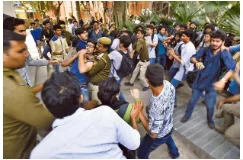
Universities are in the news. Yet again, for the wrong reasons. It would seem that February is jinxed (अभाग्य या बदकिस्मती होना) for universities in the Capital. This year, it was the violence in Delhi University’s (DU’s) Ramjas College. Last year, it was the storm in Jawaharlal Nehru University (JNU). There have also been several instances elsewhere in India during the past 12 months, sparked by the Akhil Bharatiya Vidyarthi Parishad (ABVP), where harassment, intimidation or violence have been used to stifle (दबाना) independent voices. Invitations have been withdrawn. Events have been cancelled. Meetings have been disrupted. Sometimes, university administrations have taken action against the organizers, after the event, as in Jodhpur last month. It is no coincidence that the aggressive, often militant, posture of ABVP on campuses surfaced following the election of Bharatiya Janata Party (BJP) governments in states. This has now been reinforced by the comfort of a BJP government at the Centre. In such episodes, university administrations have been silent spectators or have acted against those targeted by the ABVP. These occurrences negate the essential concept of universities as autonomous spaces, where freedom of expression, exploration of ideas and advancement of knowledge are an integral part of the learning process. There are bound to be differences in views, but these must be addressed through discussion, with open minds. In this, there must be respect—not contempt—for the other. The attitude of the ABVP is the opposite, as it seems to believe that those who are not with them are against them, or worse, anti-national. And its behaviour is simply unacceptable. The ABVP has a right to disagree. It should pose questions, engage in debate, or organize events to articulate (स्पष्ट रूप से कहना) its views, but it cannot and must not seek to silence others. Universities are, above all, about reason and tolerance. Such political intrusion in universities is not new. It began almost five decades ago, has gathered momentum in the past 25 years, and has now reached a stage that could be the edge of the precipice (a very steep or overhanging place) for public universities in India. Starting in the late 1960s, state governments began to interfere in universities. For one, it was about dispensing patronage (संरक्षण/अधिकार) and exercising power in appointments of vice-chancellors (VCs), faculty and non-teaching staff. For another, it was about extending the political influence of ruling parties. Unions of students, teachers and employees became instruments in political battles. Campuses were turned into spheres of influence for political parties. Provincial politics also played a role, with an implicit rejection of national elites and an explicit focus on regional identities. Just as important, political parties and leaders were uncomfortable with, if not insecure about, independent voices and critical evaluation that could come from universities. It was not long before similar reasons began to influence the attitudes of Central governments towards universities. Similar actions were a natural outcome. The turning point, perhaps, was 1977, the end of the era of majority governments and one-party rule. It gathered momentum after 1989. There were short-lived coalition governments. And there were regime changes after almost every general election. The competitive politics unleashed by changes in governments soon spilt over to universities not only as spheres of influence but also as arenas for political contests. The discomfiture (घबराहट) with independent or critical voices, even if few, grew rapidly. Central universities were no longer immune. The decline of public universities in India has been an inevitable consequence of this process. The first set to bear the brunt were the universities of national standing in states. The obvious examples are Allahabad, Lucknow and Patna among the old, with Baroda and Rajasthan among the new. These are not even pale shadows of what they were until around 1980. The next set to be progressively damaged were the oldest national universities in the states—Bombay, Calcutta and Madras—established more than 150 years ago. Their drop in quality is alarming. DU and JNU continued to look good in comparison, not because they got better but because others declined so rapidly. Unfolding reality suggests that they cannot be exceptions for long. This downward trajectory might just gather pace. It takes years, even decades, to build institutions. But it takes much less time to damage them. What is more, short-term actions have long-term consequences, so that revival is a difficult task. Indeed, we are simply mortgaging (Used figuratively - expose to future risk or constraint for the sake of immediate advantage.) the future of public universities in India. It would seem that the political class and the ruling elite do not have an understanding of the critical role of universities in society and democracy. It is a serious mistake to think of universities as campuses or classrooms that teach young people to pass examinations, obtain degrees, and become employable, where research is subsidiary (less important than but related or supplementary to something.) or does not matter. Universities are about far more. For students, there is so much learning outside the classroom that makes them good citizens of society. For faculty, apart from commitment to their teaching and their research, there is a role in society as intellectuals who can provide an independent, credible, voice in evaluating governments, parliament, legislatures, or the judiciary, as guardians of society. This role is particularly important in a political democracy. Thus, academic freedom is primary because universities are places for raising doubts and asking questions about everything. Exploring ideas, debating issues and thinking independently are essential in the quest for excellence. It would enable universities to be the conscience-keepers of economy, polity and society. Hence, the autonomy of this space is sacrosanct (रक्षणीय) . Of course, this cannot suffice where quality is poor or standards are low. That needs reform and change within universities. Alas, the political process, parties and governments alike, meddle in universities. In India, this has become more and more intrusive with the passage of time. Micromanagement by governments is widespread. Interventions are purposive (having or done with a purpose.) and partisan (पक्षपातपूर्ण). These can be direct, or indirect, through the University Grants Commission and pliant VCs. The motives are political. Such interventions are characteristic of all governments, whether at the Centre or in the states, and every political party, irrespective of ideology. There are no exceptions. The cadre-based parties are worse: the Communist Party of India (Marxist), mostly in the past, and the BJP, on the rise, at present. Of course, the Congress is almost the same, much experienced through long practice. The irony of double standards is striking. The same political parties when in government invoke public interest and when in opposition wax eloquent about autonomy and freedom for universities. It is essential for governments to recognize that the provision of resources to universities does not endow them with a right to exercise control. The resources are public money for public universities, which are accountable to students and society through institutional mechanisms that exist or can be created. Every government laments the absence of world-class universities, without realizing that it is attributable in part to their interventions and the growing intrusion of political processes. Where politics is largely kept out—as in Indian Institutes of Technology, Indian Institutes of Management or the Indian Institute of Science—institutions thrive. The blame for the present state of our universities cannot be laid at the door of politics and governments alone. Universities as communities, and as institutions, are just as much to blame. The quality of leadership at universities has declined rapidly, in part because of partisan appointments by governments of VCs who are simply not good enough as academics or administrators, and in part because most VCs simply do not have the courage and the integrity to stand up to governments but have an eye on the next job they might get. The professoriate (a group of professors.) is mostly either complicit (involved with others in an activity that is unlawful or morally wrong.), as part of the political process in teachers’ unions, or just silent, preferring to look the other way, engaged in their narrow academic pursuits. Those who stand up are too few. The students are either caught up in the same party-political unions or opt out to concentrate on their academic tasks. For university communities, it is imperative to recognize that such compromises are self-destructive as acts of commission. So is opting out, as an act of omission. Indeed, if universities want autonomy, it will not be conferred on them by benevolent (हितैषी) governments. They have to claim their autonomy. In this quest, solidarity within universities—leadership, faculty and students—and among universities—is absolutely essential. The whole is greater than the sum total of parts. And its voice cannot go unheard. Structures of governance in universities must be conducive to autonomy. The best model would be a board of governors, to which governments could nominate at the most one-third the total number. The other members, two-thirds or more, should be independent, of whom one-half should be distinguished academics while one-half should be drawn from industry, civil society or professions. The chairman should be an eminent academic with administrative experience. Members of the board should have a term of six years, with one-third retiring every two years. The VC, to be appointed by the board with a six-year tenure, would be an ex-officio member. Except for nominees of governments, the board should decide on replacements for its retiring members. Such institutional mechanisms are necessary but not sufficient. A better world will become possible if we can make two radical departures from our past. Governments and political parties must stop playing politics in universities and stop turning them into arenas for political battles. Universities must reclaim their autonomy from governments, for which university communities need to come together, and just focus on raising academic standards in pursuit of academic excellence.Jinx (verb)
Bring bad luck to; cast an evil spell on. अभाग्य या बदकिस्मती होना
Synonyms: Bewitch, Hoodoo, Hex
Example: His luck has been so bad he feels jinxed.
Stifle (verb)
Restrain (a reaction) or stop oneself acting on दबाना
Synonyms: Suppress, Smother, Restrain
Example: Some medical researchers believe the reduction of animal testing will have a stifling effect on drug innovation.
Articulate (verb)
Express clearly and distinctly. स्पष्ट रूप से कहना
Synonyms: State Clearly, Express Distinctly, Say Lucidly
Example: The president is known for his ability to articulate his thoughts in front of millions of people.
Patronage (noun)
Support or sponsorship/ the support given by a patron. संरक्षण/अधिकार
Synonyms: Backing, Sponsorship, Guardianship, Aegis
Example: Since patronage of the food kitchen has decreased, we have had to reduce the number of meals we serve the homeless each day.
Discomfiture (noun)
A feeling of unease घबराहट
Synonyms: Unease, Discomfort, Discomposure, Disconcertion
Example: The Political dominance has created a kind of discomfiture for honest voices in the country.
Sacrosanct (adjective)
Too important or respected to be criticized or changed रक्षणीय
Synonyms: Inviolable, Unimpeachable, Unchallengeable
Example: During the financial meeting, the company president reminded everyone that no department was too sacrosanct to avoid a cut in its yearly budget.
Mortgage (verb)
Figurative form -expose to future risk or constraint for the sake of immediate advantage. गिरवी रखना
Synonyms: Pledge, Guarantee, Pawn
Example: In the U.S., many people have to mortgage their house to pay for the medical care of a family member who becomes seriously ill.
Partisan (adjective)
Prejudiced in favor of a particular cause पक्षपातपूर्ण
Synonyms: Biased, Prejudiced, Discriminatory, Preferential, Partial, Factional
Example: Please listen to the entire suggestion before you decide to make a partisan issue out of one part of the proposal!
Complicit (adjective)
Involved with others in an activity that is unlawful or morally wrong. सह-अपराधी
Synonyms: Cahoot, Conniving, Conspiring, Colluding
Example: Your complicity in the crime is probably going to earn you five years in prison.
Benevolent (adjective)
Willing to help, do good, and be generous towards people हितैषी
Synonyms: Benign, Generous, Helpful, Unselfish, Unstinting
Example: She was a benevolent woman, volunteering all of her free time to charitable organizations.

The cycles of distress in indian agriculture
May 28, 2017
Bangladesh and india’s terrorism problem
Apr 01, 2017

Building a legal ecosystem for aadhaar
Mar 27, 2017
Job creation is vital for a new india
Mar 17, 2017
Digital payments don’t need fiscal intervention
Jan 29, 2017





Stay updated with The Hindu Editorial Vocab24 app, your definitive source for breaking news and comprehensive coverage from India and around the globe. Whether it's political developments, business updates, sports highlights, the latest technology trends, or current events, The Hindu brings live, accurate, and reliable news directly to your device.
Don’t fall for sensationalized or fake news shared online. Read and share accurate updates with friends and family through The Hindu Editorial Vocab24 app. Download it today!
News Coverage in The Hindu Editorial Vocab24 App
Breaking News: Receive instant notifications on breaking news stories as they unfold. Stay informed about major events and developments in India and around the world with live blogs, news in shorts videos, and concise articles.
Politics: Get the latest updates on Indian politics, including elections, policy changes, government decisions, and political events that shape the nation.
Business and Economy: Stay ahead in the economic landscape with detailed business news and market analysis. Learn about stock market trends, financial reports, corporate news, and economic developments to make informed investment decisions.
Current Events: Follow stories on social issues, policy changes, global events, and daily current affairs, tailored for UPSC and other competitive exam preparations.
Technology: Keep up with the latest gadgets, innovations, and tech trends. Read expert reviews and analyses in short, concise updates on cutting-edge technology from India and beyond.
Sports: Never miss a moment of your favorite sports. Get live scores, match reports, and expert analysis on cricket, football, tennis, and more.
International News: Stay informed about global events and geopolitical developments, including the Russia-Ukraine war, Israel-Palestine conflict, and other key international stories.
Local News: Stay connected to your community with the latest updates on city events, issues, and local news. Coverage includes hyperlocal updates from cities like Bangalore, Chennai, Delhi, Hyderabad, Mumbai, Kolkata, and more.
Trending Topics: Discover what's trending today with the most talked-about stories and hot topics across India and the world.
Experience journalism that values integrity, accuracy, and reliability. Download The Hindu Editorial Vocab24 app today and stay connected with the world.
Subscribe to our newsletter!







