

Job creation is vital for a new india
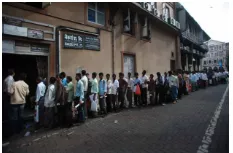
Prime Minister Narendra Modi declared his vision for a “New India” in his victory speech after sweeping the Uttar Pradesh elections. “The poor want a leg-up, not a handout,” he said. A few days earlier, a national newspaper summarized what its journalists had gathered from citizens at election rallies. It reported this on its front page in the plea of a Dalit woman. “Give my husband a job: I don’t want LPG,” she said. Jobs and livelihoods are what people want. Considering the huge population of the young that India has—the largest in the world—India should also be generating more jobs than other countries. But the Indian economy is a laggard in job creation despite good GDP (gross domestic product) growth. India’s rate of job creation is only two-thirds of the global average. Moreover, the employment elasticity of the Indian economy—the numbers of jobs it creates with economic growth—has been declining in the last few years. Modi must pull the aeroplane out of a nose-dive to lead the country to a vision of an inclusive India, where good jobs are available to all people everywhere, including Dalit men and women in the backwaters of India’s heartland. Two recent reports, both produced jointly by the Confederation of Indian Industry and Boston Consulting Group, have analysed the reasons for low job creation and suggested how more jobs can be generated. One, “India: Growth And Jobs In The New Globalization”, looks at global forces that are creating unemployment and increasing inequality around the world. “Capitalization” of production systems, with increasing automation, is reducing jobs for workers, and producing more wealth for owners of capital than for workers in production systems. “Financializing” of economies, with even more money being made from purely financial assets, has turbo-charged the increase in inequalities in incomes and wealth around the world. The report also points out that “Industry 4.0” automation technologies, more flexible, and less dependent on labour, are enabling production systems to be localized within developed countries’ markets. Combined with the pressure on governments everywhere to generate more jobs within their own countries, production systems are likely to become more local and less globally interconnected than they have been in the past 20 years. Each country must develop its own job-creation strategies with the participation of domestic stakeholders because, while technology is universal across countries, social and economic conditions vary. The other report, “Future of Jobs In India, Enterprises And Livelihoods”, is focused on India, and was prepared with the participation of over 170 diverse organizations and persons. It takes a broad systems’ view of the process of job creation, including societal forces that will make technology adapt to societal needs. Both reports recommend strategies for: (1) strengthening clusters and networks of small enterprises which can create more widespread employment and with less capital investment than large factories; (2) developing life-long learning systems that will enable people to learn new skills “just-in-time” when the content of their work changes, which it will often in future when new technologies are applied and new industries emerge; (3) re-framing labour law reform from a paradigm of more flexibility to “hire and fire” to a paradigm of better social security systems, without which societies will not allow employers more freedom to shape contracts with those who work in their enterprises (which Uber, for example, is discovering in many countries); and (4) providing easier access to finance for micro-enterprises. Both reports also highlight the Brahma face of technology as a creator of jobs, while recognizing its Shiva face of a destroyer of jobs at the same time. A youthful country of 1.2 billion people, with the largest number of employment seekers in the world, must create more jobs in many sectors. It must pursue more growth in manufacturing and build infrastructure. It must vigorously pursue other avenues too. India has a large growth opportunity in natural produce sectors—food, fruits, vegetables, dairy, poultry and fish. Rural and urban economies support each other through natural produce supply chains. Natural produce enterprises can generate jobs around the country. India has enormous and diverse assets of natural beauty, heritage and culture, spread across all its states. Therefore, another sector where India has huge, insufficiently tapped potential for widespread generation of livelihoods is tourism and hospitality. Some other sectors with large potential for more enterprises and sources of livelihoods around the country are healthcare, renewable energy, water and sanitation. A vision of a “new India”, with widespread opportunities for “a leg-up” for all, requires a coordinated, “whole of government” approach to policy reforms which are explained in the second report. It highlights that job creation must become an overarching goal for government along with economic growth, which it has not been so far. Plans at all levels of government—at the Centre, in the states, and in cities—must be directed towards creating ecosystems that generate better livelihoods and jobs, and progress must be measured accordingly. Finally, since jobs emerge from a healthy jobs ecosystem and cannot be sprinkled into the economy from above, many stakeholder groups must participate in systematic processes at the Central, state and city levels for finding and implementing solutions together.
The cycles of distress in indian agriculture
May 28, 2017
Bangladesh and india’s terrorism problem
Apr 01, 2017

Building a legal ecosystem for aadhaar
Mar 27, 2017

Digital payments don’t need fiscal intervention
Jan 29, 2017





Stay updated with The Hindu Editorial Vocab24 app, your definitive source for breaking news and comprehensive coverage from India and around the globe. Whether it's political developments, business updates, sports highlights, the latest technology trends, or current events, The Hindu brings live, accurate, and reliable news directly to your device.
Don’t fall for sensationalized or fake news shared online. Read and share accurate updates with friends and family through The Hindu Editorial Vocab24 app. Download it today!
News Coverage in The Hindu Editorial Vocab24 App
Breaking News: Receive instant notifications on breaking news stories as they unfold. Stay informed about major events and developments in India and around the world with live blogs, news in shorts videos, and concise articles.
Politics: Get the latest updates on Indian politics, including elections, policy changes, government decisions, and political events that shape the nation.
Business and Economy: Stay ahead in the economic landscape with detailed business news and market analysis. Learn about stock market trends, financial reports, corporate news, and economic developments to make informed investment decisions.
Current Events: Follow stories on social issues, policy changes, global events, and daily current affairs, tailored for UPSC and other competitive exam preparations.
Technology: Keep up with the latest gadgets, innovations, and tech trends. Read expert reviews and analyses in short, concise updates on cutting-edge technology from India and beyond.
Sports: Never miss a moment of your favorite sports. Get live scores, match reports, and expert analysis on cricket, football, tennis, and more.
International News: Stay informed about global events and geopolitical developments, including the Russia-Ukraine war, Israel-Palestine conflict, and other key international stories.
Local News: Stay connected to your community with the latest updates on city events, issues, and local news. Coverage includes hyperlocal updates from cities like Bangalore, Chennai, Delhi, Hyderabad, Mumbai, Kolkata, and more.
Trending Topics: Discover what's trending today with the most talked-about stories and hot topics across India and the world.
Experience journalism that values integrity, accuracy, and reliability. Download The Hindu Editorial Vocab24 app today and stay connected with the world.
Subscribe to our newsletter!







