

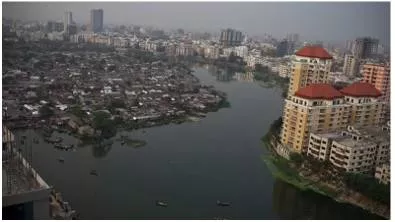
Jihadists in bangladesh are still going strong economic gains aren’t ‘wins’
The men gently floated down the Rupsa River from the Khulna Launch Dock, past the burning villages of Laban Chore and Mathabhanja, carried by the tides together with the bodies of the dead. The great river, Mohander Dhali would tell investigators, had turned red, dyed by the blood of the victims of the savage anti-Hindu massacre that tore through Bangladesh in 1964. “For days afterwards,” he testified, “dead bodies were seen at every bund and curve of the river, all through its course downwards.”Last week, mobs burned down Hindu-owned homes and businesses in Narail’s Sahapara, and vandalised local temples after a teenager posted content critical of Islam on Facebook. There have been a string of similar mob assaults in recent months, beginning from Durga Puja last autumn, when seven people were killed.
An independent watchdog, the Ain o Salish Kendra, estimates that there have been more than 3,600 attacks on Hindus since 2013. That year, Bangladesh’s largest Islamist group, the Jamaat-e-Islami, unleashed large-scale communal violence to protest the conviction of its leader, Delwar Hossain Sayeedi, for war crimes he committed in the liberation campaign of 1971.
Even though Prime Minister Sheikh Hasina and her government have sought to stamp out the violence, Islamists remain an entrenched part of Bangladesh’s political landscape. The regime’s authoritarian policies—driven, in part, by its effort to stamp out jihadism—undermined its legitimacy, forcing unhappy compromises with competing Islamist groups.
From its famine-ravaged, blood-soaked birth, Bangladesh has succeeded in transforming itself into one of the region’s most vibrant economies. Fundamentalism, though, remains a powerful force, threatening to undo those hard-won gains.
The communal tide
From the moment of independence, eastern Bengal Hindus became subject to genocidal violence: A million and a half refugees came to India in 1950; more than 6,00,000 in 1951-52; another 1.6 million from 1953 to 1956. Largely landless Muslims also streamed the east but didn’t leave behind properties that could be used for rehabilitation. India considered war to seize territory in Khulna and Jessore, historian Pallavi Raghavan recorded, only to realise the war would mean even more refugees.
The violence slowly diminished from the mid-1950s but political leaders had learned that communalism could be used for electoral gain, as well as personal profit.
In 1962, violence against Hindus in Rajshahi District sent 35,000 refugees to move to West Bengal and Assam. Their lands were often seized by local politicians and used as a tool to dispense patronage.
Then, in the winter of 1963, violence erupted in Kashmir, after a religious relic was found missing from the Hazratbal shrine. The Indian state disintegrated, with protestors setting up, what one contemporary observer described as “an unauthorised parallel administration, controlling traffic, commerce and prices.” The media in Pakistan claimed—with little basis—that Muslims had been massacred, from Kashmir to Kolkata.
The Dhaka newspaper Azad, a report by the Indian Commission of Jurists recorded, declared: “Hindus are not reliable. They can kill their mothers and fathers. Whenever opportunity will offer itself, they will throttle the Muslims to death.”
Pakistan’s communications minister Abdul Sabur Khan led the mobs that acted on these words in 1964. Leaflets were distributed by his supporters, the Commission was told, demanding Hindus leave East Pakistan. From eyewitness testimony, it is clear he often used the opportunity to seize land from the fleeing community.
The killing machine
Faced with growing opposition from 1970, the Pakistani authorities turned to communal leaders to form an institutionalised killing machine against Bangladesh nationalism. “The only people who came forward were the rightists,” former Pakistan Army Brigadier Siddique Salik wrote. Figures like Sabur, he wrote, recruited volunteers for two death squads— al-Badr and al-Shams. “In the name of Islam and Pakistan,” the officer observed, the volunteers “were prepared to risk everything.”
Led by the Jamaat-e-Islami politician Matiur Rahman Nizami, al-Badr engaged in the killings of nationalists, as well as violence intended to force Hindus to flee the country.
Formed in 1953 by Islamist ideologue Abul Ala’ Maududi, the Jamaat-e-Islami sought to build Pakistan into a sharia-governed state. The organisation had little electoral success, political scientist Seyyed Vali Nasr has observed, but acquired outsize influence in shaping the constitution and norms of the Islamic Republic.
Like Pakistan itself, the East Pakistan Jamaat was annihilated in 1971 but reemerged under the regime of Major-General Zia-ur-Rahman. His successor, General H.M. Ershad, even appointed two 1971 war criminals, Abdul Mannan and Salahuddin Quader Chowdhury, to cabinet positions. Khan was amnestied in 1972, going on to stage a triumphant electoral comeback.
From 2001 to 2006, the Jamaat allied with the Bangladesh Nationalist Party (BNP), joining the right-wing coalition that ruled Bangladesh. The Jamaat used its control of the social welfare ministry and the private-sector Islami Bank, to build a sprawling network of patronage.
The 2008 election saw the BNP-Jamaat alliance defeated on the back of a youth vote demanding accountability for the liberation of war criminals. Islamism, though, was to prove resilient.
The jihadist current
Two entwined jihadist currents, the work of scholar Ali Riaz shows, were nurtured under the shade of military authoritarianism in Bangladesh. The first was volunteers who travelled to Afghanistan to fight against the Soviet Union and returned home to form the Harkat-ul-Jihad-e-Islami in Bangladesh, which focused on fighting India and Myanmar. In 1998, a second generation formed the Jamaat-ul-Mujahideen Bangladesh, which fought to transform Bangladesh itself into an Islamic state.
Even though the Jamaat-ul-Mujahideen was ruthlessly suppressed, new tendencies emerged. Led by elements of the Bangladeshi diaspora in the United Kingdom, the Hizb-ut-Tahrir brought ideas of a global caliphate to the country’s elite campuses. The al-Qaeda-affiliated Ansarullah Bangla Team began assassinating progressive activists. Islamic State-inspired groups formed the fifth circle of jihadism in 2015.
Figures show Bangladesh succeeded in defending itself—terrorism-related fatalities have fallen steadily since 2014 but the victory came at a price.
To insulate itself from attacks by the jihadists and the Jamaat-e-Islami, prime minister Hasina’s government allied with the Hefazat-e-Islami Bangladesh, a movement of clerics and students in the country’s seminaries. The Hefazat emerged on a platform of demands, which included the incorporation of Islamic phrasing into the constitution, gender segregation in public places, and capital punishment for blasphemy—eating into the Jamaat-e-Islami constituency.
Early on, prime minister Hasina conceded several Hefazat demands, notably removing the sari-clad Lady of Justice statue from the Supreme Court, which it claimed was heretical. The government also recognised seminary qualifications as equivalent to university degrees and made amendments to school textbooks.
The Awami League purged anti-religious politicians from its ranks. Four-time Member of Parliament Abdul Latif Siddique was expelled from the ruling party after he announced his belief that the Hajj pilgrimage was a “waste of time.”
Since 2020, though, confrontation has built up with the government. Hefazat clerics began claiming that the statutes of Bangladesh’s founding leader, Sheikh Mujibur Rahman, be brought down, arguing they constituted a form of idolatry. Then, the following year, Hefazat politicians led violent protests against visiting Indian Prime Minister Narendra Modi.
The chauvinist ideas of the Hefazat, though, have proved hard to contain. Scholars Mubashar Hasan and Geoffrey Macdonald have noted that the pandemic contributed to these strains. Islamist propagandists have adroitly used digital media to disseminate claims that the pandemic was divine punishment for the government’s anti-Islamic policies and called for it to be replaced with a sharia-based state.
Anti-Muslim polemics and violence in India have also been used to target Hindus and the idea of secularism in Bangladesh.
The country’s experience holds up a mirror to India—showing what happens to polities that fail to confront communalism.










Stay updated with The Hindu Editorial Vocab24 app, your definitive source for breaking news and comprehensive coverage from India and around the globe. Whether it's political developments, business updates, sports highlights, the latest technology trends, or current events, The Hindu brings live, accurate, and reliable news directly to your device.
Don’t fall for sensationalized or fake news shared online. Read and share accurate updates with friends and family through The Hindu Editorial Vocab24 app. Download it today!
News Coverage in The Hindu Editorial Vocab24 App
Breaking News: Receive instant notifications on breaking news stories as they unfold. Stay informed about major events and developments in India and around the world with live blogs, news in shorts videos, and concise articles.
Politics: Get the latest updates on Indian politics, including elections, policy changes, government decisions, and political events that shape the nation.
Business and Economy: Stay ahead in the economic landscape with detailed business news and market analysis. Learn about stock market trends, financial reports, corporate news, and economic developments to make informed investment decisions.
Current Events: Follow stories on social issues, policy changes, global events, and daily current affairs, tailored for UPSC and other competitive exam preparations.
Technology: Keep up with the latest gadgets, innovations, and tech trends. Read expert reviews and analyses in short, concise updates on cutting-edge technology from India and beyond.
Sports: Never miss a moment of your favorite sports. Get live scores, match reports, and expert analysis on cricket, football, tennis, and more.
International News: Stay informed about global events and geopolitical developments, including the Russia-Ukraine war, Israel-Palestine conflict, and other key international stories.
Local News: Stay connected to your community with the latest updates on city events, issues, and local news. Coverage includes hyperlocal updates from cities like Bangalore, Chennai, Delhi, Hyderabad, Mumbai, Kolkata, and more.
Trending Topics: Discover what's trending today with the most talked-about stories and hot topics across India and the world.
Experience journalism that values integrity, accuracy, and reliability. Download The Hindu Editorial Vocab24 app today and stay connected with the world.
Subscribe to our newsletter!







