

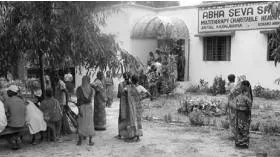
India’s sick parade
India’s economy is soaring but healthcare remains an Achilles’ heel (a weakness or vulnerable point.). For millions of people the high costs of treatment of illnesses continue to undermine (lessen the effectiveness, power, or ability of, especially gradually or insidiously.) economic progress. This is largely on account of the abysmal (extremely bad; poxy.) and chaotic (in a state of complete confusion and disorder.) healthcare system owing to the declining budgetary healthcare support by the government. India ranks close to the bottom of the pile in international rankings in most health indices.At an investment of 1.3 per cent of GDP in health services, which has remained at the same level over a decade, India ranked 187th out of 194 countries going by the World Health Organization (WHO) data, while carrying 20 per cent of the global burden of diseases. The comparable rates are 1.5 per cent in Sri Lanka, 2.7 per cent in China, and 3 per cent in Thailand. The National Health Policy 2017 has proposed to increase the public spending on health care from a dismal 1 per cent to a meagre 2.5 per cent of GDP by 2020, which in itself is well below the world average of 5.99 per cent. This is an appalling situation and calls for urgent action.
Illnesses are a severe risk and can shave off most of the hard-earned savings in low income communities. They are the No. One route to bankruptcy. The Ministry of Health found that a quarter of all people hospitalised were driven to penury (the state of being very poor) by their hospital costs ~ not including the cost of missed work.
Universal healthcare in India remains a distant reality because healthcare still continues to rank very low on the government’s priority card. Nobody wants to talk about the elephant in the room (an obvious problem or risk that no one wants to discuss). While facilities in Indian metros are competing with the world’s best medical centres, the scenario beyond the urban conglomerates (a large corporation formed by the merging of separate and diverse firms.) is quite distressing. The demand and supply in healthcare services still show a significant disparity (gulf) in urban and rural areas as also regional imbalances. Here’s a snapshot:
Thirty per cent of Indians don’t have access to primary healthcare facilities.
About 39 million Indians fall below the poverty line each year because of healthcare expenses. Around 30 per cent in rural India don’t visit hospitals afraid of the expenses.
The healthcare needs of 47 per cent of rural India and 31 per cent of urban India are financed by loans or sale of assets.
About 70 per cent of Indians spend all their income on healthcare and buying drugs.
Out-of-pocket spending in India ~ 69 per cent of total health expenditure ~ is among the highest in the world and much more than in Thailand (25 per cent), China (44 per cent), and Sri Lanka (55 per cent).
Nearly 30,000 doctors, 20,000 dentists and 45,000 nurses graduate from medical colleges across the country every year. The doctor-to-patient ratio in India is six for 10,000 people, way below Australia (1:249), the UK (5: 1,665) and the US (9:548). The global ratio stands at 15 doctors for 10,000 people. The distribution of these doctors is uneven with low ratio in states like Chhattisgarh and Jharkhand ~ just two doctors for 100,000 people. There are only six hospital beds and two surgeons per lakh of population. There is one government doctor for every 10,189 people, one government hospital bed for every 2,046 people and one state-run hospital for every 90,343 people. In comparison to these dismal numbers, the US has 24.5 doctors for every 10,000 people and one hospital bed for every 345 citizens.
India has a laggardly (developing or moving very slowly) record in healthcare. In per capita terms adjusted for purchasing power, the country’s public expenditure on health is $43 a year, compared with $85 in Sri Lanka, $240 in China, and $ 265 in Thailand. European nations spent 10 times and the US 20 times. Government contribution to insurance stands at roughly 32 per cent, as opposed to 83.5 per cent in the UK. The high out-of-pocket expenses in India stem from the fact that 76 per cent of Indians do not have health insurance.
The recently released National Health Accounts (NHA) 2014-15 shows that the average expenditure per citizen per year was just Rs 1,108, against almost Rs 6,300 for every central government employee. According to the NHA, India’s total health expenditure in 2014-15 worked out to Rs 3,826 per person. Of this, the amount people had to spend from their own pockets was Rs 2,394 (63 per cent). In 2014-15, the Union government’s expenditure on the National Health Mission, meant to boost the public healthcare system, was Rs 20,199 crore. Spread it over a population of roughly 1.25 billion and you get a paltry Rs 162 per head.
The apathy of the government is reflected in a rather poor prognosis (a forecast of the likely outcome of a situation.) for the health system. Primary health centres (PHC) in villages are supposed to screen and feed medical cases to specialised hospitals in districts and further on to state-level specialised hospitals. PHCs do not exist in many villages (about 1 for every 20 villages), and where present are so acutely undermanned that the “access” system is broken at the first mile. As many as 18 per cent of PHCs were entirely without doctors, This impacts not only the filtering of patients but also deeply impairs prevention and early detection which is a must if costs in the whole system are to be contained. The only redeeming feature is the committed cadre of Auxiliary Nurse Midwife (ANM) at PHCs and their sub-centres and accredited social health activists (ASHAs).
Our healthcare facilities have grown significantly in terms of numbers and expertise of our professionals, but this has largely been in the private sector. The government’s failure to deliver quality care has led to a rapid expansion of private hospitals, which today account for 93 per cent of all hospitals (up from 8 per cent in 1947), 64 per cent of all beds, and 80 to 85 per cent of all doctors. But mass access continues to remain a challenge. For the private sector, affordability in Tier 3 cities and rural areas is a critical limiting factor for further expansion.
The health infrastructure is heavily skewed in favour of urban areas. Nearly 75 per cent of dispensaries, 60 per cent of hospitals and 80 per cent of doctors are located in urban centres. Doctors cater (provide with what is needed or required.) to a third of the urban population, or no more than 442 million people.
There are around 734 district hospitals across the country which provide secondary healthcare facilities to people. In addition, there are around 300 other hospitals, such as women’s hospitals at the district level. They are powerful nodes in India’s healthcare network and can be revitalized to boost the health infrastructure.
India needs to reform the public health care sector’s governance and management systems. The approach to service delivery has to be a functional referral linkage and establishing a ‘continuum of care’ across the spectrum from village to sub-health centre to primary health care, sub-district hospital and the district hospitals. The challenge remains to reform the health system and its workforce in particular, so that practitioners, administrators and others have the skills, knowledge and professional attributes to meet the emerging health-care needs of our community.
Several laudatory (acclamatory) policies are already in place. The direction of travel, so to speak, is right but we have to accelerate the pace of the journey. For reforms to be successful we need hard-coded timelines and accountability of those tasked with the administration. It is now for the policy doctors to collaborate with the professional doctors to use their ingenuity (the quality of being clever, original, and inventive) to come up with radical solutions that can cope with the mounting challenges of healthcare.


Philippines president rodrigo duterte slams unhcr
Apr 06, 2018
Oli to take up currency ban issue with pm modi
Apr 02, 2018
Curbing the khaps
Apr 01, 2018





Stay updated with The Hindu Editorial Vocab24 app, your definitive source for breaking news and comprehensive coverage from India and around the globe. Whether it's political developments, business updates, sports highlights, the latest technology trends, or current events, The Hindu brings live, accurate, and reliable news directly to your device.
Don’t fall for sensationalized or fake news shared online. Read and share accurate updates with friends and family through The Hindu Editorial Vocab24 app. Download it today!
News Coverage in The Hindu Editorial Vocab24 App
Breaking News: Receive instant notifications on breaking news stories as they unfold. Stay informed about major events and developments in India and around the world with live blogs, news in shorts videos, and concise articles.
Politics: Get the latest updates on Indian politics, including elections, policy changes, government decisions, and political events that shape the nation.
Business and Economy: Stay ahead in the economic landscape with detailed business news and market analysis. Learn about stock market trends, financial reports, corporate news, and economic developments to make informed investment decisions.
Current Events: Follow stories on social issues, policy changes, global events, and daily current affairs, tailored for UPSC and other competitive exam preparations.
Technology: Keep up with the latest gadgets, innovations, and tech trends. Read expert reviews and analyses in short, concise updates on cutting-edge technology from India and beyond.
Sports: Never miss a moment of your favorite sports. Get live scores, match reports, and expert analysis on cricket, football, tennis, and more.
International News: Stay informed about global events and geopolitical developments, including the Russia-Ukraine war, Israel-Palestine conflict, and other key international stories.
Local News: Stay connected to your community with the latest updates on city events, issues, and local news. Coverage includes hyperlocal updates from cities like Bangalore, Chennai, Delhi, Hyderabad, Mumbai, Kolkata, and more.
Trending Topics: Discover what's trending today with the most talked-about stories and hot topics across India and the world.
Experience journalism that values integrity, accuracy, and reliability. Download The Hindu Editorial Vocab24 app today and stay connected with the world.
Subscribe to our newsletter!







