

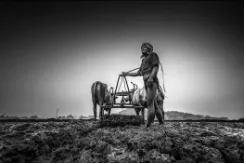
Don’t tax the tiller
For peasants, the Mughal Empire was fundamentally an extractive state; a protection racket run riot. Typically, the land revenue share of a crop varied between 33% and 50%, depending on fertility, with a further 10-25% paid to the zamindar for his efforts. Its replacement by the East India Company and later the British government provided little respite (राहत/मोहलत) . Zamindars were now granted hereditary and proprietary (मालिकाना) rights, with the rate of assessment fixed in perpetuity (लम्बे समय तक के लिए) . The Company’s share was often fixed at 2/3rd of the gross produce received by the zamindars from the ryots (an Indian peasant or tenant farmer.) . The consequences of such land revenue systems were stark — agricultural output grew at just 0.37% per annum between 1891 and 1947, with foodgrains at just 0.11% per annum, while commercial crop output rose by 1.31% annually; meanwhile the population rose at 0.67% annually. The colonial government pushed farmers into heavy debts and eventual pauperization (दरिद्री-करण) . Post-Independence, the national and State governments sought to redress (सुधारना/निवारण करना) this. The Agrarian Reforms Committee of 1949 sought a programme of land reforms that would transform the actual tillers (किसान/खेतिहर) into owner-cultivators by a large scale. Instead, a step-by-step approach was adopted to abolish intermediaries, which encouraged zamindars to evict (बेदखल करना) existing tenants (जोतदार) instead, pauperising them further. The Central government did its part by seeking to not tax agricultural income, with most States following suit. Pitfalls in the tax demand However, with growth in agriculture rising, a demand for taxing agriculture income has arisen. Agricultural income declared by taxpayers, in returns filed till end 2014, for exemption was at Rs. 9,338 crore, with over 2,746 income tax cases declaring Rs. 1 crore agricultural income in the 2014-15 assessment year. The estimated total annual agricultural income from cultivation and livestock, as estimated by the National Sample Survey Office, is at Rs. 4,16,092.5 crore, with the total income of the top bracket at Rs. 16,084 crore and that of the first two brackets, including households with over four hectares, at Rs. 83,433 crore. Taxing 9,73,000 large farm holdings having greater than 10 hectares of land earning an average of approx. Rs. 5 lakh annually shall yield about Rs. 1,200 crore of agricultural income tax on varying crop conditions, consequent incomes and applicable tax rules. We’ve tried this before. The K.N. Raj Committee on Taxation of Agricultural Wealth and Income (1972) sought to institute a progressive agriculture tax on agricultural income in a norm-based manner, with regional average crop yields defining levy rates in a universal manner. The recommendations were not accepted, given limited political and grassroots (मूलभूत) support. However, there remain significant pitfalls (छिपी हुई दिक्कत) with this demand. Given the level of informal occupation prevalent in agriculture, implementing an agricultural tax will not be easy. Any agricultural tax system would have to evolve crop-specific norms of return to the land, while accommodating external shocks like droughts, floods or pests. Furthermore, for imposing tax on value of goods produced, the mechanism would fail to take individual farm economics into account, thereby presenting a case wherein a farmer would be taxed even if he makes a loss on sale. It shall require administration to ensure exact estimate of crop productivity and realised sale price per crop harvested — a seemingly humongous task for all farmers. Lack of clarity on land titles and cropping patterns based on lease/share-cropping shall further introduce randomness to the system. Further complications arise if farmers suffer from multiple crop failures followed by one successful crop, for the income in that period may be subjected for tax payment. Taxing agricultural incomes is an idea devoid of knowledge of farming practices as well. Many farmers save seeds from one harvest for the next and the practice remains critical to running Indian agriculture — proposals based on value of goods produced would end up taxing such sustainable practices as well. For tax based on sales, it shall disincentivise farmers to sell through organised formal channels, thereby increasing risk to farmer’s income. Instead of raising agricultural income, we would trend back to age-old farmer pauperisation. Not worth the effort In addition, any crop-specific taxation would have to be traded-off against input subsidies, which are nationally uniform for fertilisers and vary on a State-wise basis for water and electricity. Should input subsidies, assumed to be high at the institution of the crop tax rate, fall in the future, the farmer would effectively lose out on both ends of the value chain. Any crop-specific taxation would have been locally based, with a national crop register not necessarily linked to which crops would be taxed in specific regions or States. The tax rates for the same crop in different regions could be different, inequitably ensuring arbitrage (the simultaneous buying and selling of securities, currency, or commodities in different markets or in derivative forms in order to take advantage of differing prices for the same asset.) for some farmers. Amidst all this, it is hard to determine if there would be net benefit to taxing agricultural revenues, even for rich farmers (defined on local thresholds), compared to cost of monitoring and rolling out such a system. Even a progressively structured taxation system would encourage fictitious (जाली/झूठा) ownership splits amongst rich farmers and their relatives. Even assuming a net take of approx. Rs. 1,200 crore, the potential increase in the Central government’s taxation revenues would be increased by about 0.1%, while input subsidies, currently totalling Rs. 35,784 crore in 2016-17, would face significant upward pressure. Is this truly worth the effort? Agricultural taxation has historically been considered the third rail of Indian politics. While we harken (listen; used mostly in the imperative) about improving economies of scale in agriculture, such efforts send discouraging signals to large and medium farmers who seek to increase their produce through utilisation of better techniques, differing crop patterns and more judicious use of agricultural inputs. A nation-state where a farmer can be moderately rich one year and marginally poor the other cannot in good conscience tax their income.
Patriot games at attari wagah
Aug 22, 2017
Beauty and the regulatory beast
Aug 16, 2017
Us north korea stand off sound and fury
Aug 14, 2017
The march from yesterday
Aug 11, 2017
A judgment for the ages
Aug 04, 2017
Cinema & censorship
Jul 29, 2017





Stay updated with The Hindu Editorial Vocab24 app, your definitive source for breaking news and comprehensive coverage from India and around the globe. Whether it's political developments, business updates, sports highlights, the latest technology trends, or current events, The Hindu brings live, accurate, and reliable news directly to your device.
Don’t fall for sensationalized or fake news shared online. Read and share accurate updates with friends and family through The Hindu Editorial Vocab24 app. Download it today!
News Coverage in The Hindu Editorial Vocab24 App
Breaking News: Receive instant notifications on breaking news stories as they unfold. Stay informed about major events and developments in India and around the world with live blogs, news in shorts videos, and concise articles.
Politics: Get the latest updates on Indian politics, including elections, policy changes, government decisions, and political events that shape the nation.
Business and Economy: Stay ahead in the economic landscape with detailed business news and market analysis. Learn about stock market trends, financial reports, corporate news, and economic developments to make informed investment decisions.
Current Events: Follow stories on social issues, policy changes, global events, and daily current affairs, tailored for UPSC and other competitive exam preparations.
Technology: Keep up with the latest gadgets, innovations, and tech trends. Read expert reviews and analyses in short, concise updates on cutting-edge technology from India and beyond.
Sports: Never miss a moment of your favorite sports. Get live scores, match reports, and expert analysis on cricket, football, tennis, and more.
International News: Stay informed about global events and geopolitical developments, including the Russia-Ukraine war, Israel-Palestine conflict, and other key international stories.
Local News: Stay connected to your community with the latest updates on city events, issues, and local news. Coverage includes hyperlocal updates from cities like Bangalore, Chennai, Delhi, Hyderabad, Mumbai, Kolkata, and more.
Trending Topics: Discover what's trending today with the most talked-about stories and hot topics across India and the world.
Experience journalism that values integrity, accuracy, and reliability. Download The Hindu Editorial Vocab24 app today and stay connected with the world.
Subscribe to our newsletter!







