

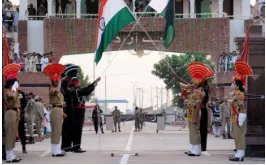
Patriot games at attari wagah
“Louder,” the tough-looking Border Security Force (BSF) guard gesticulated (use gestures, especially dramatic ones, instead of speaking or to emphasize one's words.) to the cheering, flag-waving Indian audience at Attari on the India-Pakistan border as the shouts of “Jio jio Pakistan” from the Wagah side of the border, barely 100 metres away, briefly dominated the air. The hyper-charged crowds were only too happy to comply and shouted back, “Bharat Mata ki Jai”, drowning out the Pakistani “attack”. The older we become as nation-states, the less mature we seem to have become — the retreat ceremony at the Attari-Wagah border testifies to that. Over the past 70 years, the display of respective nationalisms at the border has become far more aggressive, dramatic, and hateful. The well-choreographed hurling (utter vehemently) of the slogans “Bharat Mata ki Jai” and “Jio jio Pakistan” at each other not only reduces the India-Pakistan relationship to a juvenile (immature) shouting match but, more importantly, encourages people to belittle and disrespect each other’s sense of nationhood in praise of one’s own. The retreat ceremony today is less of a celebration and more about denigrating the other. Does belittling each other’s nationhood make our respective nations any greater? ‘No’ should be the ideal answer, but not everyone would agree. A choreography of hostility Following Partition, and the creation of the two states in 1947, the Wagah-Attari border, a short drive from Lahore and Amritsar, remained a trade and transit point between the two countries. During the heydays (the period of a person's or thing's greatest success, popularity, activity, or vigour.) of India-Pakistan relations in the mid-2000s, it was decided to allow trucks to go to designated points on either side of the border for unloading cargo. Today, there is more formalised trade between the two countries than there is transit thanks to severe visa restrictions. The Attari border was managed by the Indian Army in the first few years after Independence and later managed by the Punjab Armed Police before the BSF eventually took over after its creation in 1965. When the retreat ceremony began in 1959, the joint Check Post was marked by a few painted drums, two flag masts and a rubble (waste or rough fragments of stone, brick, concrete, etc.,) of stones astride (extending across.) the Grand Truck Road that stretches from Calcutta to Peshawar. During the early decades, the flag-lowering ritual was a low-key affair that had an almost negligible audience and spartan seating arrangements, a far cry from the grand infrastructure and pavilions that can accommodate as many as 10,000 people today. India’s 1999 victory over Pakistan in Kargil made all the difference, as well as the opening up of the Indian media space in the preceding years. Since Kargil, the Attari-Wagah border has become a tourist destination and consequently led to the expansion of infrastructure on both sides. Unlike the India-Pakistan wars of 1965 and 1971, when the ceremony was temporarily halted during the conflicts, it continued during the duration of Kargil. Given that Kargil was India’s ‘first televised war’, it also brought about several changes in the way we relate to war, peace and of course the ‘enemy’, Pakistan. Post-Kargil, the ceremony started reflecting carefully choreographed elements of hostility and resentment towards the enemy ‘other’ across the white line at Attari. A quick glance at post-Kargil films such as Gadar:Ek Prem Katha (2001), The Hero: Love Story of a Spy (2003), and LOC Kargil (2003) demonstrate how Kargil has influenced our notions of nationalism and the sources and definitions of national security threats. Over the years, the ceremony has become hostile and dramatised with the guards displaying intimidating gestures, stomping their feet and exchanging angry glares across the large iron gates, much to the delight of the cheering crowds. In 2010, BSF and Pakistan Rangers agreed to do away with some of the overt aggression, yet the angry gestures of stomping, thumping and glaring nonetheless remain an integral part of this theatrical ceremony. Some niceties “Your excellency” is the salutation officers on either side use when addressing each other, irrespective of rank, and junior officers salute senior officers from the ‘enemy side’ if they happen to meet. There are ritualistic exchanges of sweets and occasional hugs between the BSF and Pakistani Rangers on special days such as August 14-15 and Diwali/Eid (ironically, there are often reports of increased firing on the Line of Control on such days). During times of tensions, this practice is often suspended. A BSF officer pointed out that not all gestures are as aggressive as they are perceived to be but are sometimes indications to the other side about the conduct of the ceremony and what to do next. If you travel to the other side on foot, what surprises you is not just the seamlessness of life on either side of the border but also the chit-chatting and familiarity between the ‘adversaries’ that one gets to see. Behind the stomping and angry glares then, there is a certain cordiality that exists on the Attari-Wagah border, and that in a sense is what makes it even more ironical, and a theatre of the absurd. The commerce of patriotism The retreat ceremony today is not just a daily exercise in the display of nationalism and military vigour. Over the years, it has become a heady cocktail of Bollywood music, businesses flashing their tri-coloured advertisements, souvenir (a thing that is kept as a reminder of a person, place, or event.) shops selling patriotic memorabilia (memorable or noteworthy observations), and LCD screens displaying the sponsors of the event. Nationalism is good business too. The whole event is electrifying. Hordes of school students enthusiastically waving the tricolour, BSF guards dressed in white sportswear getting around the venue and sloganeering over the loudspeaker, and men and women dancing to the tune of patriotic songs from Bombay cinema — ‘Kandhon se milte hain kandhein’, ‘ Yeh desh hai veer jawaanon ka ’, ‘ Dushman ke chakke chudade hum India walle ’, ‘Desh nu chalo desh mangta kurbaniyan ’. The drill on the Pakistani side is no different, only the songs and flag are. The Bollywood connection to the retreat ceremony doesn’t end there. Popular film actors are often seen at the venue promoting their films and connecting with the crowds, besides adding to the nationalistic atmosphere. Then there is Sarhad, the highway restaurant close to the Attari-Wagah border that serves both Pakistani and Indian cuisine, reminding you of the common architectural, cultural and culinary (of cooking) heritage of pre-Partition Punjab. Sarhad also displays murals narrating the story of pre-Partition bonhomie (cheerful friendliness), Partition and its aftermath, and a potential future of borders without barriers. For those returning from the war of words at Attari, Sarhad plays soothing Coke Studio songs such as Gurdas Mann’s ‘Ki Banu Duniya Da’ (what will become of the world) — ‘O Wagah de border te, raah puchdi Lahore’an de haye, raah puchdi Lahore’an de ’ (at the Wagah border, I look for roads that once took me to Lahore). War and peace, after all, is also a state of mind and it’s in our minds that both the retreat ceremony at Attari and the Sarhad restaurant seem to be persuasively engaging in radically different ways. Seventy years on Seventy years after the violence of Partition, the India-Pakistan relationship today has been reduced to this: jointly-choreographed shouting matches and threats of apocalyptic (momentous or catastrophic.) nuclear wars. The retreat ceremony at the Attari-Wagah border, a well-rehearsed exchange of insults, is a constant, daily, reminder of our hostility towards each other as against the idea of each other’s nationhood, and the inhabitants of the two nations. Seventy years may not be a long time in the lives of two post-colonial nations, but the 70th anniversary of freedom is a good time to start accepting each other’s existence as sovereign independent entities. India needs to accept Pakistan’s tryst with its destiny and what it does with it, and vice-versa.
Beauty and the regulatory beast
Aug 16, 2017
Us north korea stand off sound and fury
Aug 14, 2017
The march from yesterday
Aug 11, 2017
A judgment for the ages
Aug 04, 2017
Cinema & censorship
Jul 29, 2017
Questions of age on sc's ruling on pocso act
Jul 27, 2017





Stay updated with The Hindu Editorial Vocab24 app, your definitive source for breaking news and comprehensive coverage from India and around the globe. Whether it's political developments, business updates, sports highlights, the latest technology trends, or current events, The Hindu brings live, accurate, and reliable news directly to your device.
Don’t fall for sensationalized or fake news shared online. Read and share accurate updates with friends and family through The Hindu Editorial Vocab24 app. Download it today!
News Coverage in The Hindu Editorial Vocab24 App
Breaking News: Receive instant notifications on breaking news stories as they unfold. Stay informed about major events and developments in India and around the world with live blogs, news in shorts videos, and concise articles.
Politics: Get the latest updates on Indian politics, including elections, policy changes, government decisions, and political events that shape the nation.
Business and Economy: Stay ahead in the economic landscape with detailed business news and market analysis. Learn about stock market trends, financial reports, corporate news, and economic developments to make informed investment decisions.
Current Events: Follow stories on social issues, policy changes, global events, and daily current affairs, tailored for UPSC and other competitive exam preparations.
Technology: Keep up with the latest gadgets, innovations, and tech trends. Read expert reviews and analyses in short, concise updates on cutting-edge technology from India and beyond.
Sports: Never miss a moment of your favorite sports. Get live scores, match reports, and expert analysis on cricket, football, tennis, and more.
International News: Stay informed about global events and geopolitical developments, including the Russia-Ukraine war, Israel-Palestine conflict, and other key international stories.
Local News: Stay connected to your community with the latest updates on city events, issues, and local news. Coverage includes hyperlocal updates from cities like Bangalore, Chennai, Delhi, Hyderabad, Mumbai, Kolkata, and more.
Trending Topics: Discover what's trending today with the most talked-about stories and hot topics across India and the world.
Experience journalism that values integrity, accuracy, and reliability. Download The Hindu Editorial Vocab24 app today and stay connected with the world.
Subscribe to our newsletter!







