

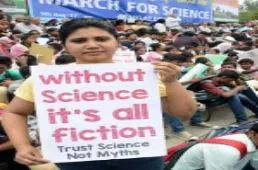
The march from yesterday
These days when everybody is marching for something or the other, scientists dont want to be left behind. A global movement called March for Science was held in different places in the world in April this year and the Indian version was held in some cities on Wednesday. But do the concerns that drove the global marches for science also matter in the Indian case? The call for this march in Indian cities had many problematic assertions(a confident and forceful statement of fact or belief). The march was justified by pointing out that science in India is facing the danger of being eclipsed by a rising wave of unscientific beliefs and religious bigotry(intolerance towards those who hold different opinions from oneself) along with reduction of funding to premier scientific institutions. They added that non-scientific ideas are being promoted and suggested that promoting [a] scientific bent(inclination) of mind can certainly help improve the social health of our country where incidents of witch hunting, honour killing and mob lynching are reported regularly. The march organisers made four suggestions: allocate a certain percentage of the GDP for science and education, stop propagation of unscientific, obscurantist ideas and religious intolerance, insist that education should only impart ideas that are supported by scientific evidence, and finally, enact policies based on evidence-based science. Problems with the narrative This statement as well as the rationale for the March for Science shows how naïve ideas of science continue to be propagated as truth. It also illustrates the power of the scientific community in India that they can continue to utter(say (something) aloud) such sweeping statements about science without worrying about their consequences. Moreover, such recycling of ideas of science and its relation to society is unfair to hundreds of thoughtful scientists. What is worrying about such calls is that they echo the national narrative on science right from Independence. Science in India has constantly legitimised itself by creating a false opposition with beliefs, superstition and religion. The fact that this same narrative continues even today just shows how these ideas are being used as a decoy(a person or thing used to mislead or lure someone into a trap) so that the real questions that the public may ask about Indian science do not get asked. This invocation of superstition, witches, mob action or even caste atrocities seems to suspiciously arise whenever the scientific community wants to demand more funds from the government. There is a striking parallel between the language and narrative of the religious right and those who hold fundamentalist ideas about science. The claim that there is a rising wave of unscientific beliefs is more rhetorical than evidence-based and deploys the strategy of fear-mongering(the action of deliberately arousing public fear or alarm about a particular issue) to make a point. To claim that a scientific bent of mind can get rid of honour and mob lynching is to betray a very poor sense of the nature of social reality and social action. The suggestions that this group made are actually unscientific. To claim that 10% of the GDP should be allocated for education is an unscientific claim and one made without factoring either the fiscal policies on education or the challenges that confront education in India today. They also want to stop the propagation of unscientific ideas, but what are unscientific ideas? The logical fallacy of using extreme examples to push for their agenda is yet another strategy of the fundamentalists. A blinkered(संकीर्ण/सीमित) viewpoint Like the right wing, these scientists too do not give the norms which will define what is scientific all that we have now is that whatever scientists say or do is scientific — analogous to the claim by the right wing(conservative or reactionary.) that whatever they say or do about their religion is that religion. Their ignorance, or perhaps their disinterest, about the rich debates on what constitutes scientific evidence betrays only an unscientific use of the term scientific evidence. Their third suggestion that education should only be about ideas that are supported by scientific evidence is patently(स्पष्ट तौर पर) absurd. True education should be as much about the capacity to critically reflect on science as on everything else we are taught. Imagine the world of education if we followed this condition: we could not teach art, music, literature, languages and quite a significant portion of social science, to list a few. We cannot teach history because it is not scientific and so we will never learn how to understand the history of science. We cannot teach sociology since many theories of sociology will not pass the test of scientific theories, so we cannot really understand how scientific knowledge is created socially. Their final suggestion that policies should be based on evidence-based science aggravates all these mistakes. What these scientists do not seem to realise is that the point of contention is precisely what they take for granted: science, scientific method and scientific temper. What is common between such claims about science and the right wing fundamentalists is that both these camps do not draw upon available material which offers a challenge to their naïve beliefs. Both these camps speak as if what they say is the literal(taking words in their usual or most basic sense) truth. Both of them try to force everybody else into their own beliefs and states of ignorance, many times by using radical oppositions and images (such as lynching). In the case of this national view of science, everything they claim can easily be disproved by referring to the extensive work in the fields of history, philosophy and sociology of science. The difficulty of giving one coherent definition of science or of scientific method, or to have a theory of causality that can help explain how scientific temper can get rid of superstition, caste, religion or even mob lynching should hopefully make them more critical of their own beliefs about science. Yet nothing changes the discourse about science in India. This is truly an example of Science Sena at work. A march based on such an unscientific understanding of science cannot be a march for science. It sounds more like a sermon for science. The scientists should instead participate in a public debate on the nature of science and its practice in India. This will take the mystery of scientific knowledge out of gated institutes and private meeting rooms into the public domain, which after all has been funding science for so long without necessarily seeing the returns for the cost it has incurred(become subject to).Right wing (adjective)
(conservative or reactionary.) दक्षिणपंथी/अपरिवर्तनवादी
Synonyms: conservative, rightist, traditionalist, conventional, old-fashioned, unprogressive.
Example: it is a joke that a Right-wing extremist is someone who believes in reform.
Blinkered (adjective)
having or showing a narrow or limited outlook. संकीर्ण/सीमित
Synonyms: narrow-minded, limited, restricted, inward-looking, parochial, petty-minded, close-minded, myopic, hidebound.
Example: In the racists blinkered mind, no other race is equal to the white race in terms of superiority.
Bent (noun)
(inclination/ a persons natural tendency or urge to act or feel in a particular way) रुझान/झुकाव
Synonyms: propensity, proclivity, leaning, inclination, disposition.
Example: As a young child, the award-winning singer had a bent for music.
Assertion (noun)
(a confident and forceful statement of fact or belief) अभिकथन
Synonyms: declaration, statement, claim, averment, opinion, proclamation, announcement. Pronouncement.
Example: the assertion that all men have certain unalienable rights is set forth in the constitution.
Bigotry (noun)
(intolerance towards those who hold different opinions from oneself) मताग्रह/धर्मान्धता/ पक्षपात
Synonyms: prejudice, bias, partiality, partisanship, sectarianism, fanaticism, dogmatism.
Example: Because Donald is a bigot, he is always looking for a reason to dislike a particular group of people.
Decoy (noun)
(a person or thing used to mislead or lure someone into a trap) लूभाव/प्रलोभन
Synonyms: lure, bait, allurement, enticement.
Example: Tony uses a worm decoy to bait fish.
fear-mongering (adjective)
(the action of deliberately arousing public fear or alarm about a particular issue) भय उत्तेजक
Synonyms: alarming, frightening, daunting.
Example: seeing a violent horror scene in a movie, she made a fear-mongering scream.
Patently (adverb)
clearly without doubt. स्पष्ट तौर पर
Synonyms: clearly, evidently, plainly, conspicuously, overtly, palpably.
Example: It is important to read through contracts before you sign them because some things are not patently stated.
Literal (adjective)
(taking words in their usual or most basic sense) यथाशब्द/शाब्दिक
Synonyms: verbatim exact, precise, plain, simple, bare.
Example: If Jake is talking literally, then you should know he means exactly what he says.
Incur (verb)
(become subject to). उत्तरदायी होना/अपने ऊपर लेना
Synonyms: acquire, bring down on, be subjected to, bring upon oneself, expose oneself to.
Example: It was impossible to incur any debt after a year of being unemployed.

Patriot games at attari wagah
Aug 22, 2017
Beauty and the regulatory beast
Aug 16, 2017
Us north korea stand off sound and fury
Aug 14, 2017
A judgment for the ages
Aug 04, 2017
Cinema & censorship
Jul 29, 2017
Questions of age on sc's ruling on pocso act
Jul 27, 2017





Stay updated with The Hindu Editorial Vocab24 app, your definitive source for breaking news and comprehensive coverage from India and around the globe. Whether it's political developments, business updates, sports highlights, the latest technology trends, or current events, The Hindu brings live, accurate, and reliable news directly to your device.
Don’t fall for sensationalized or fake news shared online. Read and share accurate updates with friends and family through The Hindu Editorial Vocab24 app. Download it today!
News Coverage in The Hindu Editorial Vocab24 App
Breaking News: Receive instant notifications on breaking news stories as they unfold. Stay informed about major events and developments in India and around the world with live blogs, news in shorts videos, and concise articles.
Politics: Get the latest updates on Indian politics, including elections, policy changes, government decisions, and political events that shape the nation.
Business and Economy: Stay ahead in the economic landscape with detailed business news and market analysis. Learn about stock market trends, financial reports, corporate news, and economic developments to make informed investment decisions.
Current Events: Follow stories on social issues, policy changes, global events, and daily current affairs, tailored for UPSC and other competitive exam preparations.
Technology: Keep up with the latest gadgets, innovations, and tech trends. Read expert reviews and analyses in short, concise updates on cutting-edge technology from India and beyond.
Sports: Never miss a moment of your favorite sports. Get live scores, match reports, and expert analysis on cricket, football, tennis, and more.
International News: Stay informed about global events and geopolitical developments, including the Russia-Ukraine war, Israel-Palestine conflict, and other key international stories.
Local News: Stay connected to your community with the latest updates on city events, issues, and local news. Coverage includes hyperlocal updates from cities like Bangalore, Chennai, Delhi, Hyderabad, Mumbai, Kolkata, and more.
Trending Topics: Discover what's trending today with the most talked-about stories and hot topics across India and the world.
Experience journalism that values integrity, accuracy, and reliability. Download The Hindu Editorial Vocab24 app today and stay connected with the world.
Subscribe to our newsletter!







