

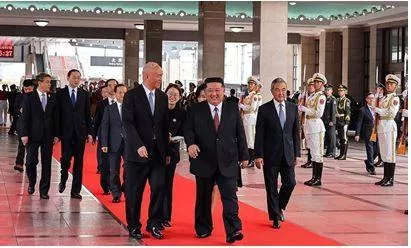
China’s parade is a show of strength after second world war devastation
The ruling Communist Party is amplifying the war anniversary with spruced-up museums, and parade attended by leaders such as Putin and Kim; domestically, the commemoration highlights the nation’s progress while reinforcing support for the Communist Party and President Xi Jinping.Yang Huafeng, a 92-year-old Chinese Army veteran, remembers the troops on horseback and the handful of planes that marked the founding of communist China in 1949.
It was a far cry from the military might the country will display on Wednesday in a parade marking the 80th anniversary of the end of the Second World War. A Japanese invasion before and during the conflict devastated China and left millions of people dead.
“Now you see our country’s planes...no one dares to mess with them,” the veteran told journalists.
The ruling Communist Party is trying to amplify that feeling by playing up the war anniversary with spruced-up museums, new war movies and the military parade, attended by leaders including Russia’s Vladimir Putin and North Korea’s Kim Jong-un.
To the outside world, the missiles, tanks and fighter jets at the parade will be a show of strength as China seeks to portray itself as an alternative to the American-dominated postwar era.
Domestically, the commemoration is an effort to show how far the country has come — and in so doing, build support for the party and its leader, President Xi Jinping. China was a major front in the Second World War, a fact often overlooked in accounts that focus more on the fight for Europe and U.S. naval battles in the Pacific.
“It’s a really important part of the Communist Party’s legitimising narrative as the leader of the Chinese people,” said Emily Matson, a scholar of modern Chinese history who teaches at George Washington universities.
The party did not always make such a big deal about the end of the war. The Communists only came to power four years later, and the bulk of the fighting was done by their rivals, the Nationalist government they overthrew in 1949.
The wartime struggle was less pertinent in the first decades of communist rule, when the focus was on building a socialist state. That began to change in 1978, when the party launched the reforms that propelled China’s economic rise. Its message gradually shifted from the triumph of the working class to nation-building.
Defeat of Japan
“This is a new nationalism in that it begins to include not just the Chinese proletariat but the whole Chinese nation,” Ms. Matson said.
Over time, the defeat of Japan became part of the nation-building story, a starting point marking the end of a long period when foreign powers imposed their will on a weaker China.
Mr. Xi, who came to power in 2012, has stepped up a drive to build a strong country that can no longer be bullied. His government pushed back against new U.S. tariffs this year, forcing President Donald Trump to scale them down.
In 2014, the government designated September 3 — the day after Japan formally surrendered — as Victory Day. The following year, the 70th anniversary of the war’s end, it staged a military parade on the day for the first time.
Party historians define Japan’s defeat as a turning point. It laid an important foundation for the rebuilding of the nation, said Wang Junwei, the chair of the Academic and Editorial Council at the Institute of Party History and Literature. “The victory in the anti-Japanese war transformed the Chinese nation from deep crisis toward great rejuvenation,” he said.
For China, the fighting in what it calls the Chinese People’s War of Resistance Against Japanese Aggression began long before the Japanese attack on Pearl Harbor in 1941.
An extensive exhibition on the war opened in July at a museum on the outskirts of Beijing near the centuries-old Marco Polo Bridge, where skirmishes in 1937 would grow into Japan’s invasion of China.
The party has, since 2017, said the war started even earlier — in 1931, when Japan occupied an area then known as Manchuria. The northeast region is home to the war museum in Shenyang, which reopened last month after an exterior face-lift. Visitors to both museums peered at artifacts of military life and grainy black and white photos of the suffering and the atrocities.
Harvard historian Rana Mitter, who has written extensively on China’s war experience, noticed some changes in the party’s presentation of the war when he visited the exhibition.
One was the playing up of the role of Soviet military pilots who helped China in the early years of the fighting, a nod to China’s deepening relationship with Russia. Mr. Putin held talks with Mr. Xi on Tuesday.
Another was the increased prominence given to China’s role as a founding member of the United Nations. China is positioning itself as a defender of the global order as Mr. Trump rips up established norms on international relations or bends them to his liking.
“The Second World War is being used as the framing to argue that China is now the real inheritor of that 1945 global order,” Mr. Mitter said.
In the 1940s, the U.S., China and other allies confronted and drove back Japan’s military-led expansion into Asia. Eight decades later, the U.S. and Japan are allies confronting a China that has grown more powerful and assertive of what it sees as its rights.
For some neighbours, notably Taiwan and the Philippines, China has become the bully in the South China Sea.
Pm proposes new growth initiatives at g 20
Nov 25, 2025
India s russian oil cuts predate u s tariffs data
Nov 22, 2025









Stay updated with The Hindu Editorial Vocab24 app, your definitive source for breaking news and comprehensive coverage from India and around the globe. Whether it's political developments, business updates, sports highlights, the latest technology trends, or current events, The Hindu brings live, accurate, and reliable news directly to your device.
Don’t fall for sensationalized or fake news shared online. Read and share accurate updates with friends and family through The Hindu Editorial Vocab24 app. Download it today!
News Coverage in The Hindu Editorial Vocab24 App
Breaking News: Receive instant notifications on breaking news stories as they unfold. Stay informed about major events and developments in India and around the world with live blogs, news in shorts videos, and concise articles.
Politics: Get the latest updates on Indian politics, including elections, policy changes, government decisions, and political events that shape the nation.
Business and Economy: Stay ahead in the economic landscape with detailed business news and market analysis. Learn about stock market trends, financial reports, corporate news, and economic developments to make informed investment decisions.
Current Events: Follow stories on social issues, policy changes, global events, and daily current affairs, tailored for UPSC and other competitive exam preparations.
Technology: Keep up with the latest gadgets, innovations, and tech trends. Read expert reviews and analyses in short, concise updates on cutting-edge technology from India and beyond.
Sports: Never miss a moment of your favorite sports. Get live scores, match reports, and expert analysis on cricket, football, tennis, and more.
International News: Stay informed about global events and geopolitical developments, including the Russia-Ukraine war, Israel-Palestine conflict, and other key international stories.
Local News: Stay connected to your community with the latest updates on city events, issues, and local news. Coverage includes hyperlocal updates from cities like Bangalore, Chennai, Delhi, Hyderabad, Mumbai, Kolkata, and more.
Trending Topics: Discover what's trending today with the most talked-about stories and hot topics across India and the world.
Experience journalism that values integrity, accuracy, and reliability. Download The Hindu Editorial Vocab24 app today and stay connected with the world.
Subscribe to our newsletter!







