

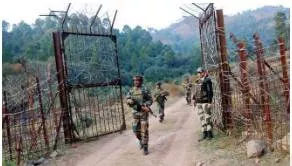
Behind the ‘enemy’ line
“Why do you want to visit our side of the Line of Control (LoC)?” a senior Pakistan army officer asked me. My request to go on a field trip to Pakistan-occupied Kashmir with the Pakistan army for research on ceasefire violations along the India-Pakistan border was still being reviewed by the higher echelons (a level or rank in an organization, a profession, or society.) of the Pakistan Army in Rawalpindi when this question was posed to me. He wanted to know the source of my interest (or ‘angle’). I am not sure if he was convinced by my reply about my hope that my research would contribute to bilateral peace, but an invitation came through a few weeks later.On the other side
Murree was under a thick blanket of snow on a cold December morning at the headquarters of General Officer Commanding of Pakistan Army’s 12 Division. There was a great deal of politeness around, probably camouflaging (hide or disguise the presence of) the disquiet at having someone over from the ‘enemy’ country. For an army that has been conditioned to view India as its existential enemy, this was to be expected. The rest of the ‘field visit’ consisted of visits to Muzzaffarabad, the capital of PoK, and the headquarters of 1-AK brigade which is deployed along the LoC facing Indian troops, the headquarters of 2-AK Brigade in Rawalakot, and finally the General Headquarters in Rawalpindi.
While on our way to the Tatrinote-Chakan Da Bagh trading point from the Battal sector (which the Pakistan Army calls a ‘hot’ area due to the frequent firing there) in the frontlines of Rawalakot, the Brigadier of 2-AK insisted on taking a circuitous (anfractuous) route. The faster road connection to the trading point was right under the Indian posts and was under constant Indian firing. “It would be a pity if you were to be shot by your country’s army,” the Brigadier said half-seriously looking up at what the Pakistan Army calls India’s ‘Jungle Post’ in the foothills of the Pir Panjal mountain range. Ducking (shirk) ‘friendly fire’ while on ‘enemy territory’ seemed sensible.
Some days later, on December 25, a Special Forces Unit of the Indian army crossed the LoC in the Poonch sector and killed three Pakistani soldiers avenging Indian casualties. The area of operation was under 2-AK brigade, close to where the Brigadier had warned of possible ‘enemy fire’.
On day three, we drove down to Rawalpindi from Rawalakot and entered what is normally off-limits for most civilians, most certainly an Indian, the ‘sanctum sanctorum (a very private or highly secret place or area of activity.)’ of the Pakistan Army, its heavily guarded General Headquarters. I handed my passport at the main entrance and the Pakistan visa in it read: “Not valid for restricted/prohibited area”. Nobody seemed to bother, not when you are a guest of the Pakistan Army. The General Headquarters is an impressive world-class campus, as are the security protocols and paraphernalia (miscellaneous articles, especially the equipment needed for a particular activity.) in and around it. I was ushered in (entered) to have a private meeting with the Chief of General Staff (arguably the second most powerful officer in the Pakistan Army) and his deputy. He seemed upbeat (cheerful) about the China-Pakistan Economic Corridor, the Pakistan Army’s ability to handle internal security challenges, and Pakistan’s return to the regional geopolitical scheme of things.
Any visitor to either side of the LoC and the International Boundary (IB) in the Jammu-Sialkot sector would be shocked by the destruction of lives and livelihoods both sides have suffered over the years. With the rampant use of high calibre weapons such as mortars and even artillery in the borders in Jammu and Kashmir, civilian casualties and the destruction of their habitats have risen steadily. The narratives about death and destruction and how children cannot attend school due to ceasefire violations are tragically similar on both sides of the border. On the Indian side, much of this destruction is in the Jammu sector where villages fall in the range of high calibre Pakistani weapons. Notably, there is far more border population on the Pakistani side than on the Indian side which has over the years put the Pakistan Army under a lot of pressure from the local population to control the firing. Unfortunately, this doesn’t seem to have put much pressure on New Delhi.
The one source of relief for the border population is the cross-LoC trade and transit that has persisted despite the ceasefire violations. Despite being disrupted for short periods due to the firing, it is eventually reinstated to the relief of the local Kashmiris on both sides.
Soldiers posted on both sides also live under the constant threat of enemy firing. A senior Border Security Force officer once described this fear: “A man standing on duty at the post is always under tremendous fear of being watched by the opposite side through a telescopic rife and of being shot at any moment.” Being patriotic is one thing, dying avoidable deaths is another.
Uneven deployment
Pakistani military deployment on the LoC is thin compared to the Indian deployment along the counterpart sectors. The Pakistani side has not erected border fences, has stationed fewer troops, constructed fewer posts, and carries out very little patrolling along the zero line. In short, Indian forces enjoy sheer physical dominance along the borders. This seems to have aided the ability of the Indian forces to carry out occassional ‘surgical strikes’, both acknowledged or otherwise, across the LoC. Thanks to its thinner presence on the borders and the asymmetric impact on its border population, there seems to be greater enthusiasm in Pakistan for confidence-building measures to reduce violations on the border. Pakistan, for instance, is keen to formalise the 2003 ceasefire agreement and to discuss other related confidence-building measures.
Not so surprisingly, officers posted on either side of the LoC and IB (in Jammu) are far more open to suggestions of confidence-building measures than the political classes and civilian bureaucracies in the respective capitals. Three suggestions which seem to have some traction on both sides deserve mention. One sure way of reducing the destruction of civilian habitats is to lower the calibre of the violations. To do so, the two sides could consider withdrawing heavy artillery to 50 km behind the zero line. Two, the two Director-Generals of Military Operations, along with their delegations, could consider holding regular meetings every six months. Data show that every time the leaderships of the armed forces meet, ceasefire violations come down — albeit for not too long. Three, establishing more flag meeting points between local commanders and responding quickly to meeting requests could lead to better communication and reduced misunderstandings resulting in fewer ceasefire violations. That the Indian side suffers fewer casualties and lesser destruction of civilian habitats is no reason why we should avoid entering into joint mechanisms to stabilise the borders in Jammu and Kashmir. Over 30 slain (killed) Indian soldiers on the LoC and close to 900 ceasefire violations last year alone (note that each ceasefire violation could be tens of thousands of shots ranging from personal weapons to heavy artillery (large-calibre guns used in warfare on land)) should be reason enough for doing so.
Author: Happymon Jacob is Associate Professor of Disarmament Studies, Centre for International Politics, Organisation and Disarmament, School of International Studies, JNU




Top court quashes FIRs against Gen Z protesters
Sep 04, 2026







Stay updated with The Hindu Editorial Vocab24 app, your definitive source for breaking news and comprehensive coverage from India and around the globe. Whether it's political developments, business updates, sports highlights, the latest technology trends, or current events, The Hindu brings live, accurate, and reliable news directly to your device.
Don’t fall for sensationalized or fake news shared online. Read and share accurate updates with friends and family through The Hindu Editorial Vocab24 app. Download it today!
News Coverage in The Hindu Editorial Vocab24 App
Breaking News: Receive instant notifications on breaking news stories as they unfold. Stay informed about major events and developments in India and around the world with live blogs, news in shorts videos, and concise articles.
Politics: Get the latest updates on Indian politics, including elections, policy changes, government decisions, and political events that shape the nation.
Business and Economy: Stay ahead in the economic landscape with detailed business news and market analysis. Learn about stock market trends, financial reports, corporate news, and economic developments to make informed investment decisions.
Current Events: Follow stories on social issues, policy changes, global events, and daily current affairs, tailored for UPSC and other competitive exam preparations.
Technology: Keep up with the latest gadgets, innovations, and tech trends. Read expert reviews and analyses in short, concise updates on cutting-edge technology from India and beyond.
Sports: Never miss a moment of your favorite sports. Get live scores, match reports, and expert analysis on cricket, football, tennis, and more.
International News: Stay informed about global events and geopolitical developments, including the Russia-Ukraine war, Israel-Palestine conflict, and other key international stories.
Local News: Stay connected to your community with the latest updates on city events, issues, and local news. Coverage includes hyperlocal updates from cities like Bangalore, Chennai, Delhi, Hyderabad, Mumbai, Kolkata, and more.
Trending Topics: Discover what's trending today with the most talked-about stories and hot topics across India and the world.
Experience journalism that values integrity, accuracy, and reliability. Download The Hindu Editorial Vocab24 app today and stay connected with the world.
Subscribe to our newsletter!







