

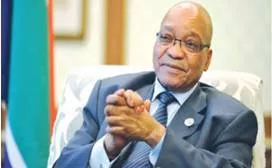
Will corruption end with zuma
Was it a controversial indictment (any charge, accusation, serious criticism, or cause for blame) of corruption that led to the resignation of South African President Jacob Zuma on 14 February? Zuma has all along denied any wrongdoing.Jacob Zuma, one of the colourful compatriots of Nelson Mandela, was elected as the fourth president in May 2009 – that is, since the end of apartheid (any system or practice that separates people according to color, ethnicity, caste, etc) in 1994. Earlier, Zuma became the president of the African National Congress (ANC) in 2007, which paved the path for him to be the president of South Africa. However, the allegations of corruption and scandals kept haunting Zuma long before he became the leader of ANC and kept chasing him even when he became the president.
Among the allegations was one involving the $5 billion weapons acquisition deal of 1999, when he was the deputy president$20.5 million of tax payers’ money to upgrade his private residence in rural Nkandla. The court ruled that Zuma has to pay back a large amount to the government. While these cases were quashed (reject or void, especially by legal procedure), they kept coming back to the court.
As Zuma battled these cases, his hold over the ANC was firm and in 2012 he was re-elected president of ANC. And in May 2014, he was re-elected as president of South Africa for the second term. The latest allegation against Zuma was rather unusual. He was accused of having a corrupt relationship with the Indian-born Gupta family. The Guptas apparently interfered in ministerial appointments and obtained lucrative government contracts. Both the Guptas and Zuma have denied these charges.
What is most extraordinary is the struggle for leadership within the ANC that has defined the post-apartheid governments of South Africa. The party continues to ride on the towering reputation of Nelson Mandela. Unfortunately, the party has always put petty politics ahead of the people.
The political landscape is characterised by multi-party parliamentary democracy. But the exclusive dominance of the ANC and the lack of credible opposition have impinged (to produce an effect, usually an unwanted one) upon the depth and quality of democracy in the country. ANC has refused to reform the current Proportional Representation system that allows the party to dominate the numbers in the 400-seat parliament. In the lower house, the ANC currently has 249 seats. Lack of democratic consolidation (the action or process of making something stronger or more solid) has in turn led to failure to promote accountability.
A little investigation into the leadership of ANC reveals that every party vice-president had conspired to oust (drive out or expel (someone) from a position or place.),) the president. Whoever got to be president of the party ended up as president of South Africa. The reason being the party charter, which requires the party members in parliament to endorse the party leader to the post of president.
Every time a corruption charge came up, Zuma was threatened with no-confidence motion, engineered by his deputies in the party. But somehow he survived those threats by manipulating the party members in parliament. On 13 February, Cyril Ramaphosa, who became president of ANC in December 2017, asked Jacob Zuma to resign.
At first, he refused but when the parliament was about to move the ninth no-confidence motion, Zuma resigned. Clearly, the struggle for leadership was in full swing. Besides, with the presidential election scheduled in 2019, ANC was getting jittery (nervous or unable to relax.),) about Zuma’s unpopularity. To maintain its hold on power, ANC finally decided to oust him despite the risks of a backlash from the ousted leader.
Apart from scandals, the economic recession was responsible for “peoples’ president” Zuma’s undoing. Actually, Zuma oversaw a steady decline of the economy with high unemployment and poor economic growth since assuming the presidency. In 2011, the GDP was the highest at $416 billion. But then, there has been steady shrinkage over the past years and in 2016 it stood at $294.84 billion. Unemployment also rose over the years and currently stands over 26.7 per cent.
Rating agencies have downgraded the country’s bond to junk status. Government debt also rose to 51.6 per cent of the GDP in 2016. The Rand (SA currency) also progressively lost its value during Zuma’s presidency. Analysts say that about $10 billion of tax payers’ money have been stolen since Zuma became president.
President Cyril Ramaphosa (65), one of the richest businessmen of South Africa, will have two clear problems to address. First, to turn around the economy from doldrums. Secondly, to get rid of corruption from ANC and the government, particularly those entrenched (establish (an attitude, habit, or belief) so firmly that change is very difficult or unlikely) vested quarters that were close to Jacob Zuma.
The other challenge that Ramaphosa will have to face is to rebuild trust with the labourorganisations that will help him gain votes at the next presidential election. He will also have to keep the current ANC Deputy President David Dabede Mabuza under control and in good humour not to rock the presidential boat.
Leaders in tribe-dominated Africa have a particular psychic trait. Once they get to the top post they tend to become tribal chieftains. They shun (persistently avoid, ignore, or reject (someone or something) through antipathy or caution) the constitution and start ruling for personal gains. Jacob Zuma is an isiZulu. He built his support base in Kwa Zulu-Natal, ANC’s region with the largest membership, and got support from his ethnic community.
It is sad that Zuma, who had served jail term with Nelson Mandela in Robben Island, did not live up to the ideals of Mandela. Mandela’s “Rainbow Nation” is still largely divided between the whites and the blacks although apartheid is defeated.
Corruption at the highest level in most countries has spawned (to cause (something) to develop or begin) because of lack of true democratic institutions. Be it in the ruling party or in the government, when democracy is forsaken, a culture of authoritarianism emerges without any accountability. That spells disasters. Can Cyril Ramaphosa deter corruption in South Africa or succumbto tribalism?


Philippines president rodrigo duterte slams unhcr
Apr 06, 2018
Oli to take up currency ban issue with pm modi
Apr 02, 2018
Curbing the khaps
Apr 01, 2018





Stay updated with The Hindu Editorial Vocab24 app, your definitive source for breaking news and comprehensive coverage from India and around the globe. Whether it's political developments, business updates, sports highlights, the latest technology trends, or current events, The Hindu brings live, accurate, and reliable news directly to your device.
Don’t fall for sensationalized or fake news shared online. Read and share accurate updates with friends and family through The Hindu Editorial Vocab24 app. Download it today!
News Coverage in The Hindu Editorial Vocab24 App
Breaking News: Receive instant notifications on breaking news stories as they unfold. Stay informed about major events and developments in India and around the world with live blogs, news in shorts videos, and concise articles.
Politics: Get the latest updates on Indian politics, including elections, policy changes, government decisions, and political events that shape the nation.
Business and Economy: Stay ahead in the economic landscape with detailed business news and market analysis. Learn about stock market trends, financial reports, corporate news, and economic developments to make informed investment decisions.
Current Events: Follow stories on social issues, policy changes, global events, and daily current affairs, tailored for UPSC and other competitive exam preparations.
Technology: Keep up with the latest gadgets, innovations, and tech trends. Read expert reviews and analyses in short, concise updates on cutting-edge technology from India and beyond.
Sports: Never miss a moment of your favorite sports. Get live scores, match reports, and expert analysis on cricket, football, tennis, and more.
International News: Stay informed about global events and geopolitical developments, including the Russia-Ukraine war, Israel-Palestine conflict, and other key international stories.
Local News: Stay connected to your community with the latest updates on city events, issues, and local news. Coverage includes hyperlocal updates from cities like Bangalore, Chennai, Delhi, Hyderabad, Mumbai, Kolkata, and more.
Trending Topics: Discover what's trending today with the most talked-about stories and hot topics across India and the world.
Experience journalism that values integrity, accuracy, and reliability. Download The Hindu Editorial Vocab24 app today and stay connected with the world.
Subscribe to our newsletter!







