

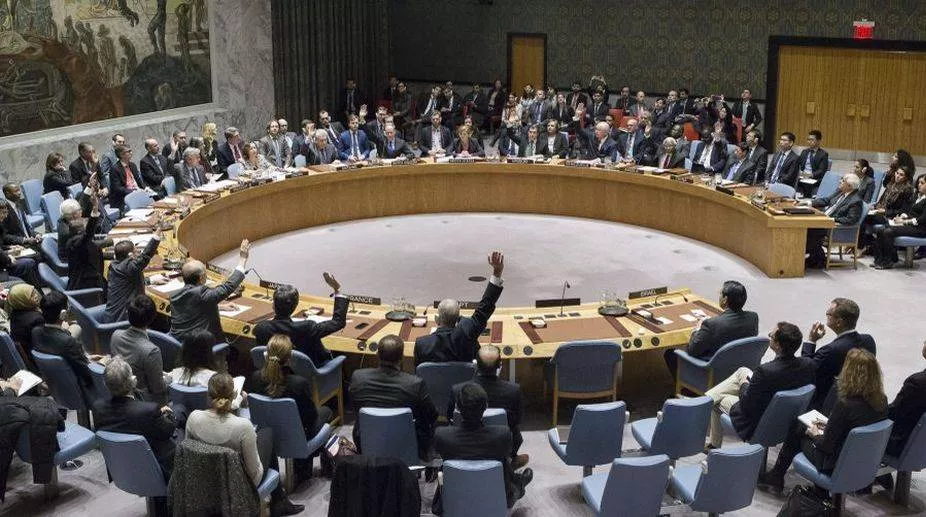
Vulnerable votes
An evaluation of the countries that voted in ‘favour’ or ‘against’ or ‘abstained’ or even refused to show up (for example, Ukraine) reflects the politics, compulsions and vulnerabilities that were at play against the bluster and intimidation of President Donald Trump’s controversial move to declare Jerusalem as the capital of Israel. While an overwhelming 128 countries voted in favour of the motion condemning the brazen US move, 9 voted against the motion and 35 abstained from the vote-count. The draft resolution against the US decision had appealed for ‘reversal of the negative trends on the grounds that are imperiling the two-State solution’, and expressing ‘deep regret at recent decisions concerning the status of Jerusalem’. It had finally demanded, ‘that all States comply with Security Council resolutions regarding the Holy City of Jerusalem, and not to recognize any actions or measures contrary to those resolutions’. Predictably, the draft resolution was vetoed by the US 14-1-0 to scuttle further embarrassment for President Trump.The run-up to the vote-count had led to unprecedented threats, with the US ambassador to the UN, Nikki Haley, openly warning and alluding to economic retribution ~ “Let them vote against us, we’ll save a lot. We don’t care. But this isn’t like it used to be where they could vote against you and then you pay them hundreds of millions of dollars and nobody knows what they’re doing”. He even somewhat incredously vowed to “take names”. Thus the seven other nations besides the US and Israel, which rejected the draft proposal, included Guatemala, Honduras, Marshall Islands, Micronesia, Nauru, Palau and Togo. A careful look into the affairs of these nations would suggest that they survive on US assistance. Micronesia is bound by a Compact of Free Association with the US, which ensures ‘substantial financial support’ and in return Micronesia is the only country that had a 100 per cent matching voting pattern to the US in the Security Council. Similarly, in 2009 the Palauan Prime Minister had famously explained its voting pattern in the UNSC by stating, “We have a very strong relationship with the United States and we don’t want to jeopardise that relationship, because it would affect Palau’s economic welfare”.
Clearly economic coercion works in the high table of international diplomacy, where technically the vote of a country like Tuvalu (which ‘abstained’) with a stated population of 10,640 (2012 census) would be equal to the vote of India, with a 1.3 billion population.
The ambiguity of ‘abstain’ votes is suggestive of the compulsions of compromise that override the assertion of long-held positions and the basic instincts of nations. While Vanuatu, Solomon Islands, Kiribati, Haiti may have had economic considerations that were perhaps additionally tempered with a principled stand, South Sudan too would have considered the fact that the US funds account for more than the next top-four donors, combined.
Even Canada, known for its progressive, liberal and ‘inclusive’ politics, decided to ‘abstain’, whispers gathered momentum of the ‘work-in-progress’ status of the crucial and impending ‘North American Free Trade Agreement’ which could have lulled both Canada and Mexico to get bullied into taking the middle path. Other major countries such as Australia, Argentina, Philippines and Colombia were part of the 35 ‘abstains’, maintaining their own nebulous logic that ultimately intended to avoid a backlash from the US.
Delegations from 21 nations simply refused to show up, unlike the deliberate ‘abstain’ vote. However, the politics of reasoning and domestic factors ensured that the majority-bloc of 128 countries that included the EU countries, India, Russia, China, Japan and the entire Islamic bloc stood-up to President Trump’s threat of dire consequences. Ironically, this draft resolution was initiated by Egypt, the second biggest recipient of US aid (after Israel). The decision to support the cause of Palestine may be a principle of morality, historically-consistent and a logical step in the context of countries like India. However, for the major recipients of US aid, notably Iraq, Afghanistan, Jordan and Egypt it was beyond the carrot of aid. It pertains to regime-survival given the emotive value of Palestine amongst its populace. Furious diplomacy is absolutely no substitute for survival instincts, and that is exactly what the voting pattern conveyed. Beyond the abrasive US diplomacy, Israel’s Prime Minister Benjamin Netanyahu’s personal networking and strategic engagements, the support of India, China and Russia also came a cropper. India had voted in favour of 15 of the previous Palestine-related resolutions in the 72nd UN General Assembly session and the 16th concerning America’s controversial move over Jerusalem, was no different.
Voting patterns in the Security Council can also reflect dynamic opportunism (realpolitik) towards the evolving geopolitics. The crucial veto vote by China against declaring the Pakistan-based terrorist Maulana Masood Azhar as a global terrorist, is symptomatic of the tactical power-play and diplomatic muscle-flexing by Beijing against India, its regional adversary.
The first time ever that Beijing had cast a negative vote was in 1972, concerning the admission of Bangladesh as a UN member.
Similarly Russia (along with China) has vetoed seven draft resolutions against Syria in recent times, which could have led to punitive action against the Russia-supported-Assad regime. The subtle-nuances of varying sovereign positions come alive in the gap between the text that is initially proposed, versus the finally included text in the draft resolution. For example, Pyongyang’s allies ~ China and Russia ~ had insisted on watering down the initial severity in the draft resolution against North Korea, before supporting the resolution.
The Security Council is becoming increasingly irrelevant with the unauthorized military strikes in Iraq, annexation of Crimea, Saudi strikes in Yemen and with Nikki Haley calling the recent draft resolution “an insult”, adding that, “the United States will not be told by any country where we can put our embassy.” It is now a platform of both, reiterating the hallowed sovereign positions and morality, as indeed of subservience, intimidation and realpolitik. Today, the literal voting patterns expose and hide the reality and evolving dynamics, in equal measure.
Courtesy : The Statesman Editorial



Philippines president rodrigo duterte slams unhcr
Apr 06, 2018
Oli to take up currency ban issue with pm modi
Apr 02, 2018
Curbing the khaps
Apr 01, 2018





Stay updated with The Hindu Editorial Vocab24 app, your definitive source for breaking news and comprehensive coverage from India and around the globe. Whether it's political developments, business updates, sports highlights, the latest technology trends, or current events, The Hindu brings live, accurate, and reliable news directly to your device.
Don’t fall for sensationalized or fake news shared online. Read and share accurate updates with friends and family through The Hindu Editorial Vocab24 app. Download it today!
News Coverage in The Hindu Editorial Vocab24 App
Breaking News: Receive instant notifications on breaking news stories as they unfold. Stay informed about major events and developments in India and around the world with live blogs, news in shorts videos, and concise articles.
Politics: Get the latest updates on Indian politics, including elections, policy changes, government decisions, and political events that shape the nation.
Business and Economy: Stay ahead in the economic landscape with detailed business news and market analysis. Learn about stock market trends, financial reports, corporate news, and economic developments to make informed investment decisions.
Current Events: Follow stories on social issues, policy changes, global events, and daily current affairs, tailored for UPSC and other competitive exam preparations.
Technology: Keep up with the latest gadgets, innovations, and tech trends. Read expert reviews and analyses in short, concise updates on cutting-edge technology from India and beyond.
Sports: Never miss a moment of your favorite sports. Get live scores, match reports, and expert analysis on cricket, football, tennis, and more.
International News: Stay informed about global events and geopolitical developments, including the Russia-Ukraine war, Israel-Palestine conflict, and other key international stories.
Local News: Stay connected to your community with the latest updates on city events, issues, and local news. Coverage includes hyperlocal updates from cities like Bangalore, Chennai, Delhi, Hyderabad, Mumbai, Kolkata, and more.
Trending Topics: Discover what's trending today with the most talked-about stories and hot topics across India and the world.
Experience journalism that values integrity, accuracy, and reliability. Download The Hindu Editorial Vocab24 app today and stay connected with the world.
Subscribe to our newsletter!







