

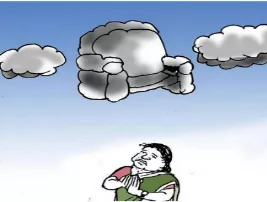
Uneasy lies the head
Tamil Nadu politics is at a murky (संदेहास्पद/अँधेरे में होना) crossroads, and a dose of realism is needed while taking stock of the choices that its political leadership now faces. It has been a little more than two months since the demise of Jayalalithaa. The veil of secrecy drawn around her in her final days generated as much angst amongst the masses of her supporters, especially in the All India Anna Dravida Munnetra Kazhagam (AIADMK), as it fuelled speculation over the cause of her death, including suspicions of foul (offensive to the senses) play. Even as she battled for life for 75 days, her nonagenarian (a person who is between 90 and 99 years old.) rival, Dravida Munnetra Kazhagam (DMK) supremo M. Karunanidhi fell seriously ill. He recuperated (सुधार होना/पुनः स्वस्थ होना) , but he’s no longer in the thick of public and party affairs. With the exit of these two titans (extremely important person) of Tamil Nadu politics, leaders who shaped the very destiny of the State for nearly half a century, the power vacuum within both parties had to be filled quickly. For the DMK, a succession plan has been in place for years, and so it was a fairly smooth transition for “Thalapathy” M.K. Stalin to step into the shoes of the “Thalaivar”, his father, by taking over as acting president of the party. He now has more than four years to build momentum for his party to bid for power in the next Assembly election. Mr. Stalin’s prospects hinge as much on being able to rally DMK troops across the State as adroitly (दक्षतापूर्वक) as his father used to, as they do on getting the DMK to be a smart opposition party, drawing attention to the failings of the AIADMK government. Questions of timing This brings us to the travails (painful or laborious effort.) of V.K. Sasikala, Jayalalithaa’s long-time confidant and presumed backseat influencer, whose foray into the arena of official power has been dramatic yet purposeful. At the present juncture she occupies an unenviable position in Tamil Nadu politics: she has clearly carved out a niche (a comfortable or suitable position in life or employment.) for herself at the very heart of the AIADMK, yet is regarded with an element of distaste by the wider cohort of party cadres and the general public. Why, with the impending verdict of the Supreme Court in the disproportionate assets case, did she make a bid for the Chief Minister’s office last weekend? One argument is that if she had attempted this manoeuvre (चाल/युक्ति) any earlier, her intentions toward Jayalalithaa and Tamil Nadu would have been seen to be suspect and she may have risked strengthening the hands of potential rivals. On the flip side, waiting too much longer would have allowed public opinion to crystallise firmly around O. Panneerselvam, who served as the incumbent (पदस्थ) Chief Minister until Ms. Sasikala saw fit to claim the throne last weekend. Indeed matters may have come to a head already after Mr. Panneerselvam registered his protest at Jayalalithaa’s memorial on Tuesday night. Leaving aside the risky gambit of seeking the chief ministership when a judicial axe could cut that ambition short in a matter of days, Ms. Sasikala may have also weakened her position by failing to capitalise on last month’s remarkable “jallikattu movement”. Had she stepped into the fight confidently but humbly, for example through visible pleas to Prime Minister Narendra Modi for an expedient (लाभकारक/सामयिक), favourable solution to the stalemate (गतिरोध) between the proponents of the bull-taming sport and animal rights activists, that may have been a golden opportunity to firm up her credentials with the people of Tamil Nadu, regardless of the judicial outcome. Instead she squandered (व्यर्थ करना) that opportunity and has double-faulted on her strategy by being seen to be pre-empting the Supreme Court verdict due next week. If she survives that ruling, Ms. Sasikala’s future would however look immeasurably brighter, with no small thanks due to Jayalalithaa’s parting gift of last May’s sweeping Assembly election victory. That win would bestow Ms. Sasikala with more than four years to accumulate political capital and the goodwill of Tamil Nadu’s electorate, the logical next step after she consolidates intra-party support. It cannot be overlooked that in the short span of time since Jayalalithaa’s death on December 5, 2016, Ms. Sasikala worked assiduously (परिश्रम से) to ensure that the highest few rungs of the AIADMK were won over to her side. Building bridges This was particularly salient (मुख्य/विशेष) for leaders of the Gounder caste who may have potentially been engulfed (घिरे होना/परिग्रहित) by insecurity about the direction in which policy and resource allocation would tilt under a Thevar Chief Minister. Among these leaders, K.A. Sengottaiyan, a member of the AIADMK since the time of M.G. Ramachandran, a staunch (निष्ठावान) Jayalalithaa loyalist, and a widely respected leader of Erode district, was apparently upset about being excluded from the Cabinet headed by Mr. Panneerselvam. Having been side-lined earlier by Jayalalithaa, he hoped to return as a Minister after her death. Upon learning of his dissatisfaction Ms. Sasikala convinced him to back her, and in a deft move she thus neutralised the biggest stumbling block to her aspirations. Ms. Sasikala also benefitted from serendipitous (occurring or discovered by chance in a happy or beneficial way.) shifts of mood with some prominent AIADMK leaders, such as Lok Sabha Deputy Speaker M. Thambidurai. A Gounder and veteran party man, he had hoped to step into Jayalalithaa’s shoes. When that did not happen, he chose to dislodge (हटाना) Mr. Panneerselvam by openly pleading with Ms. Sasikala to take over as Chief Minister. In certain cases, however, Ms. Sasikala will have to carry on the campaign to blunt criticism by her colleagues. K.P. Munusamy, a Gounder leader from Krishnagiri district, is one such AIADMK leader. Ms. Sasikala appealed to him to remain in the party despite his dissatisfaction over his position, and he initially relented (नरम पड़ जाना) . Yet he went on to become the first open challenger to her rise when he hit out at her brother and husband for interfering in party affairs. She has thus far refrained from acting against him. The down-side of these Machiavellian machinations is a hardening of the public perception of Ms. Sasikala and her family as manipulators, which is perhaps undeserved in some respects. First, almost all successful Tamil politicians, including Jayalalithaa and Mr. Karunanidhi, have in some shape or form engaged in what may be termed as “manipulation”. If not, why do judicial cases and the police machinery turn adversely against a leader who has lost an election to a bitter rival? Why do political opponents and dissenters sometimes suddenly go quiet? Have no Tamil politicians enriched themselves personally while in office? The highest irony of this state of affairs is that the Tamil Nadu electorate has often indulged its leaders these excesses from time to time, even as it has punished them on occasion with a crushing swing defeat in Assembly elections. Caste and welfare policies From a political economy perspective, what makes Tamil Nadu unique is its penchant (प्रवृत्ति) for empowering leaders who quickly centralise political power in their own hands, either through sheer force of the personality cults that they build around themselves or based on party discipline and organisational prowess. The deeper factor driving this trend is the State’s caste distribution, which is highly dispersed, which implies that, historically, only centralised political power has ensured that resources earmarked for mass welfare schemes, the mainstay of governance in Tamil Nadu, are effectively allocated down the line of an efficient bureaucracy, instead of getting frittered away (to waste something) as “rent” to political factions and local bosses. In that regard the self-elevation of Ms. Sasikala is perfectly in line with the history of Dravidian party leadership, as is the consanguinity (समरक्तता) -based rise of Mr. Stalin. Indeed, she lacks the formal governance experience of many other capable leaders around her, yet she will have to reckon with (गम्भीरता से लेना/ध्यान रखना) winning a seat in the State Assembly within six months of being sworn in as Chief Minister, and will then have time to build up her credentials in that regard. Equally it is a valid criticism that she likely ruled from the shadows during the years of Jayalalithaa’s reign, and it is not known how rapacious (aggressively greedy or grasping.) any government helmed by her would be. However, the fact that she is no worse than so many other Tamil leaders who’ve sought to rule the State should give pause to those who seek to demonise her in these early days. That she fits the profile of Tamil Nadu’s past leaders, each of them a powerful, centralising figure, much more than the genuflection (In the old days, when you came in front of your social superiors, you were expected to genuflect: that is, bend your knee and bow submissively.)- prone Mr. Panneerselvam, cannot be overlooked. The last thing that the State needs is the persisting cloud of uncertainty that now hangs over Fort St. George. The willingness to carry on playing Musical Chairs in politics should be measured against the risk of instability in a State that is still coming to grips with the string of shocks that it has faced in recent times.Adroitly (adverb)
In a clever or skilful way. दक्षतापूर्वक
Synonyms: Cleverly, Skillfully, Competently, Capably
Example: Because Leonard is adroit at mental calculations, he is able to effortlessly solve complicated math problems.
Incumbent (adjective)
Of an official or regime) currently holding office. पदस्थ
Synonyms: Current, Existing, Present, In Office, In Power, Reigning
Example: If the incumbent governor dies, his lieutenant governor will take over his office.
Expedient (adjective)
Convenient and practical/ suitable for achieving a particular end in a given circumstance. लाभकारक/सामयिक
Synonyms: Advantageous, Useful, Beneficial, Profitable, Gainful
Example: After being surrounded by two dozen police officers, the criminal felt it was an expedient time to lower his weapon.
Stalemate (noun)
A situation in which no progress can be made or no advancement is possible गतिरोध
Synonyms: Dead End, Deadlock, Impasse, Standstill
Example: A stalemate was reached when neither of the chess players could make a legitimate move.
Squander (verb)
Allow (an opportunity) to pass or be lost. /waste in a reckless and foolish manner. व्यर्थ करना
Synonyms: Waste, Misspend, Misuse, Throw Away, Fritter Away, Spend Unwisely, Make Poor Use Of, Be Prodigal With.
Example: Dina didn’t want to squander her good mood in the darkness of a movie theater, so she persuaded her friends to go dancing instead.
Assiduously (adverb)
With great care and perseverance. परिश्रम से
Synonyms: Diligently, Carefully, Laboriously, Arduously, Indefatigably
Example: With your assiduous attempt at learning Spanish, I think you will master the language in no time.
Salient (adjective)
Most noticeable or important. मुख्य/विशेष
Synonyms: Important, Main, Principal, Major, Chief, Noticeable, Remarkable, Prominent
Example: Since class was ending, my teacher had to rush and make the salient points about today’s lecture.
Engulf (verb)
To be surrounded or covered by something completely. घिरे होना/परिग्रहित
Synonyms: Overwhelm, Inundate, Encompass, Envelop
Example: The lava will begin to engulf the abandoned city in six hours.
Staunch (adjective)
Very loyal and committed in attitude. निष्ठावान
Synonyms: Stalwart, Loyal, Faithful, Trusty, Committed, Devoted, Reliable
Example: Although Joseph considers himself to be a staunch Republican, he has not voted for a Republican candidate in over six years.
Dislodge (verb)
Remove from a position of power or authority/ knock or force out of position. हटाना
Synonyms: Remove, Move, Shift, Displace, Evict
Example: Government opponents failed to dislodge the Prime Minister even after the failed scheme.
Relent (verb)
Abandon or mitigate a severe or harsh attitude, especially by finally yielding to a request/ become less severe or intense. नरम पड़ जाना
Synonyms: Slacken, Soften, Ease, Ebb
Example: When the journalist didn’t relent and release the name of her source, she was jailed for obstructing justice.
Penchant (noun)
A strong and continued inclination./ tendency to do something. प्रवृत्ति
Synonyms: Affinity, Predilection, Proclivity, Propensity, Tendency
Example: To be an exceptional baseball player, you must have skill and a penchant for the game itself.
Fritter away (verb)
To waste something/ Squander or waste little by little . गंवाना/व्यर्थ करना
Synonyms: Squander, Waste, Misspend, Trifle Away
Example: I frittered my lottery winnings away on bad investments.
Reckon with (verb)
Take into account. गम्भीरता से लेना/ध्यान रखना
Synonyms: Contemplate, Regard, Cogitate
Example: After declaring him as a CM candidate, he has started to reckon with unreliable party members.
Rapacious (adjective)
Aggressively greedy or grasping. अति लोलुप/लालची
Synonyms: Grasping, Greedy, Covetous, Usurious
Example: She inherited fortunes from her previous four husbands, who all died under mysterious circumstances, so it’s pretty clear that Delilah is nothing but a rapacious black widow.
Ec complicit in haryana vote theft rahul
Nov 08, 2025







Stay updated with The Hindu Editorial Vocab24 app, your definitive source for breaking news and comprehensive coverage from India and around the globe. Whether it's political developments, business updates, sports highlights, the latest technology trends, or current events, The Hindu brings live, accurate, and reliable news directly to your device.
Don’t fall for sensationalized or fake news shared online. Read and share accurate updates with friends and family through The Hindu Editorial Vocab24 app. Download it today!
News Coverage in The Hindu Editorial Vocab24 App
Breaking News: Receive instant notifications on breaking news stories as they unfold. Stay informed about major events and developments in India and around the world with live blogs, news in shorts videos, and concise articles.
Politics: Get the latest updates on Indian politics, including elections, policy changes, government decisions, and political events that shape the nation.
Business and Economy: Stay ahead in the economic landscape with detailed business news and market analysis. Learn about stock market trends, financial reports, corporate news, and economic developments to make informed investment decisions.
Current Events: Follow stories on social issues, policy changes, global events, and daily current affairs, tailored for UPSC and other competitive exam preparations.
Technology: Keep up with the latest gadgets, innovations, and tech trends. Read expert reviews and analyses in short, concise updates on cutting-edge technology from India and beyond.
Sports: Never miss a moment of your favorite sports. Get live scores, match reports, and expert analysis on cricket, football, tennis, and more.
International News: Stay informed about global events and geopolitical developments, including the Russia-Ukraine war, Israel-Palestine conflict, and other key international stories.
Local News: Stay connected to your community with the latest updates on city events, issues, and local news. Coverage includes hyperlocal updates from cities like Bangalore, Chennai, Delhi, Hyderabad, Mumbai, Kolkata, and more.
Trending Topics: Discover what's trending today with the most talked-about stories and hot topics across India and the world.
Experience journalism that values integrity, accuracy, and reliability. Download The Hindu Editorial Vocab24 app today and stay connected with the world.
Subscribe to our newsletter!







