

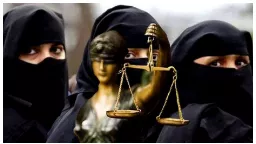
Towards liberation~ii
Sensing the direction of the wind, the AIMPLB has now changed tack (नीति/रुख़/पथ) . In a desperate attempt to protect its monopoly, it is now advocating that the nikah-nama, which is a contract for marriage between consenting adults can have clauses for invoking the triple talaq by both husband and wife. Apart from the question of how many Qazis in the country would abide by (का पालन करना) this diktat (आदेश) , it also brings out the tenuous (छोटा व कमजोर) nature of their argument about triple talaq being fundamental to Islam. Even the analogy of Muslim majority countries, which have abolished triple talaq, might not be valid and appropriate in the Indian situation in view of the fundamental rights to equality before law (Article 14), right against discrimination on grounds of religion, race, caste or sex (Article 15), and right to life and personal liberty (Article 21) guaranteed in our Constitution. But we may still draw some very useful lessons. The objective of equality and gender justice are perhaps best served by the Tunisian law, the Tunisian Code of Personal Status, 1956, under which a husband cannot unilaterally divorce his wife through verbal pronouncements; he has to first consult a judge and convince him. Marriage and divorce are controlled by the State, and all divorce proceedings must be held before a judge, with a court directed effort at reconciliation being mandatory. Each party has the right to ask for divorce, but each has to convince the judge about the reasons thereof. The judge can order a compensation to be paid by either the husband or the wife, depending on which party has been harmed by the other. Iraq was one of the first Arab countries to replace shariah courts with government-run Personal Status Courts in 1959. According to Iraq’s Personal Status Law, three verbal or gestural repudiations (इनकार/ अस्वीकरण) pronounced at once will count as only one divorce, but both husband and wife can ask for separation which is to be decided by the court. Sri Lanka, a Buddhist nation, has also enacted a law for the minority Muslims that allows divorce through talaq by the husband only, after notifying a Muslim judge (Qazi) and after 30 days to allow for reconciliation attempts by relatives and elders. In Pakistan, the husband must pronounce talaq in three successive menstrual cycles, not in a single sitting. Most Muslim nations, including Bangladesh, Jordan, Egypt, Indonesia, United Arab Emirates and Qatar have adopted a similar law on triple talaq, which is based on the interpretation of the 13th century Egyptian scholar Ibn Taimmiyah. In Pakistan, the husband must first give notice to a Government appointed council that will attempt reconciliation before the divorce becomes valid. The wife does not have the power to seek separation, but can remarry her ex-husband after divorce. By allowing a similar system, the harshness of the existing practice in India can surely be minimised, and some sections of the clergy can perhaps be brought around, but that will fall short of the needs of gender justice and fundamental rights. The fact of the matter is that talaq is inherently discriminatory against women and denies them not only their rights but dignity as well. Tahir Mahmood in his book, Introduction to Islamic Law, co-authored with Saif Mahmood, had quoted the Deobandi theologian Ashraf Ali Thanvi (1863-1943) ~ “A man pronounces a revocable (खंडन करने योग्य) talaq. He reconciles and resumes cohabitation. A few years later, under some provocation he pronounces a revocable talaq once again. On recovering from the provocation, he again resumes cohabitation. Now two talaqs are over. Thereafter whenever he pronounces a talaq it will be counted as the third talaq which will dissolve the marriage forthwith.” The right is absolute for men; women will always be at the receiving end, whether they receive the three talaqs in a single or three separate sittings. The logical inference is only a uniform civil code, as mandated in Article 44 of the Constitution under the Directive Principles of State Policy, which says that the State shall endeavour to secure for citizens a uniform civil code throughout the territory of India. This can resolve all the contradictions that will arise from substitution of the present system with any other system that derives its sustenance and sanctity (निर्मलता/पवित्रता) primarily from religion. A commendable example is Turkey, which under Mustafa Kemal Ataturk had adopted the Swiss Civil Code in 1926, discarding (छोड़ना//हटाना/निकाल देना) the Islamic laws governing divorce and marriage. The code was revised in 1980, but still remains insulated from religious footprints. We have to bite the bullet and recognize unapologetically that religion here is at the root of the problem. As long as we give primacy to religious considerations in matters of marriage, women will continue to suffer from inequality and discrimination, and the ostrich-like mentality of the AIMPLB will continue to rule the roost. In fact, that is how it came into existence in the first place, by exploiting the persecution complex among members of the minority community. In the early 1970s, Indira Gandhi had tried to control the dominance of the Sharia Law of 1937 applicable to Indian Muslims, and the then law minister H R Gokhale introduced the Adoption Bill in Parliament declaring it as “the first step towards the Uniform Civil Code”. This predictably sparked an outcry among the Muslim clergy who started whipping up passion over what it called the Government’s attempt to “subvert (पलट देना/विकृत करना) shariah law applicable to Indian Muslims through parallel legislation”. The first meeting of several Muslim organisations to ‘save the shariah’ was convened at Deoband at the initiative of Hazrat Maulana Syed Shah Minnatullah Rahmani and others, followed by a convention at Mumbai in December 1972, which unanimously decided to create the AIMPLB. It was finally set up in April 1973, and ever since, it has consistently asserted that Sharia is beyond reach and scope of India’s courts of law, including the Supreme Court, as in its opinion, secular courts do not have the authority to either interpret or apply Sharia, which is based on the Quran and the Hadith, which are above any man-made law. In its self-appointed role as the sole arbiter of Muslim destiny in secular, democratic India, the AIMPLB may have taken upon itself the onerous (दुष्कर/भारी) task of saving the minority Indian Muslims from the persecution of majority Indian Hindus. The point is, once you remove the words ‘Muslim’ and ‘Hindu’, only Indians remain ~ with no majority or minority ~ but equal in every respect before law (today they are guided by different sets of laws) enjoying equal rights and privileges under the Constitution. That can happen once the Shariah is no longer allowed to control the lives of Indian Muslims, and their freedom to worship and follow their religious practices are left to individuals, as in most religions. AIMPLB cannot allow it to happen, since it then loses its raisond’etre (उद्देश्य) . In no other religion and perhaps in no other country, least of all in any democracy, are the clergy, or the mullahs allowed to wield so much power by the State. At the time of Independence, the plight (a dangerous, difficult, or otherwise unfortunate situation.) of Hindu women was no different from the plight of Muslim women today; in many respects, it was worse. They suffered from various forms of discrimination and inequality ~ in marriage, divorce, inheritance, widow remarriage, abortion, dowry, job opportunities etc. But legal reforms initiated in 1955 and 1956 had removed most of these inequalities in respect of Hindu, Sikh and Parsi women. Of course, legislation alone cannot be effective in addressing gender disparity in a predominantly agrarian society, in which women are ignorant of their rights and continue to suffer from deeply entrenched patriarchal practices and mindset. Traditional beliefs shaped by religion still restrict the growth and liberty of women from all religions in rural India. But a beginning at least has been made for other communities, while for Muslim women, time has stood still. The Shah Bano case has been distressing enough; it has been an indelible (जो मिट न सके) blot on our secular credentials and the proclamations on equality are hollow. Let us try to redeem ourselves this one last time. Let us not shy away from demanding a uniform civil code for all. The BJP with its electoral power can bring this about. Then there will be no need to enact a separate law for Muslim divorce, in case the Court annuls triple talaq not only as something that is not integral to the practice of Islam, but also as something that violates the Indian Constitution. And the BJP will still have an assured vote-bank of most of the 84 million Muslim women living in India.Tack (noun)
A method of dealing with a situation or problem; a course of action or policy. नीति/रुख़/पथ
Synonyms: Approach, Way, Method, Process, Procedure, Technique, Plan, Direction
Example: We need to change tack; our current approach just isn't working very well, said the captain after losing the match.
Tenuous (adjective)
Very weak or slight. छोटा व कमजोर
Synonyms: Insubstantial, Flimsy, Weak, Fragile, Nebulous
Example: The uneducated man made a tenuous argument against the importance of obtaining a higher education.
Diktat (noun)
An order or decree imposed by someone in power without popular consent. आदेश
Synonyms: Edict, Directive, Fiat, Ruling, Ukase
Example: The company president issued a diktat that employees may not wear jeans to work.
Repudiation (noun)
Rejection of a proposal or idea. इनकार/ अस्वीकरण
Synonyms: Rejection, Renunciation, Disavowal, Refusal, Denial
Example: New Year's resolutions typically include the repudiation of alcohol and other indulgences and the promise to resume working out at the gym.
Revocable (adjective)
Capable of being revoked or cancelled. खंडन करने योग्य
Synonyms: Refutable, Repeal-Able, Reversible
Example: The club is going to revoke Mary’s membership because she has not paid her annual dues.
Discard (verb)
Get rid of (someone or something) as no longer useful or desirable. छोड़ना//हटाना/निकाल देना
Synonyms: Dispose Of, Throw Away, Get Rid Of, Jettison, Scrap
Example: Company discarded the old policies immediately, as it rolled out the new ones.
Sanctity (noun)
The state or quality of being holy, sacred, or saintly/ultimate importance and inviolability. निर्मलता/पवित्रता
Synonyms: Holiness, Godliness, Sacredness, Blessedness, Saintliness, Piety, Piousness
Example: The constitution sanctified the rights of the people.
Onerous (adjective)
Involving a great deal of effort, trouble, or difficulty. दुष्कर/भारी
Synonyms: Burdensome, Heavy, Cumbersome, Laborious, Strenuous
Example: Despite his rigid training, the athlete was unprepared to handle the onerous terrain.
Raison d’être (noun)
The most important reason or purpose for someone or something's existence. उद्देश्य
Synonyms: Basis, Rationale, Justification, Purpose
Example: Knowing that violence is not the principal raison d'etre to meet the demands, workers called off the strike.
Indelible (adjective)
Not able to be forgotten./ making marks that cannot be removed. जो मिट न सके
Synonyms: Ineradicable, Inerasable, Ineffaceable, Permanent, Unfading, Imperishable
Example: The kindness he has shown to our family during this difficult time, he will always have an indelible place in all our hearts.

Successful operations raise hopes in kashmir
Aug 08, 2017
Mining penalty
Aug 07, 2017
Let asean nations use the hague ruling
Aug 07, 2017
Did you say privacy it has already been violated
Jul 28, 2017
Pilgrimage that builds bridges
Jul 21, 2017
Aadhaar ambivalence
Jul 02, 2017





Stay updated with The Hindu Editorial Vocab24 app, your definitive source for breaking news and comprehensive coverage from India and around the globe. Whether it's political developments, business updates, sports highlights, the latest technology trends, or current events, The Hindu brings live, accurate, and reliable news directly to your device.
Don’t fall for sensationalized or fake news shared online. Read and share accurate updates with friends and family through The Hindu Editorial Vocab24 app. Download it today!
News Coverage in The Hindu Editorial Vocab24 App
Breaking News: Receive instant notifications on breaking news stories as they unfold. Stay informed about major events and developments in India and around the world with live blogs, news in shorts videos, and concise articles.
Politics: Get the latest updates on Indian politics, including elections, policy changes, government decisions, and political events that shape the nation.
Business and Economy: Stay ahead in the economic landscape with detailed business news and market analysis. Learn about stock market trends, financial reports, corporate news, and economic developments to make informed investment decisions.
Current Events: Follow stories on social issues, policy changes, global events, and daily current affairs, tailored for UPSC and other competitive exam preparations.
Technology: Keep up with the latest gadgets, innovations, and tech trends. Read expert reviews and analyses in short, concise updates on cutting-edge technology from India and beyond.
Sports: Never miss a moment of your favorite sports. Get live scores, match reports, and expert analysis on cricket, football, tennis, and more.
International News: Stay informed about global events and geopolitical developments, including the Russia-Ukraine war, Israel-Palestine conflict, and other key international stories.
Local News: Stay connected to your community with the latest updates on city events, issues, and local news. Coverage includes hyperlocal updates from cities like Bangalore, Chennai, Delhi, Hyderabad, Mumbai, Kolkata, and more.
Trending Topics: Discover what's trending today with the most talked-about stories and hot topics across India and the world.
Experience journalism that values integrity, accuracy, and reliability. Download The Hindu Editorial Vocab24 app today and stay connected with the world.
Subscribe to our newsletter!







