

Too close for comfort on the india u s 2+2 meeting
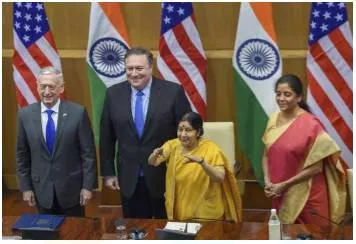
Dialogue with the U.S. should not define India’s strategic future or its other bilateral relationships.The India-U.S. 2+2 meeting on September 6 between the Defence and Foreign Ministers of the two countries appeared to be a singularly one-sided affair. Washington was calling the shots, and New Delhi was trying to wriggle out of U.S. pressure without much success. The inaugural round of the 2+2 Dialogue is therefore ‘advantage U.S.’ While carefully analysing the outcomes of the talks and the future direction of India-U.S. relations, it is difficult to get overjoyed by heart-warming American phrases like “India is a consequential emerging partner” or Washington naming and shaming Pakistan. Let’s look at the bigger, more nuanced (Made or done with extreme care and accuracy.) and consequential picture.
Buy American
Behind the carefully-constructed narrative of strategic rationales and geopolitical calculations underpinning (To give support, strength, or a basic structure to something.) India-U.S. relations, the American team came to New Delhi with an unambiguous sales pitch. Not that there wasn’t any strategic rationale to the high-level meeting, but the underlying American sales pitch was remarkable. Consider the U.S.’s insistence that India should bring down its oil imports from Iran to ‘zero’ in deference to the restrictions imposed by its unilateral withdrawal from the Iran nuclear deal. The U.S. also recommends that India buy American oil to make up the deficit. As a matter of fact, U.S. oil exports to India have more than doubled in the past year, thanks to the U.S. sanction fears, thereby helping a booming domestic crude oil industry. Notably, at the 2+2 meeting, the Indian side did not manage to get a waiver for importing Iranian crude.
Second, Washington seeks to impose the punitive provisions of a U.S. federal law called Countering America’s Adversaries Through Sanctions Act (CAATSA) on countries dealing with Russian defence and intelligence sectors, making it difficult for India to buy the much-needed S-400 missile system. For a country with close to 60% of its weapons systems originating from Russia, this would be a huge setback. Again, it’s clear the U.S. would like India to buy its weapons instead. There is still no clarity on whether India’s request for a “one-time waiver” was granted by the U.S. to buy Russian weapons at the 2+2 meeting; the joint statement is silent on this. If such a waiver was indeed not granted, it must be considered a major set-back.
In the run-up to the 2+2 meeting, the U.S. also put considerable pressure on India to reduce the bilateral trade deficit, which is in India’s favour, by buying more American goods.
Key security agreement
During the 2+2 meeting, the two countries also signed the Communications Compatibility and Security Agreement, or COMCASA. The agreement is one of three considered to be “foundational” for a viable India-U.S. military relationship. In 2016, India and the U.S. had signed the Logistics Exchange Memorandum of Agreement (LEMOA), allowing their militaries to replenish from the other’s bases. The third, the Basic Exchange and Cooperation Agreement for Geo-spatial Cooperation (BECA), is yet to be negotiated. It is necessary to take stock of the national security implications of these agreements.
The argument in favour of signing COMCASA is that it “will facilitate access to advanced defence systems and enable India to optimally utilise its existing U.S.-origin platforms”. India’s U.S.-sourced P-8I and C-130J aircraft had to use low-tech communication equipment as the U.S. could not provide India with such technologies due to domestic legal restrictions, unless India signed COMCASA. Moreover, in the absence of COMCASA, and the attendant high-tech equipment, the interoperability between Indian and U.S. forces would be severely hampered.
While there is some merit in this argument, given that the India-specific COMCASA is not a public document, we do not know the scope of the agreement. Therefore, the government needs to clarify several concerns. For one, there is the issue of visits by U.S. inspectors to Indian bases to carry out inspections on the COMCASA-safeguarded equipment sold to India.
Since we do not know how intrusive (Causing disruption or annoyance through being unwelcome or uninvited.) this inspection would be, it is useful to look at the language from a similar agreement signed between the U.S. and South Korea in 2008: “DoD [U.S. Department of Defence]-provided COMSEC [Communications Security] equipment and materials, including keying materials, will be installed and maintained only by authorized US personnel… For purposes of performing required maintenance and periodic inspections, authorized and duly identified US personnel will be permitted timely access to DoD-provided COMSEC equipment and material. DoD will, in cases when time and circumstances permit, notify MND [Republic of Korea’s Ministry for Defence] in advance in those instances when access by authorized US personnel is considered necessary.” (Emphasis added.)
No doubt, South Korea is a U.S. military ally (Someone who is ready to help you; a friend), which India is not. So one hopes that the provisions of inspections would be less intrusive. But there is no getting away from the fact that COMCASA will apply end-use monitoring and reconfiguration restrictions on India as well. In any case, by signing COMCASA and by agreeing to reduce the purchase of Russian weapon systems (in line with CAATSA), India has implicitly accepted the extraterritorial application of U.S. law on itself. While it is true that the original End-Use Monitoring Agreement (EUMA) was agreed to between India and the U.S., in 2009, New Delhi has now taken the application of U.S. federal law on India to a completely new level. EUMA had reportedly ensured that U.S. inspectors would stay away from Indian bases: is that ensured under COMCASA as well? Moreover, did India push for a U.S. presidential waiver for receiving COMSEC equipment and materials without having to sign COMCASA?
There is also a related concern whether the installation of U.S. communication systems would compromise the secrecy of Indian military communication systems. Most importantly, it might also be useful to debate the utility of such India-U.S. agreements since, at the end of the day, the two countries are not likely to be deployed alongside each other in a conflict situation. The argument here is not that India should not make use of American assistance in strengthening its national security, but there should be more clarity on what it entails (To make something necessary, or to involve something).
Balancing China
Even though the “Joint Statement on the Inaugural India-U.S. 2+2 Ministerial Dialogue” did not explicitly mention China, the section on the Indo-Pacific region implicitly referred to it. There is no denying the fact that the “China threat” is one of the major talking points between Washington and New Delhi today. While China is indeed a challenge, there is only so much India-U.S. cooperation can do to address that challenge for India. India is an Asian country, with several Southern Asian security challenges, and its ability to meet those challenges with the help of an offshore (and declining) superpower is at best limited, and counter-productive at worst.
The India-U.S. relationship shouldn’t be allowed to define India’s geopolitical character, strategic future or the limits of its other bilateral relationships. In a world that is far more chaotic than ever since Independence, India must keep its options open and be multi-aligned, even as the U.S. forms a key part in that scheme of things.

Ensure peace, freedom of navigation, PM urges Iran
Sep 03, 2026







Stay updated with The Hindu Editorial Vocab24 app, your definitive source for breaking news and comprehensive coverage from India and around the globe. Whether it's political developments, business updates, sports highlights, the latest technology trends, or current events, The Hindu brings live, accurate, and reliable news directly to your device.
Don’t fall for sensationalized or fake news shared online. Read and share accurate updates with friends and family through The Hindu Editorial Vocab24 app. Download it today!
News Coverage in The Hindu Editorial Vocab24 App
Breaking News: Receive instant notifications on breaking news stories as they unfold. Stay informed about major events and developments in India and around the world with live blogs, news in shorts videos, and concise articles.
Politics: Get the latest updates on Indian politics, including elections, policy changes, government decisions, and political events that shape the nation.
Business and Economy: Stay ahead in the economic landscape with detailed business news and market analysis. Learn about stock market trends, financial reports, corporate news, and economic developments to make informed investment decisions.
Current Events: Follow stories on social issues, policy changes, global events, and daily current affairs, tailored for UPSC and other competitive exam preparations.
Technology: Keep up with the latest gadgets, innovations, and tech trends. Read expert reviews and analyses in short, concise updates on cutting-edge technology from India and beyond.
Sports: Never miss a moment of your favorite sports. Get live scores, match reports, and expert analysis on cricket, football, tennis, and more.
International News: Stay informed about global events and geopolitical developments, including the Russia-Ukraine war, Israel-Palestine conflict, and other key international stories.
Local News: Stay connected to your community with the latest updates on city events, issues, and local news. Coverage includes hyperlocal updates from cities like Bangalore, Chennai, Delhi, Hyderabad, Mumbai, Kolkata, and more.
Trending Topics: Discover what's trending today with the most talked-about stories and hot topics across India and the world.
Experience journalism that values integrity, accuracy, and reliability. Download The Hindu Editorial Vocab24 app today and stay connected with the world.
Subscribe to our newsletter!







