

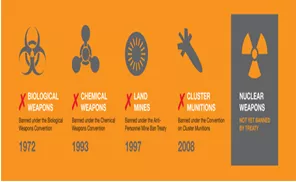
The wrong way to prevent nuclear war
A vast majority of countries want to eliminate the existential threat of nuclear catastrophe, and rightly so. But achieving a world free of nuclear weapons is easier said than done, and there is a risk that some attempts to do so could prove self-defeating.Since the end of the Cold War, nuclear stockpiles around the world have been significantly reduced. Russia and the United States have each shrunk their nuclear arsenals by 80%, and during Barack Obama’s presidency, the US urged Russia to pursue further reductions. In Western Europe, the United Kingdom and France have both made their already small arsenals even smaller.
These countries had various reasons for reducing their stockpiles. But, as signatories to the 1968 Nuclear Non-Proliferation Treaty (NPT) – the foundation of global efforts to reduce the threat posed by nuclear weapons – they also had an obligation to do so.
In recent years, progress toward nuclear disarmament has stalled. Russia is currently modernizing its strategic nuclear forces, and has started to mention its nuclear capacity more often in public statements. That explains why efforts to reduce nuclear arsenals in Western Europe have come to a halt. The US, for its part, is also reviewing its options for modernizing its nuclear arsenal.
Meanwhile, Pakistan has continued to produce the fissile materials used in nuclear weapons. Efforts to make the Middle East a nuclear-free zone have gone nowhere, largely because of Israel. The international community could not agree on a way forward at NPT review conferences in 2005 and 2015. And, of course, North Korea’s nuclear ambitions have created another nuclear crisis in East Asia.
Against this backdrop, a large bloc of countries has proposed a far-reaching Treaty on the Prohibition of Nuclear Weapons, a draft of which was endorsed by 122 United Nations member states in early July. Unfortunately, what started as a worthwhile humanitarian effort has culminated in a severely flawed proposal.
Three issues stand out. First, since no nuclear states support a nuclear-ban treaty, the current proposal, by itself, would not rid the world of a single nuclear warhead. Worse, the new treaty could undermine the NPT, which, despite its own flaws, has far wider backing, including that of the five permanent members of the UN Security Council (China, France, Russia, the UK, and the US). Finally, by treating the concept of extended nuclear deterrence as illegal, or at least immoral, the draft treaty could actually threaten security in Europe and East Asia.
The initial draft treaty, when it was unveiled earlier this year, did not include language explicitly banning the use of nuclear weapons as a deterrent. But the version that countries voted on in July did. This is a critical change. The threat of a nuclear counterstrike is what keeps countries from using nuclear weapons in the first place. And so-called extended deterrence through alliances is what protects non-nuclear states from being blackmailed by nuclear states. Without extended deterrence, non-nuclear countries could see fit to acquire nuclear weapons of their own.
It is for this reason that the Netherlands, the only NATO country to participate in developing the nuclear-ban treaty, ultimately voted against it. Japan, the only country that has ever been attacked with nuclear weapons, has also withheld support for the treaty, because it relies on extended nuclear deterrence from the US.
Without such protection, Japan would be completely vulnerable to Chinese nuclear blackmail and North Korean missile attacks. Indeed, since diplomacy and deep sanctions have not put an end to North Korea’s nuclear program, nuclear deterrence stands as the only practical way to protect East Asian countries from nuclear blackmail or attack. Likewise, the vast majority of European countries – from Finland to Portugal – have no wish to reside in the shadow of Russian nuclear warheads with nothing to protect them.
By effectively banning deterrence, the draft treaty could make the world even less safe than it already is. Of course, proponents of the treaty argue that it would build up public support for a nuclear-weapons ban over time, eventually forcing the governments of nuclear states to give up their arsenals.
But this is pure naivete. No one with any connection to reality could seriously believe that the governments of China, Israel, Pakistan, and Russia will simply abandon their nuclear weapons because public opinion has turned against them.
Unfortunately, nuclear weapons are broadly popular in these countries, because they are seen as a security guarantor and a realization of national ambitions on the world stage. Those of us who want a nuclear-free world do not have to agree with this outlook; but we had better not ignore it.
A more realistic approach would be to pursue further nuclear-weapons reductions in both the US and Russia, where serious risks still need to be addressed. To that end, it is vital that neither country modernizes its nuclear arsenal in a way that is seen as expanding its nuclear capabilities. Instead, they must pave the way for further reductions.
In the Middle East, ending current conflicts and developing conflict-resolution mechanisms could help drive progress toward nuclear-free status over time. In this regard, the nuclear agreement between Iran and the P5+1 (the five permanent members of the UN Security Council, plus Germany) is an important first step.
As for South Asia, one hopes that a detente between India and Pakistan will facilitate better nuclear-arms control, even if the shadow of China – which sees its bomb as part of its place in the world – will still hang over India.
In the end, full-scale nuclear disarmament probably cannot be achieved with a single Big Bang. The world would be better served by an incremental approach based on the NPT, strategic arms reductions by the major powers, and conflict resolution in key regions.
In the best-case scenario, the proposed nuclear-ban treaty will be just a sideshow. But there is reason to fear that it will complicate ongoing efforts to reduce nuclear arsenals further, deepen the divide between nuclear- and non-nuclear states, and, in the worst-case scenario, even increase the risk of a nuclear conflict in key regions.
Will china weaponize social media
Feb 11, 2018
The stupid economy
Jan 25, 2018
A climate cure worse than the disease
Dec 27, 2017
Asia’s new entente
Dec 23, 2017





Stay updated with The Hindu Editorial Vocab24 app, your definitive source for breaking news and comprehensive coverage from India and around the globe. Whether it's political developments, business updates, sports highlights, the latest technology trends, or current events, The Hindu brings live, accurate, and reliable news directly to your device.
Don’t fall for sensationalized or fake news shared online. Read and share accurate updates with friends and family through The Hindu Editorial Vocab24 app. Download it today!
News Coverage in The Hindu Editorial Vocab24 App
Breaking News: Receive instant notifications on breaking news stories as they unfold. Stay informed about major events and developments in India and around the world with live blogs, news in shorts videos, and concise articles.
Politics: Get the latest updates on Indian politics, including elections, policy changes, government decisions, and political events that shape the nation.
Business and Economy: Stay ahead in the economic landscape with detailed business news and market analysis. Learn about stock market trends, financial reports, corporate news, and economic developments to make informed investment decisions.
Current Events: Follow stories on social issues, policy changes, global events, and daily current affairs, tailored for UPSC and other competitive exam preparations.
Technology: Keep up with the latest gadgets, innovations, and tech trends. Read expert reviews and analyses in short, concise updates on cutting-edge technology from India and beyond.
Sports: Never miss a moment of your favorite sports. Get live scores, match reports, and expert analysis on cricket, football, tennis, and more.
International News: Stay informed about global events and geopolitical developments, including the Russia-Ukraine war, Israel-Palestine conflict, and other key international stories.
Local News: Stay connected to your community with the latest updates on city events, issues, and local news. Coverage includes hyperlocal updates from cities like Bangalore, Chennai, Delhi, Hyderabad, Mumbai, Kolkata, and more.
Trending Topics: Discover what's trending today with the most talked-about stories and hot topics across India and the world.
Experience journalism that values integrity, accuracy, and reliability. Download The Hindu Editorial Vocab24 app today and stay connected with the world.
Subscribe to our newsletter!







