

The temptation to go viral
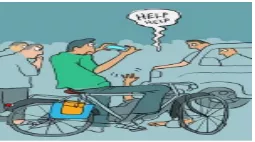
The Good Samaritan law has not sufficed to create the confidence it takes to act in an accident scene likethe one witnessed in Koppal. The reluctance (अनिच्छा) to do something is habitually guided by apprehension (भय/शंका) . Newspapers recently published a story about a young man who lay bleeding on a road while onlookers took pictures of him and made a video. The incident happened in Koppal in Karnataka. The bicycle this 18-year-old was riding was caught under the rear wheel of a State transport bus. Though he emerged alive, he was badly injured and crying for help. Apparently, bystanders couldn’t figure out how to help him, but they used their mobile phones to take pictures. A video of his suffering soon went viral, as they say, suggesting that it became visual material worth watching. An ambulance was summoned and took the young man to a hospital, but the doctors could not save him. Had he been brought sooner, they said, he might have survived. A familiar story Instantaneous gathering of curious onlookers is common in our part of the world. Anything new or unusual spotted on a street makes people stop and stare. When an accident occurs, a traffic jam follows, not always because the vehicles passing by have less space, but mostly because drivers slow down to take a good look at the accident. Cyclists place one foot down on the ground and pedestrians gather. Curiosity alone can’t explain this behaviour, for no one seems satisfied with one good look. People keep staring as if they are waiting for something to happen. They realise that the police should turn up in a short while and then something will happen, so there will be more to see. The scene finds resonance (something that evokes an association) in our mythology and history; it suggests a deep reluctance to take the initiative or to get involved. Once a crowd gathers, the lone individual who might be inclined to take the initiative also loses the instinct to do so, simply because a crowd — any crowd — discourages individuality. The pressure to behave like everybody else greatly increases when you stand in a mass. So it is natural for people standing in a crowd to simply stare rather than to do something. The cellphone’s capacity to serve as a handy camera has added a new dimension to this familiar story. If a crowd has accumulated for no particular reason or cause but merely to stare, and the people assembled have a common reluctance to do something or get involved, the camera function of the cellphone provides a fine outlet for everyone’s somewhat confused energy. The idea of taking a picture creates the option of having something to do. It presents an attractive opportunity of sending the picture across to your friends and anyone else interested. The desire to share a picture instantly by placing it on social media is a new kind of behaviour in the history of crowds. Having witnessed it among students during excursions (घूमना/भ्रमण), I think it creates the satisfaction of doing something, apart from in itself being somewhat exciting. A screen picture in colour looks sharp and bright: taking and transmitting it offers the contentment (संतुष्टता) of capturing something one has come across. It channelises and disperses (बिखराना) the sense of personal responsibility one might feel as a witness to something awful. The fact that I have sent the picture to others spread across my country and even across other countries liberates (मुक्त करना/अलग करना) me from the gnawing (चिंताजनक) thought that I did nothing because I was paralysed or scared. At the very least, it offers some relief from the feeling that I just stood there and watched a person bleed. It provides the satisfaction of doing something while maintaining the relief that I am not getting involved in something that might cause serious inconvenience later. The cellphone camera serves as a mediator. By creating a distance between the viewer and the object, it neutralises the horror of seeing someone in pain and screaming for help. Thereby, it also mitigates the guilt one might feel being a mere onlooker. The law and change Karnataka now has a Good Samaritan law that protects the kind-hearted citizen helping an accident victim from police harassment (परेशानी/कष्ट). The enactment of such a law undoubtedly marks a step towards change in onlooker behaviour as it acknowledges an old source of fear. Apparently, the Good Samaritan law has not sufficed to create the confidence it takes to act in a scene like the one witnessed in Koppal. Apart from confidence, one must also feel like taking the initiative. Reluctance to do something is habitually guided by the apprehension that the consequences of involvement can’t be predicted or controlled. This feeling runs deeper in district towns where the institutions of the state, such as the police, don’t always convey a sense of security to the common citizen who is not a local notable—a term colonial district officers were fond of. Anyone who has faced questioning by the police in a provincial town or village knows what it takes to breathe without fear in the presence of a police officer. Let us imagine that someone who saw the accident in Koppal took the initiative to stop a car and rode in it with the injured youth to a hospital. This would surely leave bloodstains in the car and one of the bystanders would have captured its number plate on the mobile camera. It takes mature sensibility and respect for ordinary people to avoid probing them unnecessarily before declaring them to be Good Samaritans. Distinguishing good involvement from bad at a scene of crime demands significant levels of training and perspicacity (समझदारी/कुशाग्रता). Long, very long and circuitous questioning by the police has been the norm since colonial days. During such sessions, the person who is not the perpetrator (अपराधी/दोषी) of a crime but merely a helper of the victim is subjected to the same routine ruthlessness (निर्दयता/निष्ठुरता) that the perpetrator might deserve. If you think your role is over once you have transported the victim to a nearby hospital, you are likely to be proved mistaken. These are still early days in the history of the Good Samaritan law. It will take a long time for people to feel secure under its provisions. Any law that attempts to change people’s perception of a state agency demands a parallel change in the behaviour of the agency itself. In this case, it is the police. Reforms in the system of investigation, articulated and recommended decades ago, have been waiting to be implemented. Both the will and the resources required to implement them are in short supply. It is anybody’s guess whether the police in Karnataka understand and accept the Good Samaritan (मुसीबत में मदद करने वाला) law. If they do and if, in a few cases, they act according to it, they will have to publicise the names of many Good Samaritans over the coming years and decades to make an impact on the public, on its insecurity and apprehensions. But what about picture taking? This behaviour has risen remarkably rapidly over the last two decades. The cellphone has transformed the meaning of photography. You can now take countless pictures without worrying about exhausting a reel. You are equipped to take pictures all the time and everywhere. No matter where you may take young students on an excursion, as soon as they get there they start taking pictures. Neither the solemnity of a place nor its rarity makes any difference. Their urge to capture everything using their mobile has turned into a compulsion. The object does not matter: it can be a flower, a poster or a person who is bleeding, as in the case in Koppal. Flat notion of education In their commentary on the Koppal story, readers have berated (फटकारना) the loss of sensitivity and values. Quite a few have blamed education. It is difficult to agree with them, although one can understand why education serves so readily as a whipping horse whenever social values are discussed. Administrators and political leaders share with ordinary people a flat notion of education. They don’t appreciate what it takes to make education an experience that has the potential to create self-awareness and sensibility. A key resource often underestimated is the teacher. It is fashionable to express frustration with teachers and to recommend technology to control and replace them. As for teachers themselves, they are being pushed hard to cope with the active presence of cellphones in the classroom. You are supposed to find ways to use students’ passion for cellphones rather than criticise it. The ideal teacher these days is one who pretends to be unaware that students are busy with their cellphones, sending and receiving messages and pictures.
Lonely and disinterested
Apr 20, 2017
Kulbushan jadhav death sentence risky ill considered
Apr 12, 2017
Banking on good faith
Jan 27, 2017
The limits to popular sentimentc
Jan 20, 2017
A wake up call
Jan 18, 2017





Stay updated with The Hindu Editorial Vocab24 app, your definitive source for breaking news and comprehensive coverage from India and around the globe. Whether it's political developments, business updates, sports highlights, the latest technology trends, or current events, The Hindu brings live, accurate, and reliable news directly to your device.
Don’t fall for sensationalized or fake news shared online. Read and share accurate updates with friends and family through The Hindu Editorial Vocab24 app. Download it today!
News Coverage in The Hindu Editorial Vocab24 App
Breaking News: Receive instant notifications on breaking news stories as they unfold. Stay informed about major events and developments in India and around the world with live blogs, news in shorts videos, and concise articles.
Politics: Get the latest updates on Indian politics, including elections, policy changes, government decisions, and political events that shape the nation.
Business and Economy: Stay ahead in the economic landscape with detailed business news and market analysis. Learn about stock market trends, financial reports, corporate news, and economic developments to make informed investment decisions.
Current Events: Follow stories on social issues, policy changes, global events, and daily current affairs, tailored for UPSC and other competitive exam preparations.
Technology: Keep up with the latest gadgets, innovations, and tech trends. Read expert reviews and analyses in short, concise updates on cutting-edge technology from India and beyond.
Sports: Never miss a moment of your favorite sports. Get live scores, match reports, and expert analysis on cricket, football, tennis, and more.
International News: Stay informed about global events and geopolitical developments, including the Russia-Ukraine war, Israel-Palestine conflict, and other key international stories.
Local News: Stay connected to your community with the latest updates on city events, issues, and local news. Coverage includes hyperlocal updates from cities like Bangalore, Chennai, Delhi, Hyderabad, Mumbai, Kolkata, and more.
Trending Topics: Discover what's trending today with the most talked-about stories and hot topics across India and the world.
Experience journalism that values integrity, accuracy, and reliability. Download The Hindu Editorial Vocab24 app today and stay connected with the world.
Subscribe to our newsletter!







