

The single service syndrome
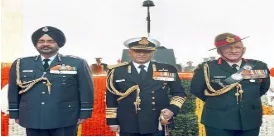
Last month the three service chiefs released the latest iteration of the Joint Doctrine for the Indian Armed Forces. In the foreword the Chairman of the Chiefs of Staff Committee, Admiral Sunil Lanba, wrote that that the Joint Doctrine “provides foundations for greater integration and interdependence, to achieve higher inter-operability and compatibility within the Armed Forces”. To its credit this version of the doctrine was released to the public (the first edition written in 2006 remains classified) with the hope, as argued by Admiral Lanba, that it “should be revisited…to extend our understanding and collative (collective and ordered) (sic) understanding.” However, that is the best that can be said about this document because a closer reading leads to an inescapable conclusion — those writing this doctrine had very little idea what they were talking about. Resistance to a joint command The debate on jointness within the Indian military has been going on for almost sixty years. As we now know Lord Mountbatten, the architect of India’s Higher Defence Organisation, was keen to appoint a Chief of Defence and lobbied (अपने पक्ष में जनमत तैयार करना) repeatedly for creation of a Joint Staff. However, there was reluctance from India’s political and bureaucratic class that were fearful of an empowered military. Later, the services also resisted jointness as they privileged the autonomy afforded by the single service approach. It was only after the post-Kargil defence reforms in 2001 that an Integrated Defence Staff (minus the post of the Chief of Defence Staff, or CDS) was established. In addition, a Joint Command was established on the Andaman and Nicobar Islands with the expectation that this “experiment” would lead to other geographically delineated (चित्रित करना/ वर्णित करना) joint commands. However, while many in the strategic community (rightly) blame politicians and bureaucrats for their reluctance to appoint a Chief of Defence Staff, they often overlook resistance to jointness within the services. Simply put, the Army, Navy and Air Force are unwilling to embrace managerial jointness, through a CDS, or operational jointness, by agreeing to joint commands. In fact, on the latter issue, they have successfully rolled back the idea for joint commands as there are reports that the Andaman and Nicobar Command will be permanently headed by a naval officer — which runs contrary to the vision of those who created the joint command. With that background, this joint doctrine should be read as a diversionary attempt by the services to resist any changes in the status quo (the existing state of affairs, especially regarding social or political issues) . It is therefore not surprising that the doctrine is confusing even on the issue of defining jointness. Sample this: “Jointness implies or denotes possessing an optimised capability to engage in Joint War-Fighting and is not limited to just Joint-War Fighting (Joint Operations). The attention to detail is in the placing of the hyphen. It needs to be clearly understood and discerned (देखना/पहचानना/ जान लेना) that ‘Jointness’ is a ‘Concept’, whereas ‘Joint Operations’ are evolutions, of both, Joint operations as well as single-Service operations are sub-sets of the larger whole of ‘conceptual Jointness’.” Noticeably, the doctrine fails to mention anything about the joint Andaman and Nicobar Command. This begs two larger questions. First, why has the joint command experiment failed? Second, as global militaries are increasing converging towards joint commands (President Xi Jinping being the latest to force this on the Chinese military), what is the exact model of jointness that the Indian military wishes to follow? The possible answer to both is that the Indian military, attached to the single service approach, just does not want any changes. A shoddy (बेकार/असफल/तुच्छ) endeavour at best Apart from being a difficult read, the doctrine fails on other levels. First, it creates an unnecessary controversy about India’s nuclear doctrine by describing it as “credible deterrence” instead of “credible minimum deterrence”. This distinction is crucial as India’s draft nuclear doctrine specifically mentions the latter. If there is a change in the nuclear doctrine, then messaging it through the joint doctrine is peculiar. A more likely explanation is that perhaps the distinction was lost upon those who wrote this document. Second, the doctrine’s referencing, editing and footnoting technique requires serious attention. When I ran the doctrine through Turnitin — software that checks for plagiarism (साहित्यिक चोरी) — it came up with a similarity index of 26%. Citing and borrowing ideas from previously published sources is acceptable; however it is important to do so using quotations, a norm that this doctrine totally ignores. This is justified away with the disclaimer that “inputs [were] compiled from Indian National Constitution, Annual Reports of Ministry of Defence, various defence publications, journals and military pamphlets, Service Headquarters, War Colleges, etc.” More than anything else, it requires war colleges and professional military institutions in India to implement capsules on academic integrity and widely use plagiarism detection software. Perhaps inadvertently (असावधानी से/गलती से/अनजाने में) , the doctrine reveals much about a topic familiar to those who study the Indian military — the issue of civil-military relations. There are only two appendices (a section or table of subsidiary matter at the end of a book or document.) to this report — one describing what is a doctrine and the second one, strangely, on the topic of civil-military relations. The latter reads like a wish list and captures the litany (पुनरावृत्ति) of complaints within the military against the civilian bureaucracy. While arguing that “layered hierarchies of the National Security structures should integrate”, it called for “inclusivity in policy making” to be “led (misspelt “lead” in the original document!) by integrated and responsive structural mechanisms.” It goes on to assert that “to address National Security imperatives, it is prudent that institutional and structural mechanisms exist that facilitate free flowing communication… The functionaries in the MoD ought to be enablers of this relationship.” This suggests that civilians in the Defence Ministry have not been doing so — a charge that one hears often from the Indian military. The divide between the military and civilian bureaucrats in the Defence Ministry is a well-known story that even this government has done little to address. What could possibly explain such a badly written doctrine and does this suggest that the Indian military is incapable of such an intellectual endeavour? Happily we do have instances of well-written doctrines — the Indian Navy’s doctrine titled “Ensuring Secure Seas” released in 2015 represents one such effort. However, that was perhaps because the Navy has invested in its doctrine writing branch and had consulted widely. But the Indian Army and perhaps even the Air Force do not incentivise and develop such expertise. What is required therefore is not minor edits but a complete withdrawal of this document with a revised version to be released later. Not doing so reflects badly on the professionalism and does little justice to the intellectual capability of the Indian military.Collative (adjective)
Collective and ordered सामूहिक तथा क्रमबद्ध
Synonyms: Organized, Systematic, Composed, Ordered
Example: Apart from nice story, the novel of the novice author was written in collative way.
Lobby (verb)
Seek to influence (a legislator) on an issue. अपने पक्ष में जनमत तैयार करना
Synonyms: Seek To Influence, Try To Persuade, Persuade, Influence, Sway
Example: Although Helen wanted to become a lobbyist, she was not very good at persuading people to take action.
Delineate (verb)
Describe or portray (something) precisely/ indicate the exact position of (a border or boundary). चित्रित करना/ वर्णित करना
Synonyms: Outline, Trace, Draw, Sketch, Block In, Mark (Out/Off), Delimit
Example: Before I began to plant my seeds, I will delineate the rows of my garden to make sure every vegetable grows in a precise line.
Status quo (noun)
The existing state of affairs, especially regarding social or political issues. वर्तमान-स्थिति
Synonyms: State Of Affairs, Status, Existing Conditions, Present Situation
Example: The American Civil War was an internal revolution that ended with the destruction of the unfair status quo that permitted slavery.
Shoddy (adjective)
Badly made or done./ not done or made well. बेकार/असफल/तुच्छ
Synonyms: Cheap, Tawdry, Rubbishy, Trashy, Gimcrack
Example: As soon as the judges heard the young man’s shoddy performance, they voted her out of the competition.
Plagiarism (noun)
The practice of taking someone else's work or ideas and passing them off as one's own. साहित्यिक चोरी
Synonyms: Infringement Of Copyright, Piracy, Theft, Stealing, Poaching, Counterfeiting
Example: The teacher accused Jerry of plagiarism because she knew he could never write such an exceptional paper.
Inadvertently (adverb)
Without intention; accidentally. असावधानी से/गलती से/अनजाने में
Synonyms: Accidentally, Unintentionally, Recklessly, Rashly, In An Unplanned Manner
Example: I wonder how many inadvertent inventions were developed in the process of trying to discover something totally different.
Litany (noun)
A tedious recital or repetitive series. पुनरावृत्ति
Synonyms: Repetitive, Recitation, Recurrence, Reiteration
Example: The politician quickly stated a litany of reasons why his political rival was an unsuitable candidate for office.
Appendix (noun)
(A section or table of subsidiary matter at the end of a book or document.) परिशिष्ट
Synonyms: Addendum, Postscript, Codicil, Adjunct
Example: I created the table for the appendix in my chemistry book because I needed to include the raw data that was used in the charts.
Discern (verb)
Distinguish (someone or something) with difficulty by sight or with the other senses./ recognize or find out. देखना/पहचानना/ जान लेना
Synonyms: Perceive, Detect, Recognize, Figure Out, Observe
Example: A detective’s job is to discern who is guilty of a particular crime by evaluating the evidence.








Stay updated with The Hindu Editorial Vocab24 app, your definitive source for breaking news and comprehensive coverage from India and around the globe. Whether it's political developments, business updates, sports highlights, the latest technology trends, or current events, The Hindu brings live, accurate, and reliable news directly to your device.
Don’t fall for sensationalized or fake news shared online. Read and share accurate updates with friends and family through The Hindu Editorial Vocab24 app. Download it today!
News Coverage in The Hindu Editorial Vocab24 App
Breaking News: Receive instant notifications on breaking news stories as they unfold. Stay informed about major events and developments in India and around the world with live blogs, news in shorts videos, and concise articles.
Politics: Get the latest updates on Indian politics, including elections, policy changes, government decisions, and political events that shape the nation.
Business and Economy: Stay ahead in the economic landscape with detailed business news and market analysis. Learn about stock market trends, financial reports, corporate news, and economic developments to make informed investment decisions.
Current Events: Follow stories on social issues, policy changes, global events, and daily current affairs, tailored for UPSC and other competitive exam preparations.
Technology: Keep up with the latest gadgets, innovations, and tech trends. Read expert reviews and analyses in short, concise updates on cutting-edge technology from India and beyond.
Sports: Never miss a moment of your favorite sports. Get live scores, match reports, and expert analysis on cricket, football, tennis, and more.
International News: Stay informed about global events and geopolitical developments, including the Russia-Ukraine war, Israel-Palestine conflict, and other key international stories.
Local News: Stay connected to your community with the latest updates on city events, issues, and local news. Coverage includes hyperlocal updates from cities like Bangalore, Chennai, Delhi, Hyderabad, Mumbai, Kolkata, and more.
Trending Topics: Discover what's trending today with the most talked-about stories and hot topics across India and the world.
Experience journalism that values integrity, accuracy, and reliability. Download The Hindu Editorial Vocab24 app today and stay connected with the world.
Subscribe to our newsletter!







