

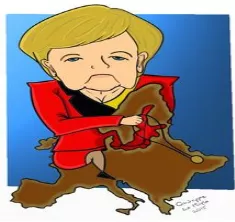
The return of the chancellor
The 2017 German Elections elicited (evoke or draw out (a reaction)) far more global interest compared to previous elections. The emergence of Germany as a robust economy and as an important pillar of the European Union is a significant reason for the growing interest in understanding the recent elections there.The German elections were held against the backdrop of geopolitical shifts involving the relative decline of the US. The concerns regarding the reliability of the US security commitments towards Europe got exacerbated (make (a problem, bad situation, or negative feeling) worse.) because of President Trump’s transactional foreign policy and anti-globalisation rhetoric.
On the other hand, Germany under the leadership of Angela Merkel had taken strong positions in favour of Paris Climate Accord and worked to preserve the Euro-zone. Therefore, the German elections generated interest as to whether the electorate would endorse or overthrow (remove forcibly from power.) a candidate who tends to celebrate trans-national interactions.
Further, given the electoral performance of some of the right-wing parties and candidates in other parts of Europe, there was an interest as to whether Germany would also witness a ‘rightward’ shift in politics. As anticipated by many pundits (an expert in a particular subject or field who is frequently called upon to give their opinions to the public), the Conservatives [The Christian Democratic Union of Germany (CDU) and Christian Social Union in Bavaria (CSU)] led by Angela Merkel emerged as the largest group. Merkel is back as Chancellor for the fourth term, a political feat achieved by only two other leaders – Helmut Kohl and Konrad Adenauer.
It should be noted that Merkel was the first woman to become the Chancellor of Germany. In many democratic countries, if a political leader received an endorsement for a fourth term with over 30 per cent vote, it would have been characterised as a stupendous (extremely impressive.) electoral victory. However, many news reports have been using phrases such as ‘diminished Merkel’.
There are two reasons for this. The German electoral system is different from the First-Past The-Post electoral system such as that in India and Britain. If a party in India receives approximately 35 per cent of vote share often it ends up with majority seats in the legislature. On the other hand, in Germany, Merkel’s Conservatives with 32.9 per cent votes would get more or less similar percentage of seats in legislatures because of proportional representation.
This means that Merkel will have to run a coalition government. Further, there has been considerable slide in Merkel’s Conservative party’s vote share which was approximately 41.5 per cent in 2013. The electorate seems to have to have expressed disappointment but not complete disapproval of Merkel.
The other main political parties have been put on (to place or set) notice as well. For instance, the Social Democrats (SPD) also witnessed a decline in vote share from 25.7 per cent in 2013 to around 20.8 per cent this time around.
Interestingly, other smaller parties such as the Free Democratic Party (FDP) and the Greens have witnessed an increase in the vote share resulting in increased representational density of parties in parliament. While the FDP received a higher percentage of votes from the richer segments of society, the Greens performed well in the urban areas.
For the first time since World War II, a right-wing nationalist party has found representation in the national legislature. The Alternative for Germany (AfD) has received about 12.6 per cent vote share and emerged as the third largest party. The AfD has performed exceedingly well in the relatively less-developed Eastern Germany with approximately 21.5 per cent vote share there. The recent rise of right-wing politics in Germany seems to have been triggered by the perception that Germany has been taking disproportionate burden in handling refugees as well as in response to the Eurozone debt crisis.
The recent German election has once again demonstrated that the immigration and refugee issues have negative electoral consequences for centrists and liberal parties. While the AfD has called for a ‘zero-immigration policy,’ a section of the conservatives led by the Christian Social Union (CSU) have been demanding a clearly defined upper limit for immigration into Germany. The CDU led by Angela Merkel and the Greens are opposed to defining such an upper limit. It is distinctly possible that Germany will take a little more conservative stance on issues concerning movement of people in near future.
With SPD expressing its reluctance to be part of the government, the Conservatives will now have to form the government in coalition (alliance) with the FDP and the Greens.
Merkel will have to operate in a constrained political space as the proposed coalition has parties with differing policy priorities. The FDP is interested in balanced budgets, simplified labour laws, tax cuts, separate digital ministry and a more enabling environment for digital commerce. The Greens have been advocating for a complete phase-out of the coal based power-plants by 2030 and a similar time-frame to ban the sale of combustion-engine cars.
There may be some consensus on the former, but an agreement on the latter may prove to be little challenging. If the Greens get the Foreign Ministry, then the probability of Germany being sympathetic to India’s approach of building a ‘green coal coalition’ is limited. The three parties will have to make considerable efforts to find common ground on many issues.
For instance, there is no unanimity (consensus) among the parties on the next steps in the European integration. Merkel has given a tentative (not certain or fixed) endorsement to some elements of French President Emmanuel Macron’s suggestion for a more integrated Europe with common budget and a Eurozone finance minister.
The Greens also seem to be inclined towards deeper integration of Europe. The FDP, on the other hand, is apprehensive (anxious or strained) to move forward on such Euro reforms and has said it opposes fiscal transfers within the Eurozone. However, the FDP has indicated that it would welcome greater integration in domains of energy and digital economies.
The impulse of smaller parties – the FDP and the Greens – will be to build on the electoral mandate that they have already received. The bigger parties such as the CDU will be keen on regaining the lost ground. Therefore, they will be tempted to drive a hard bargain on every issue to expand their support base.
However, with right-wing AfD having already demonstrated its electoral strength, it becomes imperative that the new coalition led by Merkel works to ensure political stability. A fractious ((of a group or organization) difficult to control) coalition government, which is at constant war with itself, is neither good for Germany nor Europe.
A multi-polar international order requires robust German leadership, guided by principles of democracy and cosmopolitanism (ideology that all human beings belong to a single community, based on a shared morality.), in Europe and beyond.


Philippines president rodrigo duterte slams unhcr
Apr 06, 2018
Oli to take up currency ban issue with pm modi
Apr 02, 2018
Curbing the khaps
Apr 01, 2018





Stay updated with The Hindu Editorial Vocab24 app, your definitive source for breaking news and comprehensive coverage from India and around the globe. Whether it's political developments, business updates, sports highlights, the latest technology trends, or current events, The Hindu brings live, accurate, and reliable news directly to your device.
Don’t fall for sensationalized or fake news shared online. Read and share accurate updates with friends and family through The Hindu Editorial Vocab24 app. Download it today!
News Coverage in The Hindu Editorial Vocab24 App
Breaking News: Receive instant notifications on breaking news stories as they unfold. Stay informed about major events and developments in India and around the world with live blogs, news in shorts videos, and concise articles.
Politics: Get the latest updates on Indian politics, including elections, policy changes, government decisions, and political events that shape the nation.
Business and Economy: Stay ahead in the economic landscape with detailed business news and market analysis. Learn about stock market trends, financial reports, corporate news, and economic developments to make informed investment decisions.
Current Events: Follow stories on social issues, policy changes, global events, and daily current affairs, tailored for UPSC and other competitive exam preparations.
Technology: Keep up with the latest gadgets, innovations, and tech trends. Read expert reviews and analyses in short, concise updates on cutting-edge technology from India and beyond.
Sports: Never miss a moment of your favorite sports. Get live scores, match reports, and expert analysis on cricket, football, tennis, and more.
International News: Stay informed about global events and geopolitical developments, including the Russia-Ukraine war, Israel-Palestine conflict, and other key international stories.
Local News: Stay connected to your community with the latest updates on city events, issues, and local news. Coverage includes hyperlocal updates from cities like Bangalore, Chennai, Delhi, Hyderabad, Mumbai, Kolkata, and more.
Trending Topics: Discover what's trending today with the most talked-about stories and hot topics across India and the world.
Experience journalism that values integrity, accuracy, and reliability. Download The Hindu Editorial Vocab24 app today and stay connected with the world.
Subscribe to our newsletter!







