

The phillips curve may be broken for good
Central bankers insist that the underlying theory remains validIT HAS long been assumed that economic policymakers face a trade-off between unemployment and inflation. Let unemployment fall below its “natural” rate (the level of joblessness that results merely from the normal patterns of job gains and losses at any one time) and the economy could overheat, causing inflation to spiral out of control. The Federal Reserve chair, Janet Yellen, alluded to this relationship in a speech in September when she warned that, left unchecked, America's healthy job growth could create an “inflationary problem down the road”.
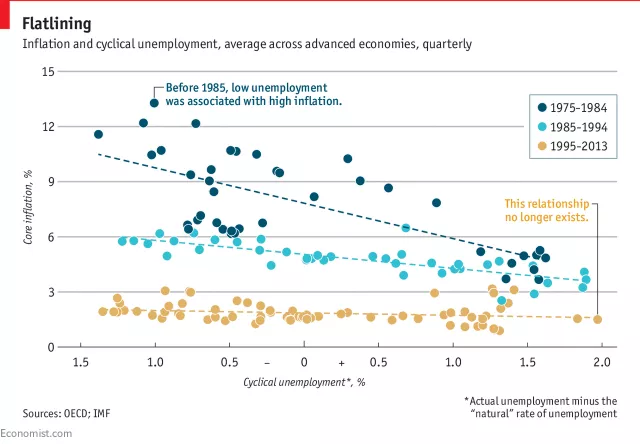
But a growing number of economists now say that the trade-off, known as the Phillips curve after an economist who described it in a 1958 paper, no longer holds. Until the mid-1980s, unemployment and wage inflation in America and other advanced economies did indeed appear to be inversely correlated. Since then, however, the relationship has weakened (see chart above). America’s recovery from the Great Recession has proved particularly puzzling. Since 2010, as the unemployment rate has fallen steadily from 10% to 4.4%, inflation has hovered between 1% and 2%. This has prompted observers like Larry Summers of Harvard University to argue that the Phillips curve has “broken down”.
So what happened? One theory holds that increased foreign competition has made it difficult for firms to raise prices or for workers to demand higher wages in response to changes in domestic demand. Another posits that central banks have become more credible at fighting inflation, in turn helping to anchor inflation expectations and making prices less sensitive to the business cycle. Whatever the reason, a new consensus has emerged that the Phillips curve is not a particularly useful tool for forecasting inflation. A recent paper by researchers at the Federal Reserve Bank of Philadelphia finds that inflation models that include unemployment data perform no better than those that do not.
For all its empirical flaws, many central bankers remain loyal to Phillips’s teachings. According to minutes from the meeting of the Fed’s rate-setters in July, “most participants” are unwilling to let the theory go just yet. As one of them, William Dudley of the New York Fed, recently told Bloomberg News, he is “not ready to throw the Phillips curve out the window”.
What is the 'Phillips Curve'
The Phillips curve is an economic concept developed by A. W. Phillips showing that inflation and unemployment have a stable and inverse relationship. The theory states that with economic growth comes inflation, which in turn should lead to more jobs and less unemployment.
However, the concept has been somewhat disproven empirically due to the occurrence of stagflation in the 1970s, when there were high levels of both inflation and unemployment.
How to interpret a market plunge
Feb 07, 2018
Why europe needs more migrants
Nov 12, 2017

Why homeopathy is nonsense
Oct 24, 2017






Stay updated with The Hindu Editorial Vocab24 app, your definitive source for breaking news and comprehensive coverage from India and around the globe. Whether it's political developments, business updates, sports highlights, the latest technology trends, or current events, The Hindu brings live, accurate, and reliable news directly to your device.
Don’t fall for sensationalized or fake news shared online. Read and share accurate updates with friends and family through The Hindu Editorial Vocab24 app. Download it today!
News Coverage in The Hindu Editorial Vocab24 App
Breaking News: Receive instant notifications on breaking news stories as they unfold. Stay informed about major events and developments in India and around the world with live blogs, news in shorts videos, and concise articles.
Politics: Get the latest updates on Indian politics, including elections, policy changes, government decisions, and political events that shape the nation.
Business and Economy: Stay ahead in the economic landscape with detailed business news and market analysis. Learn about stock market trends, financial reports, corporate news, and economic developments to make informed investment decisions.
Current Events: Follow stories on social issues, policy changes, global events, and daily current affairs, tailored for UPSC and other competitive exam preparations.
Technology: Keep up with the latest gadgets, innovations, and tech trends. Read expert reviews and analyses in short, concise updates on cutting-edge technology from India and beyond.
Sports: Never miss a moment of your favorite sports. Get live scores, match reports, and expert analysis on cricket, football, tennis, and more.
International News: Stay informed about global events and geopolitical developments, including the Russia-Ukraine war, Israel-Palestine conflict, and other key international stories.
Local News: Stay connected to your community with the latest updates on city events, issues, and local news. Coverage includes hyperlocal updates from cities like Bangalore, Chennai, Delhi, Hyderabad, Mumbai, Kolkata, and more.
Trending Topics: Discover what's trending today with the most talked-about stories and hot topics across India and the world.
Experience journalism that values integrity, accuracy, and reliability. Download The Hindu Editorial Vocab24 app today and stay connected with the world.
Subscribe to our newsletter!







