

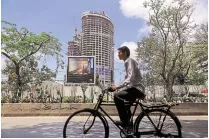
The long and short of the indian economy
The tasks before a government are not easily boxed into five-year compartments. Some require continuous attention over decades, for instance the task of reform. Others like new legislation can be achieved within a term of office. It is as natural for a father whose time is short to worry about near-term things, as it is appropriate for a son with his whole life before him to take a long-term view.Let us accept the perspective of the son, and ask if the current government has done the right thing by those who take the long-term perspective. At the time of assuming office, it had three tasks before it: identifying new growth sectors in a slowing global economy, taking care of the detritus of the previous growth spurt including non-performing assets (NPAs) and massive corruption, and creating jobs.
The growth initiative can be divided into three parts—Make In India, Digital India, and solar power generation. The goods and services tax (GST) was meant to be a facilitator via the creation of a common market.
Make In India was either a jazzed-up version of Nehruvian import substitution or an export-led growth pattern ala the East Asian economies. Unfortunately, as former Reserve Bank of India governor Raghuram Rajan noted, it was launched at a time of recession in the world and economic slowdown at home. Manufacturing growth has been tepid since Q3 2016-17, and in Q1 2017-18, plummeted to 1.2%.
In a significant milestone for Digital India, the number of mobile subscribers crossed 1.2 billion in May. But telecom operators are carrying close to Rs4 trillion of debt on their books with no signs of profitability within their sights.
GST is a solid achievement. The rules and the implementation will improve but the swelling demand for input tax credit must draw the attention of fiscal hawks.
Also, GST cannot be looked at independently of demonetization, the supposed panacea for dealing with graft. The summary withdrawal and subsequent replacement of 86% of the country’s currency was ill-conceived, poorly planned and rationalized by a series of shifting goalposts. Most of the cash has come back, making demonetization a large money- laundering scheme. True, the income tax department has sent notices against hundreds of thousands of such account holders but consider the power the taxman now wields.
If the discretion available to the inspector in the licence-permit Raj led to the mess we are in today, why should we expect the new veins of corruption conjured by demonetization to be any less lucrative? Those talking of painful but necessary structural changes must also factor in the damage to the institution of India’s central bank occasioned by this policy.
Demonetization was also supposed to make the banks flush with deposits and reduce interest rates to trigger growth. But with credit growth having turned south, the deposits represent additional cost without any matching off-take of loans. Meanwhile, the crisis inflicted upon agriculture and the rural sector has triggered a new round of loan waivers, putting additional pressure on tottering banks. The hit to the small-scale and unorganized sectors from the double whammy of demonetization and GST is partly responsible for the failure to take advantage of the revival of global trade this year.
Ultimately, the problem of NPAs can be traced back to the lack of robustness of the loan-approval process of public sector banks in the midst of the speculative commodities bubble of the first decade of the new century. The loan-closure process may have been rationalized through a bankruptcy code but a fresh crisis is already underway.
Although solar capacity has grown at an impressive pace, signifying India’s leadership position in tackling climate change, the sector could become a victim of the “winner’s curse” either because of the unreasonably low price levels determined by bidding, or due to the lack of demand for power at various points in the 20-year contracts. Given the nature of the contracts, the burden of failure will be borne by the government.
Employment creation has been meagre and there has been an increasing share of the informal and casual wage sectors, worsening labour conditions. The overall growth rate of the economy is suspect not because of the new methodology for assessment but the continued use of pre-demonetization assumptions for estimating the unorganized sector contribution.
It does appear as if there have been no high-level corruption scams but this is partly because corruption in the enforcement of contracts in the natural resource sectors is passed off as “development”. The middle class that believes such corruption is a necessary evil is complicit in this process. In any case, a slowing economy offers fewer opportunities for pelf.
Ironically for a government elected on the basis of an appeal to a market-friendly constituency, its performance on welfare schemes like Jan Dhan Yojana and the Pradhan Mantri Awas Yojana is commendable. The Clean India mission is a superb example of how a prime minister can use the bully pulpit to sear a phrase (“Swachh Bharat”) into the national consciousness, although behavioural change takes time and requires matching structural innovations. But in the absence of a solid growth engine, achievements like these are merely decorations in a party hall where the guests refuse to come. In a democracy, both the father and the son have to be made happy, or neither will be.








Stay updated with The Hindu Editorial Vocab24 app, your definitive source for breaking news and comprehensive coverage from India and around the globe. Whether it's political developments, business updates, sports highlights, the latest technology trends, or current events, The Hindu brings live, accurate, and reliable news directly to your device.
Don’t fall for sensationalized or fake news shared online. Read and share accurate updates with friends and family through The Hindu Editorial Vocab24 app. Download it today!
News Coverage in The Hindu Editorial Vocab24 App
Breaking News: Receive instant notifications on breaking news stories as they unfold. Stay informed about major events and developments in India and around the world with live blogs, news in shorts videos, and concise articles.
Politics: Get the latest updates on Indian politics, including elections, policy changes, government decisions, and political events that shape the nation.
Business and Economy: Stay ahead in the economic landscape with detailed business news and market analysis. Learn about stock market trends, financial reports, corporate news, and economic developments to make informed investment decisions.
Current Events: Follow stories on social issues, policy changes, global events, and daily current affairs, tailored for UPSC and other competitive exam preparations.
Technology: Keep up with the latest gadgets, innovations, and tech trends. Read expert reviews and analyses in short, concise updates on cutting-edge technology from India and beyond.
Sports: Never miss a moment of your favorite sports. Get live scores, match reports, and expert analysis on cricket, football, tennis, and more.
International News: Stay informed about global events and geopolitical developments, including the Russia-Ukraine war, Israel-Palestine conflict, and other key international stories.
Local News: Stay connected to your community with the latest updates on city events, issues, and local news. Coverage includes hyperlocal updates from cities like Bangalore, Chennai, Delhi, Hyderabad, Mumbai, Kolkata, and more.
Trending Topics: Discover what's trending today with the most talked-about stories and hot topics across India and the world.
Experience journalism that values integrity, accuracy, and reliability. Download The Hindu Editorial Vocab24 app today and stay connected with the world.
Subscribe to our newsletter!







