

The Iran war, India’s strategic autonomy challenges
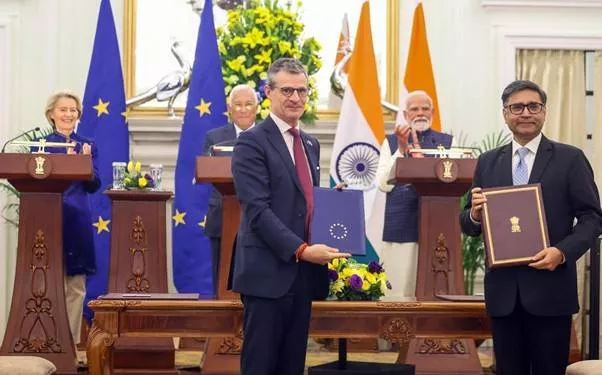
United States President Donald Trump’s tariff wars against friend and foe over the last year now pale in comparison to the upheaval created by the unprecedented Israeli-American attack on Iran and counterstrikes. For decades, India’s stakes in a stable and friendly Tehran have been huge for energy security, geopolitical advantage, and space for strategic autonomy. If the Ukraine war tested India’s foreign policy agility and independence, the Iran war is a generational challenge. The slew of economic and defence deals that India signed with European countries recently was popularly seen as a signal of major geoeconomic and geopolitical shift in India’s favour. In this new West Asian war scenario, it is already clear that deals with France and the European Union (EU) hardly give India a stronger hand.Strategic autonomy is difficult
The 114 Rafale fighter jet purchase from France and the India-EU Free Trade Agreement (FTA) pointed to historic achievements. These surprisingly quick denouements (after 20 years of slow negotiations on the FTA and extended talks on the Rafales since 2016) were mostly rearguard actions against Mr. Trump’s punishing tariffs. But New Delhi and some European countries such as France seemed to believe they were important steps toward a more distributed multipolar world order against American unilateralism. Washington’s disregard for potentially catastrophic effects from the attack on Iran on global commerce and security are showing that U.S. unipolarity is holding fast.
Until Mr. Trump’s coercive tariffs, New Delhi did not have to worry much about independence in economic policymaking. That is because unlike the post war American-led military order with the North Atlantic Treaty Organization (NATO) and Asian formal treaty alliances, Washington’s liberal economic order tended to be open and inclusive, driven largely by market forces. The double whammy of economic and military unilateralism will now make it more difficult for countries such as India to exercise strategic autonomy.
President Trump is changing the economic system in ways that mirror the exclusivist military system. The U.S. government is increasingly demanding a greater alignment of the economic policies of other countries with American strategic interests. This is a fundamental break from the earlier practice and it threatens the entire post-Second World War liberal economic order. New Delhi has been able to pick and choose close economic tie-ups with the U.S. while, at the same time, keeping its distance from alliance politics. That had not stopped the U.S. from nurturing commercial ties with India in a big way since 2000. Indeed, the U.S. overtook China as India’s largest trading partner in 2021-22. But note that China was at the top of India’s economic partners even as U.S.-China relations were sharply declining. All this is to say that until very recently, economic and strategic relations could co-exist along competing trajectories.
For India and the U.S., a convergence of interests about a rising China had brought their relations to a level that appeared irreversible. Even as this meeting of the minds occurred, India’s diversification of big power partnerships remained intact. India’s ability to maintain good relations simultaneously with the U.S., Russia, China, Iran, Israel, Vietnam, and the major European powers — without taking strong sides, even under duress — is the clearest expression and exercise of strategic autonomy.
Mr. Trump’s arbitrary demands to discontinue crude oil imports from Russia, forego the strategic partnership with Iran on Chabahar port, desist from even considering a de-dollarise option in BRICS, and clearly align with American geoeconomic and geopolitical interests, pose the biggest challenge to India’s strategic autonomy in decades. America’s 30-day waiver for Russian oil purchases owing to energy supply chain disruptions came as a brief reprieve for India, yet on terms set by Washington. It was more than just an embarrassment for India when a U.S. submarine sank an Iranian naval ship (IRIS Dena) in the Indian Ocean that was returning from the Indian Navy’s International Fleet Review 2026 naval exercise on March 4. India’s image as the key regional naval power took a big hit.
Deals with Europe have not eliminated risks
India’s FTA with the EU and historic Rafale fight jet deal with France are two developments that many interpreted as India trying to manage the new autonomy dilemma created by Mr. Trump. New Delhi chose French fighter jets over Russian and American jets with the hope that it would finally get the technology transfer and domestic production it has long sought. India is growing, and so is its military; it will keep buying, and France is locking itself into a huge commercial deal.
For India, while the spending is extremely high, it will not get a better deal with the U.S.; and it will not get a better performing fighter jet from Russia. In this geopolitical climate, this deal helps both India and France as they want to diversify partners and protect their strategic autonomy. But there is some doubt about just how much tech is being transferred and the fact that source codes and algorithms will be under French control. This means that India will be wedded to the French for upgrades. This also could undercut India’s ‘Make in India’ aspiration.
As for the FTA, we could see this in the context of Mr. Trump’s economic assaults and a rushed attempt to save the idea of a liberal economic world order. But there are domestic political hurdles in India to overcome, from farmers and industrial workers who are a big electoral chunk. Moreover, France and the EU might be using commerce and trade now as a way to gain leverage over India. De-risking from Mr. Trump’s uncertainties through the FTA has obviously not eliminated political or economic risks.
America’s long shadow
What seems the flimsiest basis for strengthening strategic autonomy is the novel idea of a common perception of a new world order. Geopolitically speaking, India is much more in favour of global multipolarity than western countries. Europe (less France) tends to fall into line with the U.S. under pressure. At this particular moment of Mr. Trump’s high-handedness with Europe, it is not surprising that Europe is turning to countries such as India. But historically they have followed the American lead.
U.S. Secretary of State Marco Rubio’s speech at the Munich Security Conference in February 2026 made it clear that Europe and America belong together, casting it in common civilisational and identity terms which leaves the Global South out in the cold. He minced no words, openly whitewashing western colonial expansion and calling for a “western supply chain” to regain its position. This suggests that a new geoeconomic alliance system of this sort would be hierarchical. The Global South seems to be less partners, more targets of competition. The standing ovation for Mr. Rubio from a supposedly critical European audience spoke volumes.
In this era of culture contests and tribalism, it is hard to see a natural affinity between Europe and India when the going gets tough. As the world remains shell shocked by the Iran war, it is clear that European states will effectively facilitate American and Israeli interests despite the display of reservations by pronouncements such as “not our war” on the West Asian conflict. In any new regional order that emerges, it is also clear that New Delhi will hardly be able to count on the Europeans for Indian strategic autonomy purposes.
Ensure peace, freedom of navigation, PM urges Iran
Sep 03, 2026





Stay updated with The Hindu Editorial Vocab24 app, your definitive source for breaking news and comprehensive coverage from India and around the globe. Whether it's political developments, business updates, sports highlights, the latest technology trends, or current events, The Hindu brings live, accurate, and reliable news directly to your device.
Don’t fall for sensationalized or fake news shared online. Read and share accurate updates with friends and family through The Hindu Editorial Vocab24 app. Download it today!
News Coverage in The Hindu Editorial Vocab24 App
Breaking News: Receive instant notifications on breaking news stories as they unfold. Stay informed about major events and developments in India and around the world with live blogs, news in shorts videos, and concise articles.
Politics: Get the latest updates on Indian politics, including elections, policy changes, government decisions, and political events that shape the nation.
Business and Economy: Stay ahead in the economic landscape with detailed business news and market analysis. Learn about stock market trends, financial reports, corporate news, and economic developments to make informed investment decisions.
Current Events: Follow stories on social issues, policy changes, global events, and daily current affairs, tailored for UPSC and other competitive exam preparations.
Technology: Keep up with the latest gadgets, innovations, and tech trends. Read expert reviews and analyses in short, concise updates on cutting-edge technology from India and beyond.
Sports: Never miss a moment of your favorite sports. Get live scores, match reports, and expert analysis on cricket, football, tennis, and more.
International News: Stay informed about global events and geopolitical developments, including the Russia-Ukraine war, Israel-Palestine conflict, and other key international stories.
Local News: Stay connected to your community with the latest updates on city events, issues, and local news. Coverage includes hyperlocal updates from cities like Bangalore, Chennai, Delhi, Hyderabad, Mumbai, Kolkata, and more.
Trending Topics: Discover what's trending today with the most talked-about stories and hot topics across India and the world.
Experience journalism that values integrity, accuracy, and reliability. Download The Hindu Editorial Vocab24 app today and stay connected with the world.
Subscribe to our newsletter!







