

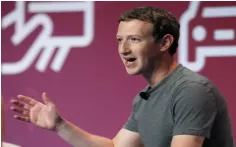
The future by mark zuckerberg
History is the story of how we’ve learnt to come together in ever greater numbers—from tribes to cities to nations. At each step, we built social infrastructure like communities, media and governments to empower us to achieve things we couldn’t on our own…. Facebook stands for bringing us closer together and building a global community.” Mark Zuckerberg does not lack chutzpah. The Facebook founder’s vision of society’s evolution places his company squarely at the heart of a future shaped by technology, in a 5,700-word manifesto released last week. The manifesto covers the breadth of today’s discourse, from globalization to the pushback against it to terrorism. And it raises several points—some inadvertently—worth debating. In the past, Zuckerberg has recommended Sapiens, Israeli historian Yuval Harari’s look at how and why humanity inherited the earth. Quite clearly, it informs his perception of Facebook’s current and future role in society, as Ezra Klein has pointed out on Vox. Humanity’s evolution from cave-dwellers required cooperation—and that cooperation, according to Harari, was based on a common understanding of communities based on shared stories. Building larger community groups—tribes, towns, cultures—required agents to promote shared myth-making and a shared reality. Thus, religions and ideologies. In his manifesto, Zuckerberg repeatedly emphasizes the global breakdown of community, shared understanding and common ground—and his ambition to have Facebook promote them. This essentially casts his company, and by extension, social media, in the same mould of supranational agents with a civilizational role. There are two problems with this. Firstly, the past few years have shown that building a community via digital means can hamper finding common ground as much as promote it. Zuckerberg recognizes this dilemma in his manifesto. On the one hand, “across the world, there are people left behind by globalization, and movements for withdrawing from global connection”. On the other, the fact that “[s]ocial media already provides more diverse viewpoints than traditional media ever has” also means that it is far easier to band together with like-minded individuals in isolated bubbles of opinion, fact and “alternative fact”.This came to a head during and after the US presidential election last year, as Zuckerberg acknowledges. As we have written in these pages, social media’s increasingly larger role as the mediator of digital socialization and news dissemination also means increasingly complicated responsibilities. The second is that Zuckerberg’s vision of Facebook as a supranational agent asks the public and governments to take a great deal on trust. One of the driving sentiments of globalization was that many of the problems facing the world today, such as terrorism and climate change, are not restricted by national boundaries. The solutions, therefore, must likewise cross those boundaries. Zuckerberg echoes this. But the current pushback against globalization has little time for grand compacts that are perceived to undermine national sovereignty and interests—and less for the traditional agents of globalization. Voters have made clear their lack of trust in corporations they see as exporting jobs and shirking taxes. Governments in Europe are likewise unenthusiastic about digital giants like Facebook and Google with their vast troves of private information on users. Given this, when Zuckerberg writes that “one of our greatest opportunities to keep people safe is building artificial intelligence to understand more quickly and accurately what is happening across our community”, it raises uncomfortable questions about what keeping people safe entails, and what it may evolve into. Debates about predictive justice utilizing AI to analyse information users posted online—and what this would mean for privacy and the nature of criminal guilt—are already on the horizon. His ambition of having Facebook provide the digital infrastructure for everything from disaster response to political processes likewise raises questions of trust and responsibility. Globalization and its discontents are old phenomena. Francis Fukuyama’s Davos Man can trace his ancestry back to the banking magnates of Renaissance-era Italian city-states that had their fingers on the economic pulse of much of the known world. Corporations being accused of re-shoring and offshoring today could have learnt a trick or two from the merchant princes of the Low Countries, agnostic in their global profiteering. European powers’ East Indies companies were undercutting sovereignty and superseding governments long before conspiracy theories and dystopian fiction about mega-corporations. But this globalization also saw pushback from places as diverse as England and China. That pushback is being echoed today, on a larger scale. There is no reason to doubt that Zuckerberg speaks in good faith. Indeed, there is much that is intriguing in his vision—from its audacity to the implications for private industry’s role in a digitally enabled world. But as the quintessential Davos Man himself, he has perhaps failed to grapple adequately with the extent of today’s pushback.





Stay updated with The Hindu Editorial Vocab24 app, your definitive source for breaking news and comprehensive coverage from India and around the globe. Whether it's political developments, business updates, sports highlights, the latest technology trends, or current events, The Hindu brings live, accurate, and reliable news directly to your device.
Don’t fall for sensationalized or fake news shared online. Read and share accurate updates with friends and family through The Hindu Editorial Vocab24 app. Download it today!
News Coverage in The Hindu Editorial Vocab24 App
Breaking News: Receive instant notifications on breaking news stories as they unfold. Stay informed about major events and developments in India and around the world with live blogs, news in shorts videos, and concise articles.
Politics: Get the latest updates on Indian politics, including elections, policy changes, government decisions, and political events that shape the nation.
Business and Economy: Stay ahead in the economic landscape with detailed business news and market analysis. Learn about stock market trends, financial reports, corporate news, and economic developments to make informed investment decisions.
Current Events: Follow stories on social issues, policy changes, global events, and daily current affairs, tailored for UPSC and other competitive exam preparations.
Technology: Keep up with the latest gadgets, innovations, and tech trends. Read expert reviews and analyses in short, concise updates on cutting-edge technology from India and beyond.
Sports: Never miss a moment of your favorite sports. Get live scores, match reports, and expert analysis on cricket, football, tennis, and more.
International News: Stay informed about global events and geopolitical developments, including the Russia-Ukraine war, Israel-Palestine conflict, and other key international stories.
Local News: Stay connected to your community with the latest updates on city events, issues, and local news. Coverage includes hyperlocal updates from cities like Bangalore, Chennai, Delhi, Hyderabad, Mumbai, Kolkata, and more.
Trending Topics: Discover what's trending today with the most talked-about stories and hot topics across India and the world.
Experience journalism that values integrity, accuracy, and reliability. Download The Hindu Editorial Vocab24 app today and stay connected with the world.
Subscribe to our newsletter!







