

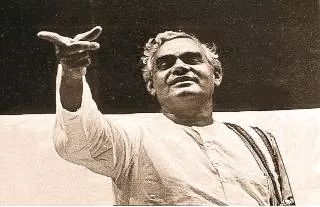
The enigma of vajpayee
He stands as the archetypal representative of what a kinder and gentler BJP can be.Atal Bihari Vajpayee was an enigma, a moderate who often appeared to be at odds with his own party and ideological fraternity, a point he openly made about himself. Yet his six year reign was a critical milestone in BJP’s journey to becoming India’s pre-eminent political party. He presided over that significant time in contemporary Indian history when BJP ended what was then called its “untouchability”. It was Vajpayee’s reputation that made it possible for regional parties to flock to BJP as the age of Congress hegemony came to an end.
Under Vajpayee, India got its first stable coalition government. It’s hard to believe today, but at some point in his reign both Mamata Banerjee and Naveen Patnaik served as Union ministers, as did Nitish Kumar. All three would go on to become powerful chief ministers. All of this was possible because Vajpayee embodied civility in public life and was quintessentially a democrat by instinct and training during his long parliamentary innings, both in Jan Sangh and BJP. So, though he was at the helm of affairs in the age of dramatic events such as the Pokhran II nuclear tests, the Kargil war, the Kandahar hijack and so much more, through it all he carried disparate allies along.
He set a model for running a federal government and for that he must be remembered and if necessary, emulated.
Vajpayee struggled to set BJP on a course that would make it more independent of its ideological fraternity. He was BJP’s first president when the party was formed in 1980, and in his presidential address he played down the legacy of RSS-Jan Sangh while highlighting the legacy of Jayaprakash Narayan (the socialist leader whose Sampoorna Kranti or ‘total revolution’ against Indira Gandhi had led to the imposition of the Emergency in 1975). Vajpayee had been part of the Janata Party experiment and he wanted to carry that experience to BJP. Yet, full of contradictions and dualisms, he also poetically described the Sangh (RSS) as being his “soul”.
But the moderate path did not bring electoral success and four years after its founding, in 1984, BJP was reduced to just two MPs in parliament with Vajpayee himself facing a humiliating defeat in Gwalior, MP. The party would eventually be rebuilt under the leadership of Lal Krishna Advani and would arrive on the national stage riding the strident wave of the Ram temple movement in the 1990s.
In the history of political parties the Advani-Vajpayee equation, with all its ups and downs, was a true partnership that put BJP on the political map of India. And it is to the credit of the strategic thinking of Advani that he recognised the limitations of his own image. It was with Advani’s encouragement that Vajpayee was posited as the BJP’s prime ministerial candidate, because he was seen as a moderate. He was also the first leader around whom the BJP built a personality centric campaign, presidential in its scale.
It was an accurate assessment that Vajpayee could bring alliance partners on board. But what was his strength, could in inner party dynamics also be perceived as a weakness, such as when a senior RSS-BJP functionary famously described Vajpayee as a “mukhauta’ or mask, saying a mask is good only for theatre!
Vajpayee’s reign as PM was indeed marked by a constant tussle with the ideological purists. His second innings as PM in 1998 (after the 13 day governmentin 1996) actually began with the RSS vetoing his choice for finance minister, Jaswant Singh, who was perceived as being too much of an advocate of free markets. Vajpayee sulk, agreed not to appoint Jaswant Singh to the post but would not agree to RSS nominees either (Yashwant Sinha got catapulted to this ministry as a compromise candidate).
I personally witnessed Vajpayee’s aversion to the aesthetics of hardline agitations, while following him on one of his campaign tours in 1998. As he stepped out of his car in Surat a volunteer, who appeared to be in a state of frenzy, began shouting “Jai Shri Ram” at a high pitch. Vajpayee just turned around and snapped; “Bolte raho Jai Shri Ram; aur karo mat koi kaam!” (keep shouting Jai Shri Ram; do little else). It was one of those Vajpayee moments i shall always remember. In an interview to me some months later his main point was that BJP should not and would not be remote controlled by RSS.
India-Pakistan relations is the theatre on which Vajpayee sought to perform and wanted peace to be his legacy. But he was thwarted by the direction in which the world was moving. The incursions into Kargil sector by Pakistani covert operators had Vajpayee calling the Pakistan prime minister and speaking of a betrayal. He got war, tension and conflict instead of peace. Yet, after all the bitterness, he still had the imagination to go to Kashmir and speak of democracy and humanity, words that were recently repeated by Prime Minister Narendra Modi during the 2018 Independence Day speech.
Vajpayee failed to achieve BJP’s autonomy from RSS, or India-Pakistan peace. But whenever strategy or politics requires BJP to appear gentler and kinder in the future, it could revisit the legacy of its first prime minister.









Stay updated with The Hindu Editorial Vocab24 app, your definitive source for breaking news and comprehensive coverage from India and around the globe. Whether it's political developments, business updates, sports highlights, the latest technology trends, or current events, The Hindu brings live, accurate, and reliable news directly to your device.
Don’t fall for sensationalized or fake news shared online. Read and share accurate updates with friends and family through The Hindu Editorial Vocab24 app. Download it today!
News Coverage in The Hindu Editorial Vocab24 App
Breaking News: Receive instant notifications on breaking news stories as they unfold. Stay informed about major events and developments in India and around the world with live blogs, news in shorts videos, and concise articles.
Politics: Get the latest updates on Indian politics, including elections, policy changes, government decisions, and political events that shape the nation.
Business and Economy: Stay ahead in the economic landscape with detailed business news and market analysis. Learn about stock market trends, financial reports, corporate news, and economic developments to make informed investment decisions.
Current Events: Follow stories on social issues, policy changes, global events, and daily current affairs, tailored for UPSC and other competitive exam preparations.
Technology: Keep up with the latest gadgets, innovations, and tech trends. Read expert reviews and analyses in short, concise updates on cutting-edge technology from India and beyond.
Sports: Never miss a moment of your favorite sports. Get live scores, match reports, and expert analysis on cricket, football, tennis, and more.
International News: Stay informed about global events and geopolitical developments, including the Russia-Ukraine war, Israel-Palestine conflict, and other key international stories.
Local News: Stay connected to your community with the latest updates on city events, issues, and local news. Coverage includes hyperlocal updates from cities like Bangalore, Chennai, Delhi, Hyderabad, Mumbai, Kolkata, and more.
Trending Topics: Discover what's trending today with the most talked-about stories and hot topics across India and the world.
Experience journalism that values integrity, accuracy, and reliability. Download The Hindu Editorial Vocab24 app today and stay connected with the world.
Subscribe to our newsletter!







