

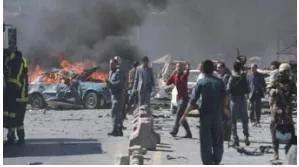
The afghan cauldron
The Afghan cauldron (a situation characterized by instability and strong emotions).Terror and violence in Afghanistan continue unabated. Nearly 200 people have been killed in the past month in deadly suicidal attacks perpetrated by the Taliban. Afghan authorities claim these outrages were masterminded by terrorists based and trained in Pakistan.
This is confirmed by the confessions of some of the captured ISIS militants. Pakistan, as usual, has denied the charge and alleged that Afghanistan is providing safe haven to the terrorists and other insurgents. The fighting usually abates during winter, but this year the Taliban and Islamic State groups have intensified their operations in response to US air assaults.
Earlier, President Trump had bluntly criticised Pakistan for providing support to the terrorists particularly the Haqqani network whose activists are killing American troops in Afghanistan.
Many in the US view Pakistan as the biggest disruptive force in Afghanistan. But this is the first time an American President has advanced such a stern (harsh, hard or severe in character or manner) message. At a meeting of the National Security Council, President Trump stated that the US has given Pakistan $ 33 billion over the past 15 years, but in turn has been deceived by Pakistan.
America has already cut off security-related assistance to Pakistan and has threatened to take more drastic steps if Pakistan does not change its course. There is little likelihood of any major shift in Pakistan’s policy under American pressure. In an article in Foreign Affairs, Sumit Ganguly and Christian Fair have written: “After much puffery, the Trump administration has sent an unequivocal message to a duplicitous (dishonest behavior that is intended to trick someone) ally.
Even if this does not change Pakistan’s behaviour, the American public will have the satisfaction of knowing that they are no longer subsidising a country that undermines its regional interest in every conceivable way”. Another columnist David Rhode, writing in New Yorker, remarked that “Pakistan has been a Frankenstein’s monster for decades but this diplomatic gun-slinging (throw it there carelessly) will end up benefitting China”.
Earlier American efforts to exert pressure on Pakistan to change its policy of covertly supporting the non-state actors in Afghanistan had not been successful. In 2011 President Obama suspended the $ 800 million assistance package and the Congress blocked the sale of F-16 fighters to Pakistan. None of these measures worked. Now the Pakistan army appears to have pushed the Haqqani network from Miran Shah, North Waziristan’s capital, to the lightly monitored frontier.
But the Pakistani generals are not willing to squeeze them any further as they fear that more pressure on the Afghan militants might trigger domestic blowbacks. There are other security considerations as well. The Pakistan army views unfriendly Afghanistan as a major security threat. Pakistan was one of the very few countries to recognise the Taliban regime as it felt that it would be friendly to Pakistan’s security interests based on the existential fear of India.
Michael KugelMan, Deputy Director of Program Asia in Wilson Centre, has pointed out that Pakistan has deep immutable (unchanging over time or unable to be changed.) strategic interests that entail maintaining ties with the Talibans.
This explains why Pakistan has not taken any determined action against the Haqqani network. It has hummed and hawed (to utter a sound representing a hesitation or pause in speech), offering up now and then some low-level Haqqani operatives and occasionally trimming the support available to them.
President Trump’s comment that India must have a larger footprint in Afghanistan is deeply worrying for Pakistan. Pakistani Generals fear that India, with Afghanistan as a base, will meddle (to interfere in something that is not your concern) in Pakistan and support the rebels in Baluchistan. Hence, Pakistan will continue to support the Haqqanis and other groups that bolster (to make (something) stronger or better) its interest of keeping India at bay in Afghanistan. Pakistani Generals are livid at American bullying.
They realise that they hold the trump card and can stop American supplies to the NATO forces and the Afghan government through Pakistan The other alternative route will be longer and require Russian consent ~ no an easy arrangement. However, America can tighten the screws on Pakistan in many ways. It happens to be the biggest export market for Pakistan. Pakistani-Americans form one of its major diaspora (a group of people who live outside the area in which they had lived for a long time or in which their ancestors lived) groups. Ryan Crocker, former American ambassador in Pakistan and Afghanistan, has said in a CNN interview that President Trump must make it clear that American troops will continue its operations in Afghanistan and help the Afghan army till some settlement is reached.
Further, it will not refrain from pursuing and striking at the Taliban even inside Pakistan. The hard fact is that without American support the Afghan army and security forces will not be able to withstand the fire and fury of the Taliban. President Ghani has also acknowledged that if American troops are now withdrawn, the present Afghan regime will collapse.
In the US military’s semi-annual assessment to Congress in June, General John Nicholson Jr. commander of US Forces said the Taliban’s exploitation of ungoverned sanctioned sanctuaries outside of Afghanistan (aka Pakistan) “is the single greatest external factor that could cause failure of the coalition campaign”.
In addition to US troops, Nato and its alliance partners have more than 6,500 troops in the theatre. The Afghan National Army numbers about 1,75,000 including the Afghan Air force. Government forces suffer from poor leadership in some areas, a lack of care for those wounded or killed, inconsistent pay, and training and inadequate living conditions.
President Ashraf Ghani has agreed to a four-year plan to reinvent the Afghan military by expanding its special forces and Air Force with continued American support. The plan envisions large-scale manoeuvres in 2020 to break the stalemate with the Taliban. The situation in Afghanistan has been further compounded by the turf war between the Taliban and ISIS insurgents.
Reports indicate that fighters owning allegiance to the Islamic State succeeded in capturing large territories from the Taliban in Nanghar province of Afghanistan which borders Pakistan. ISIS fighters are mainly the disaffected Taliban activists, disillusioned by the movement’s failure to return to power in Kabul. Black flags of the ISIS have been hoisted in some of the captured areas. Thus its intervention introduces a new dimension to the Afghan war.
Rising levels of violence and the Caliphate’s rapid growth in Afghanistan should set alarm bells ringing in Pakistan. Last year, it perpetrated one of the deadliest suicide attacks in Pakistan. Along with terrorist violence, opium cultivation has increased in Afghanistan. The UN Drug Report of 2014 states that the country produced 85 per cent of the world’s opium. Eradication programmes target the poor farmers and not the influential poppy growers. Many farmers stripped of their livelihood joined the Taliban.
Among the regional powers, China is concerned because Uighur separatists are receiving military training and acquiring experience in Afghanistan. There are also economic and political considerations. China’s Silk Route Economic Belt strategy is geared to develop infrastructure that will connect Eurasian economies, giving China better access to new markets. Being a close ally of Pakistan, China can bridge the gap between Pakistan and Afghanistan.
Trump has calculated that as long as he keeps Afghanistan from blowing up or sliding into civil war like Iraq, he can afford to keep US troops engaged without paying too high a domestic political price, according to Shibley Telhami, a pollster and professor at the University of Maryland. The risk is that there will be a sharply higher rate of US casualties that would shape America’s public opinion of the 17-year conflict.
America will have to work through diplomacy with other countries, especially China and Gulf Arab states that share US concern about Pakistan’s tolerance of terrorist organisations and individuals. While China will avoid steps that embarrass Pakistani leaders or that significantly skew (make biased or distorted in a way that is regarded as inaccurate, unfair, or misleading) the two countries’ historically close ties, Beijing may be willing to work with Washington behind the scenes to press Pakistan to crack down on terrorists within its territory. Gulf countries, too, must be encouraged to press Pakistan to change its direction.


Philippines president rodrigo duterte slams unhcr
Apr 06, 2018
Oli to take up currency ban issue with pm modi
Apr 02, 2018
Curbing the khaps
Apr 01, 2018





Stay updated with The Hindu Editorial Vocab24 app, your definitive source for breaking news and comprehensive coverage from India and around the globe. Whether it's political developments, business updates, sports highlights, the latest technology trends, or current events, The Hindu brings live, accurate, and reliable news directly to your device.
Don’t fall for sensationalized or fake news shared online. Read and share accurate updates with friends and family through The Hindu Editorial Vocab24 app. Download it today!
News Coverage in The Hindu Editorial Vocab24 App
Breaking News: Receive instant notifications on breaking news stories as they unfold. Stay informed about major events and developments in India and around the world with live blogs, news in shorts videos, and concise articles.
Politics: Get the latest updates on Indian politics, including elections, policy changes, government decisions, and political events that shape the nation.
Business and Economy: Stay ahead in the economic landscape with detailed business news and market analysis. Learn about stock market trends, financial reports, corporate news, and economic developments to make informed investment decisions.
Current Events: Follow stories on social issues, policy changes, global events, and daily current affairs, tailored for UPSC and other competitive exam preparations.
Technology: Keep up with the latest gadgets, innovations, and tech trends. Read expert reviews and analyses in short, concise updates on cutting-edge technology from India and beyond.
Sports: Never miss a moment of your favorite sports. Get live scores, match reports, and expert analysis on cricket, football, tennis, and more.
International News: Stay informed about global events and geopolitical developments, including the Russia-Ukraine war, Israel-Palestine conflict, and other key international stories.
Local News: Stay connected to your community with the latest updates on city events, issues, and local news. Coverage includes hyperlocal updates from cities like Bangalore, Chennai, Delhi, Hyderabad, Mumbai, Kolkata, and more.
Trending Topics: Discover what's trending today with the most talked-about stories and hot topics across India and the world.
Experience journalism that values integrity, accuracy, and reliability. Download The Hindu Editorial Vocab24 app today and stay connected with the world.
Subscribe to our newsletter!







