

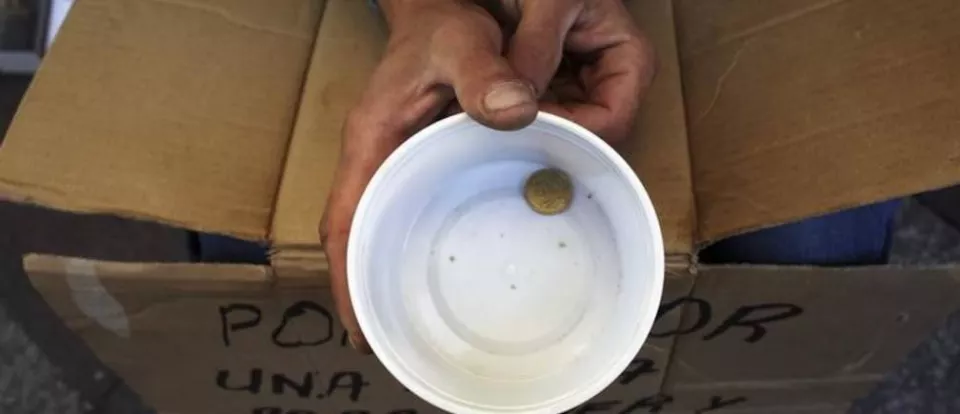
The 34 billion dollar question is microfinance the answer to poverty
Despite around US$34 billion in funding and numerous microfinance initiatives to help entrepreneurs in the world’s poorest countries, informal moneylenders and predatory loan sharks continue to thrive. Designed to help alleviate poverty in some of the world’s poorest countries, microfinance initiatives provide loans to entrepreneurs and small businesses, hoping this will help the poor to work themselves out of desperate poverty.But if formal, government-supported microfinance initiatives are widely available, why haven’t loan sharks and predatory lenders been wiped out? If microfinance cannot compete with informal lenders, can we be confident that it really works?
These questions really matter. Philanthropic donors and policy-makers are enthusiastic about microfinance initiatives and, understandably, those working in microfinance often have a vested interest in showing that their work is effective. Research into how microfinance initiatives really are performing should therefore take into account the often highly politicised context in which poverty alleviation schemes operate. But that isn’t always easy – or even possible.
In Thailand, for example, the controversy surrounding rice subsidies for poor farmers forced the former prime minister, Yingluck Shinawatra, to flee the country. She was tried and convicted in absentia. At around the same time, it was reported that, relative to their peers in South-East Asia, Thailand’s poor are getting poorer. In such politicised contexts, it is difficult to find researchers willing to ask awkward questions about why this might be so.
This means that the enthusiasm of microfinance funders is still not grounded in rigorous studies. Research on microfinance sits somewhat uncomfortably across disciplines – finance, economics, management and development studies, among others – and many research projects studying the effectiveness of microfinance schemes are driven by academics’ need to publish in high-ranking academic journals. This can lead to research that applies highly complex and discipline-specific quantitative methods to large samples of microfinance borrowers without focusing on more fundamental questions such as why predatory lenders still thrive.
Fortunately, some researchers and governments are starting to realise that we know less about these schemes’ effectiveness than we might think. That’s why my team started our research by asking a fundamental question: Why is it that moneylenders still thrive when formal microfinance is widely available?
The sceptical approach
Attempting to evaluate microfinance initiatives in isolation, many studies ignore the competition from informal lenders. In contrast, we set out to listen to people and gather information from three different sources. We conducted in-depth interviews with poor micro-entrepreneurs, many of which had borrowed from both formal and informal lenders. This latter type of borrower, in particular, drew interesting comparisons. We also interviewed representatives of formal microfinance initiatives and informal lenders, including loan sharks.
Tagging along to visit loan shark clients, ethnography-style, provided the level of insight often absent from purely quantitative studies. Interviewing both lenders and borrowers allowed us to uncover distinct informal borrowing schemes used by microbusinesses, and revealed a mismatch between incentives and strategic objectives in formal microfinance schemes.
Our recent paper aggregates findings from two studies in Indonesia – an ideal research setting because, along with Bangladesh, it hosts some of the world’s most widely available microfinance schemes.
Among our findings is that microfinance initiatives can produce unintended consequences. When poorly managed, they provide entrepreneurship opportunities for “middle men”, where borrowers who more easily qualify for loans from microfinance initiatives then lend to poorer borrowers. Consequently the poorest of the poor micro-entrepreneurs benefit less than the comparatively less poor, and this reinforces existing socio-economic hierarchies in these countries.
Getting it right (and wrong)
This informal intermediation is just one of the problems making formal microfinance initiatives less effective than they might be. In fact, the formal sector can learn a lot from the informal sector.
Poor staff management in formal organisations permits – and even fosters – informal intermediation, reducing microfinance effectiveness. We found that loan officers at formal microfinance organisations have an incentive to focus on quantitative outcomes such as the number of loans provided and rollovers of “safe” loans, rather than on funding the poorest borrowers. Loan officers know that some borrowers use their loans to lend to others; they provide loans to these informal intermediaries because they know that they will reliably pay back their loans.
We even found collusion between intermediaries and loan officers, as well as former microfinance loan officers becoming informal lenders themselves. “It is easy to do”, they said, easier than to “sell noodles or operate a small grocery stall”, and borrowers “do not care whether we have licenses or not”. During preliminary fieldwork in Thailand in August 2017, we found that informal intermediation and relending of loans between borrowers occurs there, too.
To stop predatory lenders from taking advantage of poorer borrowers, the microfinance industry needs to develop ways to identify and prevent management failures. It is also important to understand that informal lending doesn’t just involve predatory loan sharks. There is a whole spectrum of informal intermediation, for example, ranging from the benign and casual to the systematic and downright criminal.
Therefore, research on poverty alleviation must take a sceptic approach, and listen to borrowers and all lenders carefully. Without learning from the different lending schemes of informal lenders, microfinance initiatives cannot be efficient and competitive – and that is why they haven’t displaced the informal lending on which many borrowers still depend.
Courtesy : Frithjof Arp Assistant Professor

Tropical forests used to absorb carbon not any more
Jan 29, 2018
Four new 'superpowers' you should know about
Jan 23, 2018


China is creating new forests the size of ireland
Jan 13, 2018
Here's how asia can resist the rise of the robots
Jan 09, 2018





Stay updated with The Hindu Editorial Vocab24 app, your definitive source for breaking news and comprehensive coverage from India and around the globe. Whether it's political developments, business updates, sports highlights, the latest technology trends, or current events, The Hindu brings live, accurate, and reliable news directly to your device.
Don’t fall for sensationalized or fake news shared online. Read and share accurate updates with friends and family through The Hindu Editorial Vocab24 app. Download it today!
News Coverage in The Hindu Editorial Vocab24 App
Breaking News: Receive instant notifications on breaking news stories as they unfold. Stay informed about major events and developments in India and around the world with live blogs, news in shorts videos, and concise articles.
Politics: Get the latest updates on Indian politics, including elections, policy changes, government decisions, and political events that shape the nation.
Business and Economy: Stay ahead in the economic landscape with detailed business news and market analysis. Learn about stock market trends, financial reports, corporate news, and economic developments to make informed investment decisions.
Current Events: Follow stories on social issues, policy changes, global events, and daily current affairs, tailored for UPSC and other competitive exam preparations.
Technology: Keep up with the latest gadgets, innovations, and tech trends. Read expert reviews and analyses in short, concise updates on cutting-edge technology from India and beyond.
Sports: Never miss a moment of your favorite sports. Get live scores, match reports, and expert analysis on cricket, football, tennis, and more.
International News: Stay informed about global events and geopolitical developments, including the Russia-Ukraine war, Israel-Palestine conflict, and other key international stories.
Local News: Stay connected to your community with the latest updates on city events, issues, and local news. Coverage includes hyperlocal updates from cities like Bangalore, Chennai, Delhi, Hyderabad, Mumbai, Kolkata, and more.
Trending Topics: Discover what's trending today with the most talked-about stories and hot topics across India and the world.
Experience journalism that values integrity, accuracy, and reliability. Download The Hindu Editorial Vocab24 app today and stay connected with the world.
Subscribe to our newsletter!







