

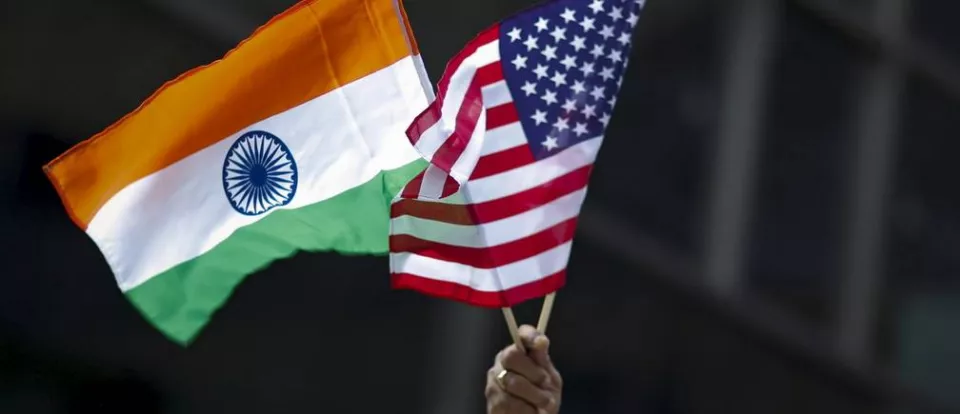
India and the us can show us how to build bridges in a fractured world
The magic of Davos lies not so much in highlighting the unexpected, but in showcasing the less than apparent. While the headlines are focused on the day-to-day, quieter and more subtle transformations occur every day. Some of these hold huge significance for our collective future.This year’s Annual Meeting marks the first time in the history of Davos that leaders of both -the world’s largest democracy and of the world’s oldest democracy - will be in attendance. The summit will be bookended by these democracies: by the opening address of Prime Minister of India, Narendra Modi, and by the closing address by the President of United States, Donald Trump. Amongst the both of them, they are elected representatives of nearly 1.7 billion people collectively, and preside over nearly a third of the world economy.
PM Modi comes to Davos at an important time in history. India is re-framing its role in the world, aiming to reclaim its position as a center of global economics and trade. The US on the other end, still the world’s only superpower, is beginning to re-evaluate its engagement in the world in a new light. This dynamic will play itself out in Davos, as no doubt, even though the US remains critically important in world affairs, and indeed for the future well-being of the planet; a united and democratic India, with its continental-sized population, diverse with religions, cultures, classes and races, becomes even more relevant in a fractured world that sometimes appear to struggle with keeping together because of these.
PM Modi is the first Indian Prime Minister to arrive in Davos after 20 years. In these 20 years, India has changed in ways not earlier imaginable. India has emerged as one of the world’s largest economies, whose technology-led growth has had a ripple effect on the economies of many countries around the world, creating new aspirations, laying the basis for new industries, providing the raw material for the Fourth Industrial Revolution, and lifting millions out of poverty.
President Trump arrives as the first US President in nearly 20 years as well. During these 20 years, the US, through its hubs of innovation that have attracted high-skilled talent from the world has led the technological revolution that has made the world more connected than ever before, laying the foundations of a potentially more transparent, more accountable and more just world. Post the fall of the Berlin Wall, no two countries have played a bigger role in bringing down technological barriers amongst people around the world than India and the US. And they have done this through cooperation, collaboration and through economies that have become more and more enmeshed through ties of commerce, business, entrepreneurship, education and kinship.
Further, more than mere statistics, the two countries, at the level of its diverse populations, represent something important: the desire and ability of hundreds and hundreds of millions of people to take their individual aspirations, varied hopes and myriads of opinions, no matter how different, to the ballot box in their desire for a better future. Citizens of both countries have decided there is no other way, but the democratic process, no matter how chaotic and contested it gets, to reach across fractures and fissures ofcomplex society, and through peaceful means.
Be that as it may, irrespective of their commonalities, in the last twenty years, the narratives of the US and India individually have also begun to diverge. The latter is an ascendant star on the world horizon, growing in influence, building new and different alliances and partnerships. India, on the other hand, has actively built economic ties with Asian countries to its East and has recalibrated its cooperation with traditional partners in the West on pragmatic terms, shedding decades of post-colonial legacies. As a testimony to its growing influence in the eastern bloc, India will welcome not one head of state as is customary, but all the heads of state of the ASEAN block in an unprecedented break with protocol on the country’s upcoming Republic Day.
When Prime Minister Modi and President Trump address those gathered in Davos, the world will be listening to what they have to say about the challenges and opportunities in today’s world. Both countries show how to build a bridge in a seemingly fractured world: through intent, patience and interconnectedness, and demonstrate how they are pursuing seemingly different destinies in the same world. The hope placed on the leaders will also be that they tune into a less feted success of our modern times that quietly powers the world’s democratic ideals and the aspirations of billions who live inside and outside these two countries.
What is certain, is that Davos participants will be treated to and left to consider, debate and absorb the implications of the many paradoxes that the new-Old, i.e., India, and the old-New, i.e. the US, present to the future.
Courtesy : Viraj Mehta, Head of Regional Strategies - India and South Asia, Member of the Executive Committee, World Economic Forum Geneva

Tropical forests used to absorb carbon not any more
Jan 29, 2018
Four new 'superpowers' you should know about
Jan 23, 2018

China is creating new forests the size of ireland
Jan 13, 2018

Here's how asia can resist the rise of the robots
Jan 09, 2018





Stay updated with The Hindu Editorial Vocab24 app, your definitive source for breaking news and comprehensive coverage from India and around the globe. Whether it's political developments, business updates, sports highlights, the latest technology trends, or current events, The Hindu brings live, accurate, and reliable news directly to your device.
Don’t fall for sensationalized or fake news shared online. Read and share accurate updates with friends and family through The Hindu Editorial Vocab24 app. Download it today!
News Coverage in The Hindu Editorial Vocab24 App
Breaking News: Receive instant notifications on breaking news stories as they unfold. Stay informed about major events and developments in India and around the world with live blogs, news in shorts videos, and concise articles.
Politics: Get the latest updates on Indian politics, including elections, policy changes, government decisions, and political events that shape the nation.
Business and Economy: Stay ahead in the economic landscape with detailed business news and market analysis. Learn about stock market trends, financial reports, corporate news, and economic developments to make informed investment decisions.
Current Events: Follow stories on social issues, policy changes, global events, and daily current affairs, tailored for UPSC and other competitive exam preparations.
Technology: Keep up with the latest gadgets, innovations, and tech trends. Read expert reviews and analyses in short, concise updates on cutting-edge technology from India and beyond.
Sports: Never miss a moment of your favorite sports. Get live scores, match reports, and expert analysis on cricket, football, tennis, and more.
International News: Stay informed about global events and geopolitical developments, including the Russia-Ukraine war, Israel-Palestine conflict, and other key international stories.
Local News: Stay connected to your community with the latest updates on city events, issues, and local news. Coverage includes hyperlocal updates from cities like Bangalore, Chennai, Delhi, Hyderabad, Mumbai, Kolkata, and more.
Trending Topics: Discover what's trending today with the most talked-about stories and hot topics across India and the world.
Experience journalism that values integrity, accuracy, and reliability. Download The Hindu Editorial Vocab24 app today and stay connected with the world.
Subscribe to our newsletter!







