

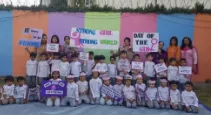
Second wave feminism
In the well-established democracies of the West, feminism in the post-World War II era became concerned with independence, and with greater political action to improve women’s rights and economic equality between the genders, to address the rights of female minorities, rather than absolute rights, such as, suffrage (the right to vote in political elections.).A new phrase, the ‘second wave’, was coined by Marsha Lear. It was referred to as the second wave, as its advocates highlighted the failure of the early, or the first-wave feminism to achieve its aims. The term ‘first wave’ was used retroactively, after the emergence of the second-wave feminism, to describe the more recent feminist movement.
The first wave of feminism was the first concerted movement for the reform of women’s social and legal inequalities in the nineteenth century.
It was about women as women; it glorified motherhood, accepted the basic aspects of the division of labour between the sexes, that women were responsible for home and for bringing up children, while men were responsible for the public world of paid work.
Based on these parameters, the arguments for women’s suffrage were articulated. The second wave of feminism was about women as persons celebrating personhood. It called for the breaking down of the division of labour between the sexes, which was perceived to be the reason for women’s oppression. It demanded that women ought to play an equal role in the world of paid work and that men should play an equal part at home.
While the first wave defined equality around the idea of sameness between women and men, the second wave stressed on equality on the basis of the difference between women and men. The second wave was shaped and dominated by what has come to be known as radical feminism.
The phenomenon primarily emerged in the late 1960s in New York and Boston in the United States among women who were politically active in the civil rights movement and the anti-Vietnam war campaigns. Some of its ideas had their roots in the cultural/ material feminist tradition of the United States in the late nineteenth century, though many viewed radical feminism as a new deviation of the 1960s.
It emerged in response to women’s experience of the limitations of ‘equal rights’ of their marginalisation in the left-wing and radical male dominated movements and, above all, in the advances in knowledge and understanding which women had attained thanks decades of access to education. Radical feminism located the root cause of women’s oppression in patriarchy (a system of society or government in which men hold the power and women are largely excluded from it.). It symbolized female rage (anger or aggression associated with conflict arising from a particular situation.) against male power, against patriarchy.
Many of them were ideologically with the New Left and its ‘great refusal’ of American capitalism. They wanted a radical transformation of society and of personal life, and were ready to speak out about abortion, rape, lesbianism, orgasms, imperialism and welfare. Kate Millett (1934-2017) was among the notable second-wave feminists of this period.
Her Sexual Politics (1969) presented a ‘manifesto for revolution’ in the winter of 1968 to a women’s group at Columbia University, where Millett was a doctoral student in English and comparative literature. The manifesto declared that when one group ruled over another, the relationship between the two was political.
When such an arrangement was carried out over a long period of time, it evolved into an ideology. The doctoral thesis was revised and published as Sexual Politics. Over 10,000 copies were sold in a fortnight.
“The fusing together of the words “sexual” and “politics” opened up new theoretical possibilities for feminist debate”, according to Whelehan. This enabled “the assertion that all things private and personal in women’s lives were affected by the politics of the state and patriarchy”.
The New York Times in its review in 1970, described the book as the ‘Bible of Women’s Liberation’. Time magazine described her as ‘the Mao Tse Tung of Women’s Liberation’. The sexual domination of men over women was the most pervasive ideology, and the most fundamental power structure in society.
The principles of patriarchy were two-fold: (a) men shall dominate over women, and (b) older men shall dominate over the young. Sexual politics was the politics of patriarchy. All historical civilisations were patriarchies: their ideology was embedded in male supremacy. The family was the chief institution of patriarchy. Patriarchal power is socially constructed as opposed to biological or the innate (inborn; natural.).
Male supremacy and women’s subordination were the core of patriarchal ideology. Millet explained how patriarchy, or male-rule, was maintained~ “Government is upheld by power, which is supported through consent (social opinion), or imposed by violence. Conditioning to an ideology accounts to the former.
But there may be a resort to the latter at any moment when consent is withdrawn ~ rape, attack, sequestration (the action of taking forcible possession of something), beatings, murder. Sexual politics obtains consent through the socialisation of both sexes to patriarchal policies”. The family, for Millet, was the main source of ideological indoctrination (the process of teaching a person or group to accept a set of beliefs uncritically.), and was needed for reproduction of patriarchy.
It socialised ‘the young into the patriarchal ideology’s prescribed attitudes towards the categories of role, temperament and status’. Millett pointed out that in traditional families, women did not have a legal standing, nor did they own property.
In contemporary patriarchy, women have rights but are economically subordinate, first because they are not paid for the work that was done at home, and second because they were restricted to subordinate employment opportunities. A complete sexual revolution, which would destroy the traditional taboos on homosexuality, bastardry, adolescent, pre and extra-marital sex, was needed to overthrow patriarchy.
The family would be replaced with professional collective care of the young, and with public education. This revolution would come about primarily in the realm (a field or domain of activity or interest.) of human consciousness with the destruction of male supremacist ideas and its traditional forms of socialisation. Millett acknowledged the changes that have taken place in institutions but not in the habits of the mind. Her arguments were akin to Gramsci and Althusser who held that the state maintained its rule though not through force but primarily by ideological hegemony (leadership or dominance, especially by one state or social group over others.).
She catalogued (make a systematic list of (items of the same type).) ‘instances of sexual politics’, which she drew from modern literature, and in this context mentioned the works of DH Lawrence, Henry Miller and Norman Mailer. She pointed out that Freud continued with the misogynistic (strongly prejudiced against women.) Western philosophical tradition that Aristotle initiated; one that saw a woman as an incomplete male. Freud presumed the superiority of the male anatomy, which prevented him from identifying social institutions as the cause for women’s unhappiness. She wanted feminism to be revolutionary and not incremental like the first-wave feminism. The striking feature of Millett’s Sexual Politics, according to Mead, was its vision of freedom and a radically transformed society.
Writing on Millett, Andrea Dworkin said: “Betty Friedan had written about the problem that had no name. Kate Millett named it, illustrated it, exposed it, analysed it”. Millett’s Sexual Politics provided a transformative critique of feminism and has been a reference point since then. No feminist treatise (a written work dealing formally and systematically with a subject.) is complete without reference to her seminal contribution.



Philippines president rodrigo duterte slams unhcr
Apr 06, 2018
Oli to take up currency ban issue with pm modi
Apr 02, 2018
Curbing the khaps
Apr 01, 2018





Stay updated with The Hindu Editorial Vocab24 app, your definitive source for breaking news and comprehensive coverage from India and around the globe. Whether it's political developments, business updates, sports highlights, the latest technology trends, or current events, The Hindu brings live, accurate, and reliable news directly to your device.
Don’t fall for sensationalized or fake news shared online. Read and share accurate updates with friends and family through The Hindu Editorial Vocab24 app. Download it today!
News Coverage in The Hindu Editorial Vocab24 App
Breaking News: Receive instant notifications on breaking news stories as they unfold. Stay informed about major events and developments in India and around the world with live blogs, news in shorts videos, and concise articles.
Politics: Get the latest updates on Indian politics, including elections, policy changes, government decisions, and political events that shape the nation.
Business and Economy: Stay ahead in the economic landscape with detailed business news and market analysis. Learn about stock market trends, financial reports, corporate news, and economic developments to make informed investment decisions.
Current Events: Follow stories on social issues, policy changes, global events, and daily current affairs, tailored for UPSC and other competitive exam preparations.
Technology: Keep up with the latest gadgets, innovations, and tech trends. Read expert reviews and analyses in short, concise updates on cutting-edge technology from India and beyond.
Sports: Never miss a moment of your favorite sports. Get live scores, match reports, and expert analysis on cricket, football, tennis, and more.
International News: Stay informed about global events and geopolitical developments, including the Russia-Ukraine war, Israel-Palestine conflict, and other key international stories.
Local News: Stay connected to your community with the latest updates on city events, issues, and local news. Coverage includes hyperlocal updates from cities like Bangalore, Chennai, Delhi, Hyderabad, Mumbai, Kolkata, and more.
Trending Topics: Discover what's trending today with the most talked-about stories and hot topics across India and the world.
Experience journalism that values integrity, accuracy, and reliability. Download The Hindu Editorial Vocab24 app today and stay connected with the world.
Subscribe to our newsletter!







