

SC pauses Aravalli ruling, moots new panel
Court keeps in abeyance November 20 decision upholding govt. definition of mountain systemThe definition meant only 1,048 Aravalli hills in Rajasthan would meet the elevation threshold
Activists fear unbridled mining in the hill ranges, which serve as a barrier against the Thar desert
The Supreme Court on Monday kept in abeyance its November 20 judgment upholding a government expert panel definition restricting the world’s oldest surviving mountain system, the Aravalli Range, to hills sporting an elevation of 100 metres or above, and hill clusters, slopes, and hillocks located within 500 metres of each other.
“This stay shall remain in effect until the present proceedings reach a state of logical finality, ensuring that no irreversible administrative or ecological actions are taken based on the current framework,” the court ordered. It directed that no fresh or renewed mining leases should be given without prior permission of the top court.
A three-judge Bench, headed by Chief Justice of India Surya Kant, took suo motu cognisance of the widely publicised public apprehension over the restrictive definition, especially that only 1,048 Aravalli hills out of a total 12,081 in Rajasthan alone would meet the 100-metre elevation threshold and, consequently, the lower ranges would be “stripped off” the environmental protection due to them. The court agreed that if true, it would be a “significant regulatory lacuna” in safeguarding the Aravallis.
High-powered panel
The Bench proposed the constitution of a high-powered committee to analyse whether “sustainable mining” or “regulated mining” within the newly demarcated Aravalli areas, notwithstanding regulatory oversight, would result in any adverse ecological consequences.
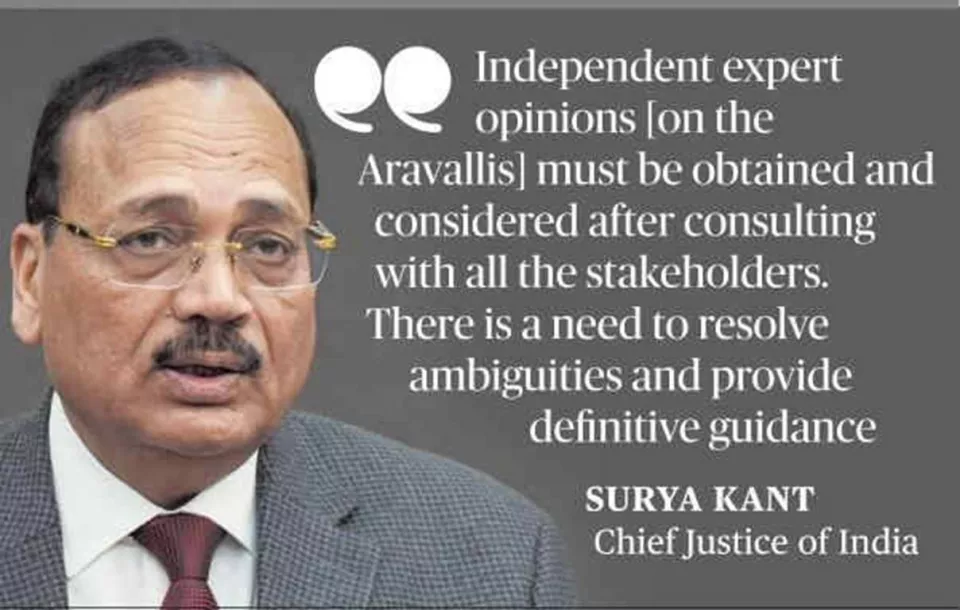
“Independent expert opinions must be obtained and considered after consulting with all the stakeholders. There is a need to resolve ambiguities and provide definitive guidance,” Chief Justice Kant said. The committee would assess the areas no longer covered by the definition, specifically whether such exclusion risks their eventual degradation, thereby compromising the overall ecological integrity of the Aravalli Range.
The restrictive definition upheld by the top court in November had sparked a public furore across the four Aravalli States of Rajasthan, Uttar Pradesh, Haryana, and Delhi, with environmentalists and activists voicing concerns that the shrinking of protection would open the doors for unbridled mining in the hill ranges, which act as a green barrier against the eastward expansion of the Thar desert, and worsen pollution in cities such as Delhi.
Critical issues
The proposed panel would also hold a multi-temporal evaluation of the short-term and long-term environmental impacts resulting from the implementation of the recommended definition and its associated directions.
The Bench said several critical issues needed further clarification, including “whether the restrictive demarcation has inversely broadened the scope of ‘non-Aravalli’ areas, thereby facilitating the continuation of unregulated mining and other disruptive activities in terrains ecologically contiguous but technically excluded by this definition”.
The court indicated that the definition of the Aravalli range must be arrived at only after exhaustive scientific and geological estimations, and precise measurements of all the hills and hillocks.
The definition of the Aravallis, the court underscored, must be more nuanced and and measured to maintain the “ecological integrity of the entire range”.
The government, represented by Solicitor-General Tushar Mehta, said the court’s acceptance of the recommendations of a committee of the Ministry of Environment, Forest and Climate Change has led to “misconceptions and misrepresentations” about the court and the government in the public domain.
Mr. Mehta flagged that the judgment had directed the preparation of a “Management Plan for Sustainable Mining” by the Environment Ministry through the Indian Council of Forestry Research and Education, which would have had to get the nod of the top court.
‘Structural paradox’
A definition restricting the Aravalli Range to clusters within 500 m of each other may introduce a “structural paradox” wherein the geographical scope of protected territory would be significantly narrowed, the court said. The court explained whether clusters with larger gaps but contiguous to the Aravalli terrain would be then opened to unregulated mining and other “disruptive activities”, thereby causing and spreading extensive damage even to the protected areas.
The court listed the suo motu case on January 21.


Ensure peace, freedom of navigation, PM urges Iran
Sep 03, 2026







Stay updated with The Hindu Editorial Vocab24 app, your definitive source for breaking news and comprehensive coverage from India and around the globe. Whether it's political developments, business updates, sports highlights, the latest technology trends, or current events, The Hindu brings live, accurate, and reliable news directly to your device.
Don’t fall for sensationalized or fake news shared online. Read and share accurate updates with friends and family through The Hindu Editorial Vocab24 app. Download it today!
News Coverage in The Hindu Editorial Vocab24 App
Breaking News: Receive instant notifications on breaking news stories as they unfold. Stay informed about major events and developments in India and around the world with live blogs, news in shorts videos, and concise articles.
Politics: Get the latest updates on Indian politics, including elections, policy changes, government decisions, and political events that shape the nation.
Business and Economy: Stay ahead in the economic landscape with detailed business news and market analysis. Learn about stock market trends, financial reports, corporate news, and economic developments to make informed investment decisions.
Current Events: Follow stories on social issues, policy changes, global events, and daily current affairs, tailored for UPSC and other competitive exam preparations.
Technology: Keep up with the latest gadgets, innovations, and tech trends. Read expert reviews and analyses in short, concise updates on cutting-edge technology from India and beyond.
Sports: Never miss a moment of your favorite sports. Get live scores, match reports, and expert analysis on cricket, football, tennis, and more.
International News: Stay informed about global events and geopolitical developments, including the Russia-Ukraine war, Israel-Palestine conflict, and other key international stories.
Local News: Stay connected to your community with the latest updates on city events, issues, and local news. Coverage includes hyperlocal updates from cities like Bangalore, Chennai, Delhi, Hyderabad, Mumbai, Kolkata, and more.
Trending Topics: Discover what's trending today with the most talked-about stories and hot topics across India and the world.
Experience journalism that values integrity, accuracy, and reliability. Download The Hindu Editorial Vocab24 app today and stay connected with the world.
Subscribe to our newsletter!







