

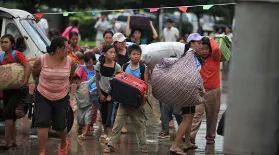
Rohingya crisis should concern region
Reacting to the insurgent attacks on some police outposts and an army camp on August 25, the Myanmar security forces have unleashed a ‘war’ of sorts on the Rohingya Muslims – an ethnic minority group living for centuries in the Rakhine state of Myanmar – burning down their villages, killing their men and raping their women, committing what can be termed as ‘crimes against humanity’ that have resulted in nearly 500 dead and nearly 200,000 taking shelter in Bangladesh, which has hosted Rohingya refugees for more than three decades in varying numbers depending on the level of oppression across the border.Myanmar, then called Burma, became independent in 1948 from the British, a year after the latter’s withdrawal from the Indian subcontinent in 1947. Geographically Rakhine state, where the current conflict is taking place, is separated from the rest of Myanmar by a barren mountain range. Ancient history gives the area its own separate past with a distinct Rakhine Kingdom being established in 1430 with its capital in Mrauk U located as a link between Buddhist and Muslim Asia with close ties with the Sultanate of Bengal.
After 350 years of independent existence Rakhine State was conquered by the Burmese in 1784. This annexation was short lived as the territory was occupied by the British in 1824 and made a part of the British Indian Empire.
Today the Rohingyas are about 1.1 million Muslim citizens of the Rakhine state but are not recognised legally as one of the 135 ethnic groups constituting a part of the citizenry of Myanmar. It is perhaps not just a coincidence that the current attack on the Rohingyas follows on the heels of the report of the Rakhine Advisory Commission led by the former UN Secretary General Kofi Annan.
This Commission was set up with active participation of the Myanmar government, albeit under severe pressure from the international community, and whose findings it had earlier pledged to implement. Now with the latest spate of violence the prospect of implementation of the Rakhine Commission recommendations appears remote and the possibility of a peaceful resolution of the Rohingya crisis may elude us once more.
The Commission has correctly identified the central questions to be “citizenship verification, documentation, rights and equality before the law” and goes on to say that “… if they are left to fester, the future of the Rakhine state – and indeed of Myanmar as a whole – will be irretrievably jeopardized.”
As we see it from Bangladesh, it is not only the future of Myanmar which will be jeopardised but that of this region itself as the Secretary General of the UN warned last Wednesday (6th September). China, given its historical links, will take more than a passing interest in this affair, an effort in which it will be supported by Russia the indications of which is discernible in their pattern of voting at the UN Security Council on recent resolutions on Rohingya issue.
The bloc of Arab and Muslim countries will naturally be drawn into this fray as fellow Muslims are being slaughtered. Already there is sufficient reason for concern at the flow of Middle eastern money in the region with distinct fundamentalist overtones.
We all know about Rohingyas finding their way into various Arab and Muslim countries with stories of atrocities invoking a natural reaction for seeking justice and fighting a future of fear and intimidation by building up some sort of resistance including armed.
These are but natural outcomes of prolonged oppression to which the Annan Report clearly alludes to. The US is likely to be more interested than usual given its deteriorating relationship with both China and Russia and the rising tiff in the South China Sea, not to speak of tension with North Korea and its unpredictable and dangerous consequences.
India has completely surprised Bangladesh by its all out endorsement of Myanmar’s position.
We, naively as it now appears, were hoping that Prime Minister Modi’s visit to Myanmar would help, if not to solve issue but at least to stop the violence and ebb the flow of refugees.
PM Modi’s support to Myanmar’s position and the absence of any substantive reference to the refugees issue and the consequent humanitarian disaster has greatly disappointed Bangladesh. The rising terrorism that both Prime Minister Modi and the Aung San Suu Kyi have pledged to fight are created and sustained by oppression and ignoring the rights of a minority group. That has been the experience everywhere. For the so-called “Jihadists” the oppression of the Rohingyas fit the bill completely as a cause they will espouse to gain credibility in the Muslim world whose natural support for this oppressed group of Muslims is only obvious.
In this regard the emergence of ARSA (Arakan Rohingya Salvation Army) is something that should concern all. In the early hours of August 25 this group, whose Arabic name is Harakah al-Yaqin simultaneously attacked 30 police posts and an army base in the northern side of the Rakhine state. Twelve Myanmar troops and officials and 77 insurgents were killed.
This is by far the most audacious and damaging attack by the insurgents who are mostly equipped with machetes, few small arms and hand held explosives.
The emergence of such an armed group cannot be welcomed by any country wanting peace and stability in this region.
The International Crisis Group (ICG) termed this as the most serious escalation in the conflict. Obviously the biggest losers from the escalation and continuation of this conflict will be the two countries directly affected – Myanmar and Bangladesh. Bangladesh has not yet taken any hard-line against its only other neighbour save India and has tried, over the years to reach an understanding with Myanmar.
It has internationalised the issue only to the extent of seeking humanitarian aid and nothing more. It first received about 300,000 Rohingya refugees in 1978. Through negotiations about 210,000 were repatriated with the rest continuing to live in Bangladesh. However, the latest situation has changed everything. Bangladesh will now be under severe pressure from the Arab and Muslim world to internationalise the issue and take a tougher stance than it has hitherto taken.
The visits of the Indonesian and Turkish foreign ministers are indications of that.
If there is no change in the situation on the ground Bangladesh will be left with little option but to take a tougher stance leading to further complicating the situation.
Myanmar on its part must realise that blaming all the current atrocities on the so-called terrorists and claiming that its security forces had nothing to do with the crimes committed, in spite of unvarying account of thousands of refugees to the contrary, is neither credible nor helpful in solving the situation. The Kofi Annan Commission has painstakingly worked out what international experts say is a realistic path towards peaceful resolution of a conflict that left to itself may become a dangerous crisis.
Myanmar must pay heed to the recommendations of that report. Aung San Suu Kyi, the leader of Myanmar needs to remember what she herself said in her Nobel Prize acceptance speech that “Whenever suffering is ignored, there will be seeds of conflict, for suffering degrades and embitters and enrages”.

Driving oneself to death
Sep 07, 2017
Extreme views extreme actions
Aug 25, 2017





Stay updated with The Hindu Editorial Vocab24 app, your definitive source for breaking news and comprehensive coverage from India and around the globe. Whether it's political developments, business updates, sports highlights, the latest technology trends, or current events, The Hindu brings live, accurate, and reliable news directly to your device.
Don’t fall for sensationalized or fake news shared online. Read and share accurate updates with friends and family through The Hindu Editorial Vocab24 app. Download it today!
News Coverage in The Hindu Editorial Vocab24 App
Breaking News: Receive instant notifications on breaking news stories as they unfold. Stay informed about major events and developments in India and around the world with live blogs, news in shorts videos, and concise articles.
Politics: Get the latest updates on Indian politics, including elections, policy changes, government decisions, and political events that shape the nation.
Business and Economy: Stay ahead in the economic landscape with detailed business news and market analysis. Learn about stock market trends, financial reports, corporate news, and economic developments to make informed investment decisions.
Current Events: Follow stories on social issues, policy changes, global events, and daily current affairs, tailored for UPSC and other competitive exam preparations.
Technology: Keep up with the latest gadgets, innovations, and tech trends. Read expert reviews and analyses in short, concise updates on cutting-edge technology from India and beyond.
Sports: Never miss a moment of your favorite sports. Get live scores, match reports, and expert analysis on cricket, football, tennis, and more.
International News: Stay informed about global events and geopolitical developments, including the Russia-Ukraine war, Israel-Palestine conflict, and other key international stories.
Local News: Stay connected to your community with the latest updates on city events, issues, and local news. Coverage includes hyperlocal updates from cities like Bangalore, Chennai, Delhi, Hyderabad, Mumbai, Kolkata, and more.
Trending Topics: Discover what's trending today with the most talked-about stories and hot topics across India and the world.
Experience journalism that values integrity, accuracy, and reliability. Download The Hindu Editorial Vocab24 app today and stay connected with the world.
Subscribe to our newsletter!







