

Extreme views extreme actions
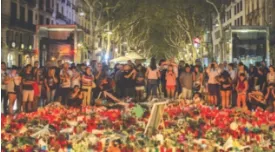
Given that Barcelona is among the most popular tourist destinations in Europe, it is hardly surprising that almost all victims of last Thursday’s terrorist rampage (a period of violent and uncontrollable behaviour by a group of people.) came from different parts of the world.The murderous intent, as is usual in such cases, was indiscriminate. Precisely what motivated the young Muslims, several of them still in their teens, to participate in the gory (involving or showing violence and bloodshed.) plot is open to conjecture, although it is probably safe to assume that a profoundly misguided view of religious obligations was a part of the mix.
News reports suggest they were radicalised by a Salafist imam – who, like the terrorists, was of Moroccan origin, and died in the massive explosion in Alcanar when gas canisters stored for the purpose of staging a more explosive attack thankfully blew up prematurely.
Apparently, the intended target was the Sagrada Familia church, the most prominent example of Antonio Gaudi’s quirky (having or characterized by peculiar or unexpected traits or aspects.) architecture in a city delightfully peppered with (filled with) examples of his unorthodox designs. The resort to a vehicle as an instrument of terrorism – along the lines of attacks in France, Germany and Britain – seems to have been Plan B. And although even a single life lost in such horrifying instances is one too many, the toll, dreadful as it was, could have been much worse.
Much the same could be said about the violence in Charlottesville, Virginia the previous weekend, where a radicalised young man targeted anti-fascist protesters by driving a car into them and killing Heather Heyer, a legal assistant. She was among those who rallied to oppose the Unite the Right demonstration organised by a panoply (array) of racist groups, ostensibly to oppose the local government’s decision to remove a statue of Confederate general Robert E. Lee that had been put up in 1924, almost 60 years after the South had lost its right to perpetuate (make (something) continue indefinitely.) slavery.
The American Civil War ended in 1865, but the struggle to clarify its legacy goes on. The period known as Reconstruction was relatively short-lived. It wasn’t until a century after Abraham Lincoln’s Emancipation Proclamation that voting rights and other constitutional guarantees of equality for African Americans were ensconced (establish or settle) in law.
Even so, the white supremacists have sporadically resurfaced. They were suitably impressed by Donald Trump’s efforts, long before he became a presidential candidate, to insinuate that anyone called Barack Hussein Obama could hardly be American.
They were even more enthused when candidate Trump articulated slurs (an insinuation or allegation about someone that is likely to insult them or damage their reputation.) against Mexicans and declared he would institute a ban on Muslims entering the US. After Charlottesville, he was quiet for a while, then announced he saw little difference between the neo-Nazis and their opponents. He was subsequently persuaded to be more clear-cut in his denunciation of racists, but thereafter returned to his original formulation, declaring that there were “many fine people” on both sides.
The president may have felt flattered because some of the far-right demonstrators wore ‘Make America Great Again’ caps, never mind that many of them were echoing the ‘blood and soil’ slogans of the German Nazis amid considerable evidence of distinctly anti- Semitic vibes. His ambiguity spurred a backlash from leading lights of the Republican Party as well as the captains of industry, which flowed into the West Wing disarray that has crippled the White House.
The announcement of a ‘new’ strategy for Afghanistan (and Pakistan) was at least partially an attempt to restore presidential authority, presaging increased participation in an essentially unwinnable war. But the darkness that simultaneously crept across the continental US, courtesy of a complete solar eclipse, was perhaps a better metaphor for its current woes at home and abroad.
Writing recently in The Guardian, Jason Burke drew appropriate parallels between the Islamist and American nationalist varieties of the far right, with- out claiming equivalence. It is perfectly true that those determined to spread hatred prey on ( to take advantage of someone or something.) vulnerable young minds and channel their grievances towards antagonism against ‘the other’, invariably those of a different religion, race or ethnicity. Wherever this attempt succeeds, the consequences tend to be horrendous.
At the most basic level, such tendencies derive from a refusal to recognise the common humanity we all share. In the narrative of the Islamists, anyone not fundamentally wedded to a heinous interpretation of the faith is fair game. Among American nationalists, the enemies range from people of colour to Jews and ‘communists’, a list that has not changed a great deal since the resurgence in far-right tendencies after the Second World War, amid open references to “finishing Hitler’s work”.
Back then, Harry Truman, who ushered in the American security state, baulked (hesitate or be unwilling to accept an idea or undertaking.) from taking action against African American lynchings. But neither he nor his successors in the White House, regardless of how far to the right they leaned or how shamelessly they dog-whistled, publicly declared neo- Nazis to be “very fine people”. The shift is both telling and ominous.

Rohingya crisis should concern region
Sep 09, 2017
Driving oneself to death
Sep 07, 2017





Stay updated with The Hindu Editorial Vocab24 app, your definitive source for breaking news and comprehensive coverage from India and around the globe. Whether it's political developments, business updates, sports highlights, the latest technology trends, or current events, The Hindu brings live, accurate, and reliable news directly to your device.
Don’t fall for sensationalized or fake news shared online. Read and share accurate updates with friends and family through The Hindu Editorial Vocab24 app. Download it today!
News Coverage in The Hindu Editorial Vocab24 App
Breaking News: Receive instant notifications on breaking news stories as they unfold. Stay informed about major events and developments in India and around the world with live blogs, news in shorts videos, and concise articles.
Politics: Get the latest updates on Indian politics, including elections, policy changes, government decisions, and political events that shape the nation.
Business and Economy: Stay ahead in the economic landscape with detailed business news and market analysis. Learn about stock market trends, financial reports, corporate news, and economic developments to make informed investment decisions.
Current Events: Follow stories on social issues, policy changes, global events, and daily current affairs, tailored for UPSC and other competitive exam preparations.
Technology: Keep up with the latest gadgets, innovations, and tech trends. Read expert reviews and analyses in short, concise updates on cutting-edge technology from India and beyond.
Sports: Never miss a moment of your favorite sports. Get live scores, match reports, and expert analysis on cricket, football, tennis, and more.
International News: Stay informed about global events and geopolitical developments, including the Russia-Ukraine war, Israel-Palestine conflict, and other key international stories.
Local News: Stay connected to your community with the latest updates on city events, issues, and local news. Coverage includes hyperlocal updates from cities like Bangalore, Chennai, Delhi, Hyderabad, Mumbai, Kolkata, and more.
Trending Topics: Discover what's trending today with the most talked-about stories and hot topics across India and the world.
Experience journalism that values integrity, accuracy, and reliability. Download The Hindu Editorial Vocab24 app today and stay connected with the world.
Subscribe to our newsletter!







