

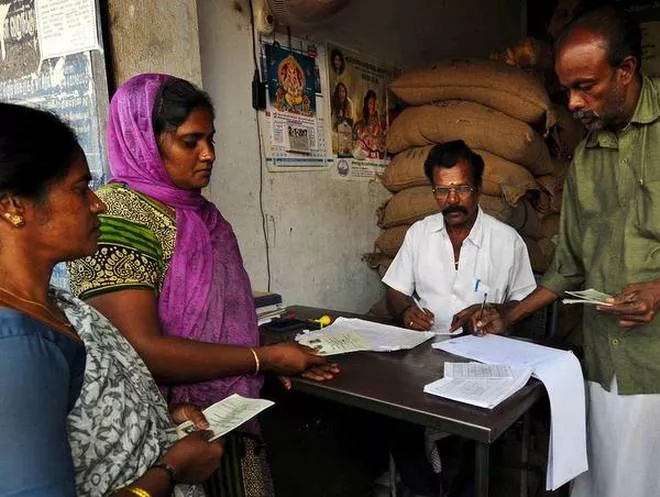
Providing food to the poor or targeted groups at subsidized prices is fully wto compatible
Providing food to the poor or targeted groups at subsidised prices is fully WTO-compatible Transformational changes are taking place in India currently, improving the way we live. These changes are impacting all our lives in small or significant ways. It is gratifying to know that the citizens at large are happy with these changes. However, for some who have fed themselves on the fodder that such changes are not for the near future, there is consternation. Even worse, these people find it difficult to comprehend that technology and policy are working together to remove discretion and opaqueness.The
ongoing discourse, particularly in Tamil Nadu, on the Public Distribution System (PDS), the procurement of grains/pulses from farmers, public storage in Food Corporation of India godowns, commitments made in the World Trade Organisation (WTO), Direct Benefit Transfer, etc. is interesting. However, there are strands in this discourse which are impressionistic and not based on data. They create a populist narrative and distract from the core issues. It is necessary, therefore, to infuse facts into the discourse.
Facts
in Tamil Nadu The PDS in Tamil Nadu is intact and continues to retain the feature of universal coverage even after implementation of the National Food Security Act, 2013 (NFSA). Although the guidelines under the NFSA prescribe identification of priority households, there is no denial of any benefit under the PDS. There is no reduction even in the total coverage from the earlier Targeted Public Distribution System, which was effective till Tamil Nadu joined the NFSA in November 2016. The average annual off take or the annual allocation has remained 36.78 lakh tonnes. The major part of the subsidy for the distribution of food grains (90.81% for rice and 91.70% for wheat) is borne by the Government of India.
The
implication of this subsidy allocation to Tamil Nadu alone on the Government of India is approximately ₹843 crore per month and approximately ₹10,120 crore per year. Since the central issue price under the NFSA is much lower compared to the erstwhile Targeted Public Distribution System, the burden on the State government has come down. On implementing the NFSA, the savings for the State exchequer on account of this subsidy, thanks to the lower central issue price, is approximately ₹436.44 crore per year.
Union
Consumer Affairs Minister Ram Vilas Paswan on August 1 stated in a series of tweets the data for Tamil Nadu and also highlighted the fact that Tamil Nadu gets the highest allocation in the country as ‘tide over’ allocation of 12.52 lakh metric tonnes of food grains. The narrative in Tamil Nadu cannot be devoid of these facts.
Ensuring
trade transparency Another disturbing strand in this narrative in Tamil Nadu is that the Indian government has callously sold away the interests of our farmers at the WTO by agreeing to the Trade Facilitation Agreement. Nothing can be further from the truth than this!
The
Trade Facilitation Agreement was agreed on in 2013 in Bali and came into force from February 2017 after two-thirds of the WTO’s 164 members ratified it. Several trade-related issues such as transparency, predictability and efficiency at the ports, faster clearance procedures, and improved appeal rights for traders are to be addressed by countries. They shall notify various provisions to bring in the facilitation, over three years or more. Only the basic set of provisions will be implemented within one year. The Trade Facilitation Agreement allows for consultations before any new trade rules are notified. A WTO study indicated that when the Trade Facilitation Agreement is fully implemented, trade costs for member countries will decrease by an average of 14.3%. It is also estimated that the time taken to export and import will come down drastically. Finance Minister Arun Jaitley has made budgetary allocations for bringing in single-window clearance and improving customs clearance at the ports. A high-level committee chaired by the Cabinet Secretary will monitor logistics and efficiency at ports and related issues.
Thus
, it can be seen that the Trade Facilitation Agreement is not about market access but inter alia about facilitating and bringing trade transparency. By ratifying the Trade Facilitation Agreement, India has not forgotten the developmental agenda lying unfulfilled at the WTO.
Protecting
the farmer The Public Stock Holding issue remains unresolved at the WTO. Although agreed on in Bali in 2013 and reiterated in Nairobi in 2015, that a permanent solution for Public Stock Holding be found by 2017, it is still a ‘work-in-progress’. The existing WTO rules would have allowed a legal challenge to our Public Stock Holding and minimum support price-based procurement Programme in case we breached ‘the limit’ on procurement. ‘The limit’ is defined as 10% of the value of production of the particular grain being procured. WTO rules classify procurement and holding of public stocks for food security purposes as ‘Green Box’ or non trade-distorting. However, if food grains for the public stocks are procured through an administered price/minimum support price and if this minimum support price is higher than the archaic fixed reference price (calculated on base period 1986-88), then it is considered as trade-distorting agriculture support. Such trade-distorting support should be within ‘the limit’, which is 10% of the value of production of the particular grain being procured. One of the first things that this government did in 2014 was to intensely engage with the WTO to obtain a ‘peace clause’ so that even if we did breach ‘the limit’, no one shall challenge our programme till such a time a permanent solution is found, agreed on, and adopted by the WTO membership. Prime Minister Narendra Modi, on this matter, personally engaged with global leaders, and by November 2014 we obtained an open-ended peace clause from the General Council of the WTO, which was later reaffirmed at the Nairobi Ministerial. So Prime Minister Modi has safeguarded the interests of the farmer and ensured that India’s sovereign right to protect them is not diluted.
Providing
food to the poor or targeted groups at subsidised prices is fully WTO-compatible. This does not figure at all in the WTO calculations. We have not undertaken any commitment in the WTO for any kind of limit on the food supplied under the NFSA. An informed discourse based on facts is welcome and I believe such a discourse shall strengthen public policy.
Nirmala
Sitharaman is Minister of State (Independent Charge) for Commerce and Industry, Government of India ×


The unilateral vote
Sep 28, 2017
Power problem — on saubhagya scheme
Sep 27, 2017
Worrying downgrade — on snow leopard conservation
Sep 26, 2017
Unending slowdown indian economy
Sep 02, 2017





Stay updated with The Hindu Editorial Vocab24 app, your definitive source for breaking news and comprehensive coverage from India and around the globe. Whether it's political developments, business updates, sports highlights, the latest technology trends, or current events, The Hindu brings live, accurate, and reliable news directly to your device.
Don’t fall for sensationalized or fake news shared online. Read and share accurate updates with friends and family through The Hindu Editorial Vocab24 app. Download it today!
News Coverage in The Hindu Editorial Vocab24 App
Breaking News: Receive instant notifications on breaking news stories as they unfold. Stay informed about major events and developments in India and around the world with live blogs, news in shorts videos, and concise articles.
Politics: Get the latest updates on Indian politics, including elections, policy changes, government decisions, and political events that shape the nation.
Business and Economy: Stay ahead in the economic landscape with detailed business news and market analysis. Learn about stock market trends, financial reports, corporate news, and economic developments to make informed investment decisions.
Current Events: Follow stories on social issues, policy changes, global events, and daily current affairs, tailored for UPSC and other competitive exam preparations.
Technology: Keep up with the latest gadgets, innovations, and tech trends. Read expert reviews and analyses in short, concise updates on cutting-edge technology from India and beyond.
Sports: Never miss a moment of your favorite sports. Get live scores, match reports, and expert analysis on cricket, football, tennis, and more.
International News: Stay informed about global events and geopolitical developments, including the Russia-Ukraine war, Israel-Palestine conflict, and other key international stories.
Local News: Stay connected to your community with the latest updates on city events, issues, and local news. Coverage includes hyperlocal updates from cities like Bangalore, Chennai, Delhi, Hyderabad, Mumbai, Kolkata, and more.
Trending Topics: Discover what's trending today with the most talked-about stories and hot topics across India and the world.
Experience journalism that values integrity, accuracy, and reliability. Download The Hindu Editorial Vocab24 app today and stay connected with the world.
Subscribe to our newsletter!







