

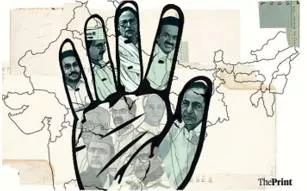
Patel nehru were right on strong centre just look at us you can’t leave it to the states
People like historian Ayesha Jalal have criticised Patel and Nehru for insisting on a strong central rule in India. Many criticised Ambedkar for opting for a central control in our Constitution. Even today, many argue for ‘decentralisation’. And they all sound plausible, reasonable, even correct. They are just wrong.States’ rights are among the most foolish constitutional ideas that have had a life of their own. It’s bad enough that two Indian states — Gujarat and Bihar — have prohibition and encourage bootlegging and smuggling, wasting the time and attention of their overstretched police forces. But to have neighbouring states allowing or forbidding abortion must be the ultimate in political naivety and banality. The recent judicial decision in the world’s longest surviving constitutional republic shines the light on this strange anomaly.
We certainly need states, districts, tehsils, corporations, municipalities, panchayats and so on. We need them for administrative convenience, not for the silly notion of granting them separate legal and constitutional muscle-flexing rights. The idea that a murderer can hang in one state, but only get life imprisonment in another is preposterous and egregiously ill-conceived.
Flawed ‘union’ of republics
It is often argued that the US was conceived as a relatively loose union of states, and it has survived quite successfully. One wonders if that in fact is the case. Eighty-seven (or if you prefer four score and seven!) years after its founding, the US experienced a ghastly civil war with enormous casualties. ‘States rights’ arguments precipitated that conflict. America’s economic and military successes may in fact be despite the loose union, rather than on account of it.
I go back to the fateful years of 1946 and 1947. Many have argued that Jawaharlal Nehru torpedoed the Cabinet Mission Plan, which proposed a three-tier administrative structure in British India. This is because as a socialist, he believed in a strong central government. Others have argued that the experiences during the ill-fated interim government convinced Vallabhbhai Patel that no government, let alone a strong government, was possible without acquiescing to and even embracing India’s partition. Nehru, the socialist and Patel, who was more market-friendly, ended up on the same side. They preferred a strong Centre and were dead set against a woolly headed ‘provincial grouping’ formula that Cripps and Company would have forced on us.
Both B.R. Ambedkar and Benegal Narsing Rau, who were great admirers of the Government of India Act of 1935, had no hesitation in leveraging that legislation while working out India’s constitutional arrangements between 1947 and 1950. Interestingly, one part of the 1935 Act which they completely ignored and bypassed was the section dealing with ‘federation’. Even in 1935, this section was possibly mischievously included by the Whitehall mandarins precisely to ensure that India remained a weak and fractious nation state. The ‘Sovereign Democratic Republic of India’ emerged as a strong ‘Union’, not a weak federation.
The Yugoslav experiment (1948-1974) demonstrates the folly of experimenting with weak nation states. They did not even bother to refer to the constituent units as states or provinces. They were called ‘republics’. Soon after Yugoslavia’s charismatic president Josip Broz Tito died, different republics decided to go their own way. As can be expected, there were scheming neighbours willing to fish in troubled waters by recognising the hasty independence of these republics. The German foreign office must have been full of smug, self-satisfied officials as they helped dismember Yugoslavia by conferring the dubious distinction of ‘recognition’ on Slovenia and Croatia. The violent and gruesome Balkan Civil War (1991-2001) was a direct consequence of starting with a loose union of states, sorry republics.
Structured centre protects diversity
The idea that diversity can be respected only if the constitutional arrangement is a loose one with emphasis on states’ rights is a fallacious one. In the real world, diversity is better preserved if there is a well-structured Centre. The recurring ‘anti-outsider’ movements in several Indian states have been contained and marginalised precisely because we have a strong Centre. Some readers may recall that former US president Dwight Eisenhower very cleverly mandated that Arkansas law enforcement forces were effectively under federal control and helped enforce desegregation in the schools at Little Rock. If states rights had been upheld, the minority Blacks in Arkansas would have had no protection or protectors.
Strong Centres can be misused. But let’s not forget that there are many more competing checks and balances on central governments than on states. I still remember Kolkata in its Communist Party of India (Marxist) heyday, when an entire building was sealed off on election day because it was inhabited by North Indians who would likely vote against the CPM. The state officials had no intention of giving protection to these marooned Hindustanis. So much for states being supporters of diversity!
Having said all this, one can and should make the case for strong, efficient, even modestly competing states. States can focus on efficient delivery of services and can competitively differentiate themselves. The mid-day meal scheme or better electricity supply come to mind here. The primary focus can and should be on efficient administration. That is what we need states for. We do not need them to indulge in constitutional fantasies on an extravagant scale. Let us not forget that we rejected the Cabinet Mission Plan for good reason. Let us not forget what happened to Yugoslavia. And let us not ignore what is happening in the United States of America.












Stay updated with The Hindu Editorial Vocab24 app, your definitive source for breaking news and comprehensive coverage from India and around the globe. Whether it's political developments, business updates, sports highlights, the latest technology trends, or current events, The Hindu brings live, accurate, and reliable news directly to your device.
Don’t fall for sensationalized or fake news shared online. Read and share accurate updates with friends and family through The Hindu Editorial Vocab24 app. Download it today!
News Coverage in The Hindu Editorial Vocab24 App
Breaking News: Receive instant notifications on breaking news stories as they unfold. Stay informed about major events and developments in India and around the world with live blogs, news in shorts videos, and concise articles.
Politics: Get the latest updates on Indian politics, including elections, policy changes, government decisions, and political events that shape the nation.
Business and Economy: Stay ahead in the economic landscape with detailed business news and market analysis. Learn about stock market trends, financial reports, corporate news, and economic developments to make informed investment decisions.
Current Events: Follow stories on social issues, policy changes, global events, and daily current affairs, tailored for UPSC and other competitive exam preparations.
Technology: Keep up with the latest gadgets, innovations, and tech trends. Read expert reviews and analyses in short, concise updates on cutting-edge technology from India and beyond.
Sports: Never miss a moment of your favorite sports. Get live scores, match reports, and expert analysis on cricket, football, tennis, and more.
International News: Stay informed about global events and geopolitical developments, including the Russia-Ukraine war, Israel-Palestine conflict, and other key international stories.
Local News: Stay connected to your community with the latest updates on city events, issues, and local news. Coverage includes hyperlocal updates from cities like Bangalore, Chennai, Delhi, Hyderabad, Mumbai, Kolkata, and more.
Trending Topics: Discover what's trending today with the most talked-about stories and hot topics across India and the world.
Experience journalism that values integrity, accuracy, and reliability. Download The Hindu Editorial Vocab24 app today and stay connected with the world.
Subscribe to our newsletter!







