

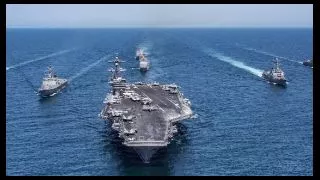
Oceanic semantics
Some are born great, some achieve greatness, and some have greatness thrust upon them, said the Bard. Experts in the field of international politics would perhaps disagree and affirm that nations acquire greatness, be it economic strength, political prominence or strategic domination, only through a painstaking process of building up its power base, though favourable natural condition or geographic location are contributing factors. Repeated use of the concept of Indo-Pacific, preceding and during the visit of President Trump to five Asian countries, China, Japan, Vietnam, South Korea and Philippines recently and its spirited defence by White House officials, who proclaimed that use of the term “Indo-Pacific” instead of the more frequently used “Asia-Pacific” is an explicit acknowledgement of India’s growing preponderance (the quality or fact of being greater in number, quantity, or importance.) in the region. The claim begs the obvious question ~ Has India really arrived on the theatre of geo-politics of the Asia-Pacific in such a big way?Ever since the 1990s, there has been a steady shift in the foundational aspect of India’s foreign policy objectives and interests. A vast range of variables, including India’s freedom from the compulsions of Cold War-related political grandstanding and the resultant sense of autonomy, participation in the liberalization-globalization processes, rapid economic growth yielding a new sense of power and heightened aspirations, all brought about an urge to explore the possibility of having new partners in the external sphere. The Look-East policy adopted at that time as well as the propagation of ‘extended neighbourhood’ concept was suggestive of India’s desire to redefine the behavioural and geographical contours of regional engagement. It carried an unmistakable message that India no longer viewed its destiny to be tied only to South Asia and that it was aiming high.
As Prime Minister, Narasimha Rao had explicitly conveyed this message very early in 1994. He said: ‘The Asia-Pacific could be the springboard for our leap into the global market place’ . The country’s growing engagement with the ASEAN bloc (a group of countries or political parties with common interests who have formed an alliance.) and other East Asian countries has continued through the successive governments. Ever since the summer of 2014, Prime Minister Narendra Modi has pursued an ambitious foreign policy vis-à-vis not only the immediate neighbourhood of South Asia but also, perhaps more significantly, the wider Asia-Pacific region as well.
The Look-East policy has metamorphosed (change or cause to change completely in form or nature.) into Act East Policy with the objective of enhancing the country’s engagement with ASEAN and East Asia. Analysts believe that Modi’s assertiveness in the Asia-Pacific is indicative of growing confidence and ambitious re-evaluation of India’s self- perception about its role and importance in the affairs of the region. It signifies the arrival of India as a major player in the strategic chessboard of the region. Any attempt to contextualize the concept of Indo-Pacific must take into account this emerging scenario.
The term Indo-Pacific has been increasingly in use in diplomatic and academic circles since 2010, and appears to have been first used by Gurpreet Khurana, an Indian naval officer, in his paper on India-Japan cooperation over oceanic security. Hillary Clinton is the first world leader to use the term in 2010 when in her capacity as the Secretary of State, she commented, “We understand how important the Indo-Pacific basin is to global trade and commerce,” she said. “The stretch of sea from the Indian Ocean through to the Pacific contains the world’s most vibrant (flamboyant) trade and energy roots linking economies and driving growth, and India straddling the waters from the Indian to the Pacific Ocean is, with us, a steward of these waterways’.
Since then, no American President used the term ‘Indo-Pacific’ till President Trump recently avoided the expression ‘Asia-Pacific’ and repeatedly mentioned their interest in the ‘Indo-Pacific’ on the eve of the President’s five-nation Asia tour. For analysts, the subtle nuances of this fascination for a new construct are quite engaging.
The main theoretical reasoning behind a switchover from “Asia-Pacific” is that it is no longer correct to think about South Asia and East Asia separately. While “Asia-Pacific” conventionally focuses on the area from North Korea to the southern tip of China, “Indo-Pacific” includes countries on the Indian Ocean coastline, South-east Asia, and Australia, Indonesia, and New Zealand. At the heart of that area are two oceans ~ the Indian Ocean and the Pacific. “Indo-Pacific” blurs the division between these two stretches of water. By that token, the word “Indo” could mean more of “Indian Ocean” and less of “India.”
As China’s over-ambitious Belt and Road Initiative keeps pushing the limits of its sphere of influence to as far as Africa, ‘Indo-Pacific’ may be viewed as a covert attempt to change the narrative of strategic prominence in the region by making China appear less important and giving a fillip (something which acts as a stimulus or boost to an activity.) to India’s position. President Trump and his team repeatedly articulated their objectives of promoting ‘ a free and open Indo-Pacific Region’ which carries with it both economic and strategic considerations. A US official explained that the President was making a long-term commitment to the region, based on the shared principles of rules, high standards, the economic system and reduction of chronic (of a problem) long-lasting.) trade deficits. China must provide fair and reciprocal treatment, not just to the U.S. but to all countries in the region.
Coupled with this is the appreciation for Prime Minister Modi and high expectations about the rise of India, whose democratic credentials have received profuse (very plentiful; abundant.) accolades (an expression of praise or admiration.). Mr. Modi’s arrival in Manila was preceded by the first meeting of the India-U.S.-Japan-Australia quadrilateral, a grouping first mooted in 2006 by Japanese Prime Minister Shinzo Abe. It ended with statements on cooperation for a “free, open, prosperous and inclusive Indo-Pacific region”, a direct signal that it will counter China’s actions in the South China Sea if necessary. Mr. Modi’s meeting with U.S. President Donald Trump saw a similar emphasis on cooperating in the Indo-Pacific, a term now widely adopted by the U.S. The ‘Quad’ doesn’t just pertain to maritime surveillance, it also aims at enhancing connectivity in accordance with “the rule of law” and “prudent (acting with or showing care and thought for the future.) financing” in the Indo-Pacific together, apparently, a US alternative to China’s Belt and Road initiative.
While all these augur well for India’s regional status, the hard reality is that with magnificent projection of power comes intense responsibilities to act on them, as has been acknowledged by Mr Modi himself. India’s Free Trade Agreement with ASEAN till now has had a limited impact; many connectivity projects are experiencing significant time-and-cost overruns (an instance of something exceeding an expected or allowed time or cost.); India has been hesitant to throw its weight around in the cauldron (a situation characterized by instability and strong emotions.) of the South China Sea dispute. In 2016, the navies of India and the ASEAN countries had conducted joint maritime exercises in South China Sea, in an apparent show of strength and solidarity. In foreign policy, the Prime Minister has abjured (solemnly renounce) his robust attitude that is so very manifest in his domestic dealings and rightly so. Despite winning the war of nerves in Doklam, Mr Modi should be cautious and wary of China’s enormous economic and military clout as well as its soaring ambition, which was vehemently articulated at the recent 19th Congress of the Communist Party of China.
India should rather walk the tight rope (Take or be on a very precarious course) of balancing China strategically while engaging with it economically in several important fora, such as BRICS and the Shanghai Cooperation Organisation. India also needs to follow up on the initiatives it has taken in the region, for example by deepening relations with the small Pacific Island nations. It should take forward the agenda of the ‘Forum for India-Pacific Islands Cooperation’ (FIPIC) by providing economic and technical assistance to these countries in combating non-traditional security threats like climate change and soft-pedalling the supremacy of its democratic set-up vis-à-vis China which can buttress (increase the strength of or justification for; reinforce.) its regional stature. Given China’s wary reaction to Quad with the comment that regional cooperation groupings should ‘avoid politicising or excluding countries,’ India should downplay any attempt to project the grouping as a front to counter Chinese influence. Our own house needs to be kept in order, pluralist democratic ethos jealously guarded and the process of slowing down of the economy in the wake of demonetisation reverted. India can truly aspire to become the ‘rule-maker’ from ‘rule-taker’ in the complex security matrix of the Indo-Pacific.



Philippines president rodrigo duterte slams unhcr
Apr 06, 2018
Oli to take up currency ban issue with pm modi
Apr 02, 2018
Curbing the khaps
Apr 01, 2018





Stay updated with The Hindu Editorial Vocab24 app, your definitive source for breaking news and comprehensive coverage from India and around the globe. Whether it's political developments, business updates, sports highlights, the latest technology trends, or current events, The Hindu brings live, accurate, and reliable news directly to your device.
Don’t fall for sensationalized or fake news shared online. Read and share accurate updates with friends and family through The Hindu Editorial Vocab24 app. Download it today!
News Coverage in The Hindu Editorial Vocab24 App
Breaking News: Receive instant notifications on breaking news stories as they unfold. Stay informed about major events and developments in India and around the world with live blogs, news in shorts videos, and concise articles.
Politics: Get the latest updates on Indian politics, including elections, policy changes, government decisions, and political events that shape the nation.
Business and Economy: Stay ahead in the economic landscape with detailed business news and market analysis. Learn about stock market trends, financial reports, corporate news, and economic developments to make informed investment decisions.
Current Events: Follow stories on social issues, policy changes, global events, and daily current affairs, tailored for UPSC and other competitive exam preparations.
Technology: Keep up with the latest gadgets, innovations, and tech trends. Read expert reviews and analyses in short, concise updates on cutting-edge technology from India and beyond.
Sports: Never miss a moment of your favorite sports. Get live scores, match reports, and expert analysis on cricket, football, tennis, and more.
International News: Stay informed about global events and geopolitical developments, including the Russia-Ukraine war, Israel-Palestine conflict, and other key international stories.
Local News: Stay connected to your community with the latest updates on city events, issues, and local news. Coverage includes hyperlocal updates from cities like Bangalore, Chennai, Delhi, Hyderabad, Mumbai, Kolkata, and more.
Trending Topics: Discover what's trending today with the most talked-about stories and hot topics across India and the world.
Experience journalism that values integrity, accuracy, and reliability. Download The Hindu Editorial Vocab24 app today and stay connected with the world.
Subscribe to our newsletter!







