

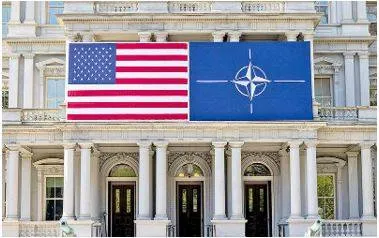
Nato members reluctant to endorse trump’s defence spending proposal
The U.S. President-elect said members of the military alliance should spend 5% of gross domestic product on defence – a huge increase from the current 2% goal and a level that no NATO country currently reaches; a new target is likely to be agreed at a NATO summit in The Hague in June.NATO won’t heed Donald Trump’s proposal for a massive hike in defence spending but will likely agree to go beyond its current target, according to officials and analysts.
The U.S. President-elect declared on Tuesday members of the military alliance should spend 5% of gross domestic product (GDP) on defence – a huge increase from the current 2% goal and a level that no NATO country, including the United States, currently reaches.
Mr. Trump’s comments – at a press conference that also generated a blizzard of headlines on Greenland, Canada and Panama – were a reminder of his focus on NATO spending during his first term and his threats not to protect allies that fail to meet the target.
Politically impossible
Officials from NATO countries said they agreed defence spending needs to rise further but did not endorse the 5% figure, which analysts said would be politically and economically impossible for almost all members. It would require hundreds of billions of dollars in extra funding.
However, a new target is likely to be agreed at a NATO summit in The Hague in June, spurred by fears that Russia may attack a NATO country after Ukraine and by Mr. Trump’s exhortations, officials said.
The key open questions are what that new target will be and whether it will be enough to satisfy Mr. Trump.
Some expect NATO’s 32 members to agree, after much wrangling, to a target of around 3% of GDP. But even that would be a stretch for many, who barely meet or fall short of the 2% goal now – a decade after it was set.
“It seems there will be a shift,” Italian Defence Minister Guido Crosetto said. “I don’t think it will be 5%, which would be impossible for almost every nation in the world right now but... it will not be two [per cent], which we are already struggling to reach, but it will be more than two.”
Italy, with defence spending at around 1.5% of GDP, is among eight NATO members that do not meet the current target.
Poland, which borders Ukraine, is the NATO member that spends the highest share of GDP on defence – 4.12% last year, alliance estimates show. It is followed by Estonia with 3.43% and the United States with 3.38%.
NATO estimated the combined defence spending of its members at $1.474 trillion in 2024 - around $968 billion from the United States and $507 billion from European nations and Canada.
The overall average is about 2.71% of NATO GDP.
Some officials and analysts see Mr. Trump’s 5% suggestion as a deliberately high opening bid to kick off months of negotiations and expect he may settle for something closer to 3%.
During last year’s U.S. presidential election campaign, Mr. Trump proposed a 3% target, adding this would mean a defence budget increase of about 30% for most NATO countries.
Spending surge
Shocked by Russia’s war in Ukraine, many European countries have ramped up defence spending in recent years.
But with public finances tight, and defence spending not politically popular in some countries, it would not be easy for governments to find the extra billions that even a move to spend 3% of GDP on defence would entail.
While Mr. Trump has likened NATO defence spending to alliance membership fees, they reflect budgets set by national governments.
Fenella McGerty, a defence economics expert at the International Institute for Strategic Studies think tank, said recent increases had been “remarkable” but it takes years for countries to start reaching new targets.
“Even if Europe were to continue that rate of quite extraordinary growth - in excess of 10% in real terms in 2024 - it would still take another 10 years to even get to 3% of GDP,” she said.
However, many European governments say the continent should do more to defend itself and rely less on the United States.
France and the Baltic states are pushing for joint European Union borrowing to fund defence spending. The outcome of that debate may depend on next month’s national election in Germany, which has so far opposed the idea.
To become more self-reliant, the European allies need to spend more to develop capabilities that the U.S. currently provides such as air-to-air refuelling, heavy-duty military air transport and electronic warfare, said Camille Grand, who previously served as NATO’s top official for defence investment.
“All of these things cost a lot of money. Some of them are big-ticket items,” said Grand, now with the European Council on Foreign Relations think tank.
The current security environment suggests European countries should be spending about 3% of GDP on defence, she said.
Marie-Agnes Strack-Zimmermann, chair of the European Parliament’s defence subcommittee, said Europe must ramp up spending but not fixate on an arbitrary figure.
“We need to mobilise a lot more money, but we shouldn’t let Trump drive us crazy,” she said.
Poland, which borders Ukraine, is the NATO member that spends the highest share of GDP on defence – 4.12% last year, alliance estimates show.

Atiqa records two top-four finishes in WSK Final Cup
Sep 05, 2026










Stay updated with The Hindu Editorial Vocab24 app, your definitive source for breaking news and comprehensive coverage from India and around the globe. Whether it's political developments, business updates, sports highlights, the latest technology trends, or current events, The Hindu brings live, accurate, and reliable news directly to your device.
Don’t fall for sensationalized or fake news shared online. Read and share accurate updates with friends and family through The Hindu Editorial Vocab24 app. Download it today!
News Coverage in The Hindu Editorial Vocab24 App
Breaking News: Receive instant notifications on breaking news stories as they unfold. Stay informed about major events and developments in India and around the world with live blogs, news in shorts videos, and concise articles.
Politics: Get the latest updates on Indian politics, including elections, policy changes, government decisions, and political events that shape the nation.
Business and Economy: Stay ahead in the economic landscape with detailed business news and market analysis. Learn about stock market trends, financial reports, corporate news, and economic developments to make informed investment decisions.
Current Events: Follow stories on social issues, policy changes, global events, and daily current affairs, tailored for UPSC and other competitive exam preparations.
Technology: Keep up with the latest gadgets, innovations, and tech trends. Read expert reviews and analyses in short, concise updates on cutting-edge technology from India and beyond.
Sports: Never miss a moment of your favorite sports. Get live scores, match reports, and expert analysis on cricket, football, tennis, and more.
International News: Stay informed about global events and geopolitical developments, including the Russia-Ukraine war, Israel-Palestine conflict, and other key international stories.
Local News: Stay connected to your community with the latest updates on city events, issues, and local news. Coverage includes hyperlocal updates from cities like Bangalore, Chennai, Delhi, Hyderabad, Mumbai, Kolkata, and more.
Trending Topics: Discover what's trending today with the most talked-about stories and hot topics across India and the world.
Experience journalism that values integrity, accuracy, and reliability. Download The Hindu Editorial Vocab24 app today and stay connected with the world.
Subscribe to our newsletter!







