

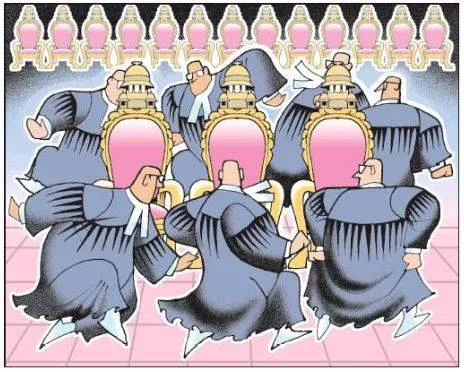
Musical chairs in supreme court
Time to replace seniority convention (परिपाटी) with an alternate, clearly articulated method of appointmentsA curious spectacle (drama) unfolds in the courtrooms of the Supreme Court whenever a senior member of the Bar walks in. Since chairs are scarce, (limited) one might imagine the senior member waiting his turn or being offered a seat by a relatively junior member. Though both of these possibilities do manifest themselves sometimes, quite often an amusing sequence of events ensues as the senior occupies his rightful place in the front row of the courtroom.
This causes others on the row shifting one seat in order of seniority to accommodate the new entrant. This pattern of adult musical chairs repeats itself if another even more senior member walks in. While one might dismiss such a harmless practice as yet-another arcane courtroom convention, it is symptomatic of the pervasive influence of seniority over every conceivable aspect of the legal profession.
From seat availability of lawyers to the choice of bungalows for judges, the right to argue first in court to who gets appointed Chief Justice of India, seniority applies to mundane and significant matters in equal measure. So when the collegium of the Supreme Court recommended Justice Sanjiv Khanna, the third-most senior sitting judge of the Delhi high court (fifth, if Delhi high court judges serving as chief justices in other courts are included) and Justice Dinesh Maheshwari (whose junior from the Rajasthan high court, Justice Ajay Rastogi is already a judge of the Supreme Court) it was subject to severe opprobrium (disrespect).
In the case of Justice Khanna, not only was seniority breached but also Justices Mittal, Nandrajog, Menon and Bhat, all fine judges in their own right, were overlooked. Justice Maheshwari’s case was more far-reaching in its impact – by recommending him to the Supreme Court after a judge junior to him had been appointed, the sanctity of the very principle of seniority was questioned.
This assault on seniority is not without precedent. In several instances, junior judges in high courts have been appointed to the Supreme Court over their senior brethren. In fact, two present judges in the Supreme Court – Justices Shantanagoudar and Nazeer – were not the seniormost judges of the Karnataka high court when they were appointed to the Supreme Court.
However what makes this particular instance stand out is how everyone involved in the process looks the worse for it. The collegium headed by Chief Justice Gogoi looks bad for not offering reasons for their decision. Such reasons were critical to its popular and legal validity. The Second Judges’ Case requires reasons if seniority is departed from; equally importantly, having seemingly found two other more senior judges suitable for the Supreme Court a month previously, an unexplained recommendation of two distinct names lent itself to hearsay of the worst kind.
Chief Justice Gogoi’s participation at the press conference last year suggested a new dawn of transparency and accountability in judicial functioning. One year on, in the absence of publicly disclosed reasons in controversial collegium recommendations, little seems to have changed.
The judges who accepted such appointments look bad for two distinct reasons. When in the past, Justice UL Bhat of the Kerala high court was passed over for the Supreme Court in favour of his junior colleague Justice KS Paripoornan from the same court, he claimed to have refused his consent
to a later appointment to the Supreme Court. In the same situation, Justice Maheshwari seems to have forsaken such institutional convention.
Justice Sanjiv Khanna’s elevation presents a more poignant case. His uncle, the hallowed Justice HR Khanna, brave dissenter during the Emergency, resigned from his office when he was superseded in favour of Justice Beg by Indira Gandhi. His nephew, now in Justice Beg’s shoes, jumped the queue. Institutional integrity and personal memory appears to have counted for little.
Finally the government looks selfserving having recently kicked up a storm about seniority not being adhered to in the appointment of Justice KM Joseph. The alacrity with which Justices Khanna and Maheshwari were appointed without the faintest objection being raised on similar grounds reveals the truth about seniority – it is a wolf of favouritism in sheep’s clothing of convention.
Taken together, this episode points to a fundamental disjunct in matters pertaining to the Supreme Court. We have an unstated expectation that vintage conventions from a more genteel time will prevail in the court, isolated, as it is, from the hurly-burly of politics. But in fact, the writing has been on the wall from the time of the NJAC judgment – judicial appointments are no longer about convention, they are primarily about power.
This is precisely why seniority, time and again, is cast aside, without articulating a clear alternate principle of merit or an optimally transparent process of selection. The reputational damage that such opaque decision-making causes to otherwise upright collegium judges, competent prospective appointees and the institution of the judiciary is immense. It is also entirely avoidable.
There are enough good reasons for the seniority convention to be given a decent burial. It isn’t as objective it pretends to be, leads to absurdly short tenures for chief justices and is a strategic device wielded when convenient. But for that we need an alternate, clearly articulated method of appointment to take its place. Without that, all appointments, no matter how well-intentioned, will appear like skulduggery. Just as it would, if senior members of the Bar suddenly found no empty chairs to sit on in court and were left wondering why.










Stay updated with The Hindu Editorial Vocab24 app, your definitive source for breaking news and comprehensive coverage from India and around the globe. Whether it's political developments, business updates, sports highlights, the latest technology trends, or current events, The Hindu brings live, accurate, and reliable news directly to your device.
Don’t fall for sensationalized or fake news shared online. Read and share accurate updates with friends and family through The Hindu Editorial Vocab24 app. Download it today!
News Coverage in The Hindu Editorial Vocab24 App
Breaking News: Receive instant notifications on breaking news stories as they unfold. Stay informed about major events and developments in India and around the world with live blogs, news in shorts videos, and concise articles.
Politics: Get the latest updates on Indian politics, including elections, policy changes, government decisions, and political events that shape the nation.
Business and Economy: Stay ahead in the economic landscape with detailed business news and market analysis. Learn about stock market trends, financial reports, corporate news, and economic developments to make informed investment decisions.
Current Events: Follow stories on social issues, policy changes, global events, and daily current affairs, tailored for UPSC and other competitive exam preparations.
Technology: Keep up with the latest gadgets, innovations, and tech trends. Read expert reviews and analyses in short, concise updates on cutting-edge technology from India and beyond.
Sports: Never miss a moment of your favorite sports. Get live scores, match reports, and expert analysis on cricket, football, tennis, and more.
International News: Stay informed about global events and geopolitical developments, including the Russia-Ukraine war, Israel-Palestine conflict, and other key international stories.
Local News: Stay connected to your community with the latest updates on city events, issues, and local news. Coverage includes hyperlocal updates from cities like Bangalore, Chennai, Delhi, Hyderabad, Mumbai, Kolkata, and more.
Trending Topics: Discover what's trending today with the most talked-about stories and hot topics across India and the world.
Experience journalism that values integrity, accuracy, and reliability. Download The Hindu Editorial Vocab24 app today and stay connected with the world.
Subscribe to our newsletter!







