

‘Mother of all deals’: India and the EU finalise FTA
Officials say document will undergo a legal scrubbing, translation before ratification by European ParliamentEuropean wines, luxury cars to become cheaper as two sides conclude trade negotiations that began in 2007
Modi calls it historic pact, while EU chief says the deal will reduce strategic dependency at a time of global upheaval
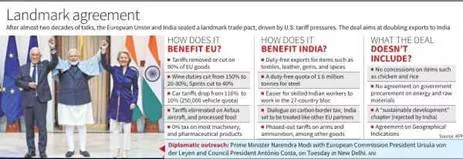
After almost two decades of negotiation, India and the European Union (EU) finalised a free trade agreement (FTA) on Tuesday, billed as the “mother of all deals”, that will see the EU drop tariffs on 99.5% of Indian exports to the 27-nation bloc.
India has given tariff concessions on 97.5% of imports from the EU, with European wines and luxury cars set to become less expensive here as a result.
Beyond the economics, both sides stressed the geopolitical significance of a deal between two economies that together account for a third of global trade in the shadow of uncertainty sparked by the U.S. tariff regime.
Prime Minister Narendra Modi declared that the partnership would “strengthen stability” at a time of global turmoil, while European Commission President Ursula von der Leyen said it would reduce strategic dependency at a time when global trade is increasingly fractious.
“We have delivered the mother of all deals,” she said. “Two giants who choose partnership, in a true win-win fashion. A strong message that cooperation is the best answer to global challenges.”
‘Largest-ever FTA’
Noting that this is India’s largest-ever FTA, Mr. Modi said: “This historic agreement will facilitate access to the European market for our farmers and small industries, create new opportunities in manufacturing, and strengthen cooperation in our services sectors.”
Both sides, however, made sure to exclude their respective sensitive sectors. India’s strategic agricultural and dairy sectors remain protected, while the EU will maintain its current tariffs on beef, sugar, rice, chicken meat, milk powder, honey, bananas, soft wheat, garlic, and ethanol.
India-EU FTA talks were first launched in 2007. Following several hiccups and pauses, they were resumed in 2022 with both sides agreeing to exclude issues on which agreement had been elusive.
According to Commerce Ministry officials, the language in the document will first be cleaned up over the next 10 to 15 days, following which it will undergo “legal scrubbing”. It will then have to be translated and sent to all 27 EU member states, before it can be ratified by the European Parliament. “We do hope that we should be able to celebrate the entry into force of this agreement within calendar 2026 itself,” said Union Minister Piyush Goyal.
According to the Commerce Ministry, India has gained tariff reductions across 97% of tariff lines, covering 99.5% of trade value. Of this, 90.7% of India’s exports will see duties eliminated entirely on the first day of the deal’s implementation, including labour-intensive sectors such as textiles, apparel, leather, footwear, tea, coffee, spices, sports goods, toys, gems and jewellery, and certain marine products, amongst others.
Another 2.9% of India’s exports will see duty elimination over three to five years.
This would include certain marine products, processed food items, and arms and ammunition. Over and above this, 6% of India’s exports will see tariff reductions including certain poultry products, preserved vegetables, bakery products, amongst others.
“Key labour-intensive sectors comprising more than ₹2.87 lakh crore [$33 billion] of exports that are currently subjected to import duty between 4% to 26% in the EU and are crucial for employment generation, will enter zero duty from entry into force of the FTA and thus gain enhanced competitiveness in the EU market,” the Ministry said in a release.
Duty elimination
In particular, of the sectors that India primarily exports to the EU, the following will see duties eliminated entirely: marine products (current duties of up to 26%), chemicals (12.8% currently), plastic and rubber items (6.5%), leather footwear (17%), textiles and apparel (12% each), base metals (10%), gems and jewellery (4%), furniture and allied consumer goods (10.5%), and toys and sports goods (4.7%). On services, the EU has agreed to commitments across 144 services sub sectors, including IT/ITeS, professional services, education, and other business services.
Overall, India is offering duty elimination and reductions on 92.1% of the tariff lines, which comprises 97.5% of the EU exports to India. Within this, 49.6% of the tariff lines will see an immediate duty elimination once the agreement comes into effect.
Another 39.5% of the tariff lines will be subject to a phased elimination of tariffs over five, seven, and 10 years. An additional 3% of products will see phased tariff reductions.
“Imports of EU’s high technology goods are expected to diversify India’s import sources, thereby reducing input costs for businesses, benefit consumers and will create opportunities for Indian businesses to integrate into global supply chains,” the statement added.
Notably for the EU, the following European sectors will see duty-free access to the Indian markets: machinery and electrical equipment, aircraft and spacecraft, optical, medical and surgical equipment, plastics, precious stones and metals, chemicals, motor vehicles, iron and steel, pharmaceuticals, and various agricultural products. On services, India has agreed to open up 102 sub sectors covering EU priorities such as professional, business, telecommunications, maritime, financial, and environmental services.
It has been learnt that negotiations over a few sectors such as automobiles and wine had caused some problems, but that the two sides finally agreed to quota based systems that were satisfactory to both sides. India agreed to allow European cars with a price tag above ₹25 lakh to be imported at lower duties of as low as 10%, from the current 110%, but subject to a quota.
India and the EU also reached a limited agreement on the contentious Carbon Border Adjustment Mechanism (CBAM), Mr. Goyal added. The agreement creates a way for carbon footprint verifiers in India to gain accreditation. It also specifies that, should the EU give concessions under CBAM to a third country, those concessions would automatically apply to India too.
Ensure peace, freedom of navigation, PM urges Iran
Sep 03, 2026






Stay updated with The Hindu Editorial Vocab24 app, your definitive source for breaking news and comprehensive coverage from India and around the globe. Whether it's political developments, business updates, sports highlights, the latest technology trends, or current events, The Hindu brings live, accurate, and reliable news directly to your device.
Don’t fall for sensationalized or fake news shared online. Read and share accurate updates with friends and family through The Hindu Editorial Vocab24 app. Download it today!
News Coverage in The Hindu Editorial Vocab24 App
Breaking News: Receive instant notifications on breaking news stories as they unfold. Stay informed about major events and developments in India and around the world with live blogs, news in shorts videos, and concise articles.
Politics: Get the latest updates on Indian politics, including elections, policy changes, government decisions, and political events that shape the nation.
Business and Economy: Stay ahead in the economic landscape with detailed business news and market analysis. Learn about stock market trends, financial reports, corporate news, and economic developments to make informed investment decisions.
Current Events: Follow stories on social issues, policy changes, global events, and daily current affairs, tailored for UPSC and other competitive exam preparations.
Technology: Keep up with the latest gadgets, innovations, and tech trends. Read expert reviews and analyses in short, concise updates on cutting-edge technology from India and beyond.
Sports: Never miss a moment of your favorite sports. Get live scores, match reports, and expert analysis on cricket, football, tennis, and more.
International News: Stay informed about global events and geopolitical developments, including the Russia-Ukraine war, Israel-Palestine conflict, and other key international stories.
Local News: Stay connected to your community with the latest updates on city events, issues, and local news. Coverage includes hyperlocal updates from cities like Bangalore, Chennai, Delhi, Hyderabad, Mumbai, Kolkata, and more.
Trending Topics: Discover what's trending today with the most talked-about stories and hot topics across India and the world.
Experience journalism that values integrity, accuracy, and reliability. Download The Hindu Editorial Vocab24 app today and stay connected with the world.
Subscribe to our newsletter!







