

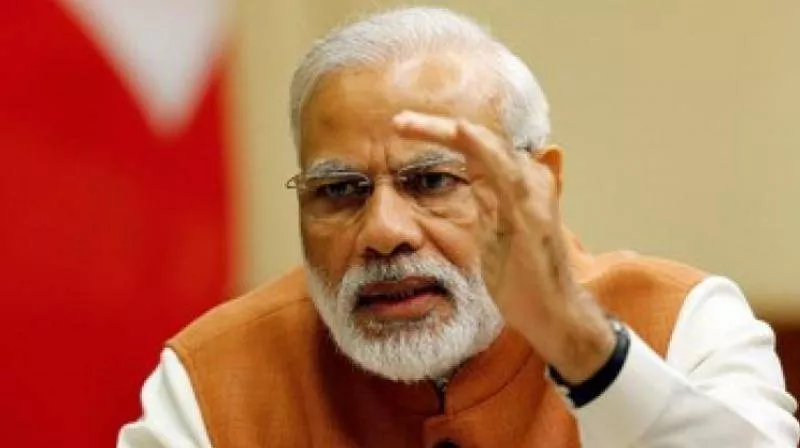
Modi@davos a new kind of challenge
As Prime Minister Narendra Modi decided to wing it to frosty Davos for the World Economic Forum’s annual meeting later this month, his bete-noire — Congress president Rahul Gandhi — decided to be different and spend the coming week in his parliamentary constituency of Amethi, in rural Uttar Pradesh. Both seek inspiration and support. But from very different sources.As usual, bombast is expected to rule at Davos. Consider the title of this year’s meet — “Creating a shared future in a fractured world”. It completely obfuscates the fact that everything the world has done over the past 40 years has conspired to keep the majority share of the fruits of development within the elites. The rising inequality and congealing wealth at the very top is witness to the failure of the open economy model to deliver growth benefits across the population. China’s President Xi Jinping contested this proposition in his address at Davos last year. Yes, China has lifted 700 million people out of poverty — more than any other nation. But relative poverty has increased even in China.
As if this was not enough, automation and artificial intelligence shall, over the next two decades, push ever greater masses of unfortunates outside the virtuous cycle of income enrichment. This is a prime concern for India, with 60 per cent of our current population less than 31 years of age.
It doesn’t end there. Once we create this dystopian world in which the few, engaged humans work within the insulated eco-system of high tech, the large mass of humanity will be on the outside looking in. They would be fed by subsidies thrown at them. Consider that block chain if applied widely to everyday transactions can scupper the employment of auditors, accountants, lawyers and judges — all of whom earn a living out of the problem of authenticating facts. Possibly, the efficiency benefits of automation may be high enough to finance generous handouts to the losers. But it would be a sorry society surviving on aid, rather than individual effort. We know already how debilitating aid dependency is.
This model of growth is not sustainable and needs to be junked. But it is unclear what should replace it. Davos is unlikely to help in that direction. There is never time at Davos to get beyond the breaking news.
Consider also the assertion that the world is a more fractured place today that it was a few years ago. Nothing could be further from the truth. Just last year at Davos, China, a habitual outlier, took the lead to reinforce the need for world integration. Compare this with the China of just 40 years ago — which was not even a member of the World Bank, and which joined the World Trade Organisation only in 2001. The rapid increase in the share of domestic GDP exported today is another indication that the world has shrunk, not fractured.
Davos is more about striking deals than philosophising about the world order. Prime Minster Modi is a consummate deal-maker. So, expect some significant commercial action at Davos. After all, Davos is not the United Nations, where nations talk at each other. It is a forum for leveraging business opportunities through public-private partnerships.
India has already thrown its hat into the ring of frugal innovation in space technology, with our Mars mission. Davos would be a good opportunity to emphasise the peaceful development of missile technology by India — in stark and sharp contrast to China, Pakistan and North Korea.
No country has taken steps, on the scale we have, to root out corruption using digital technology, banked transactions and the Goods and Services Tax. These have together negatively impacted economic growth in the short term. To be sure, there have been glitches along the way. But steadfast remedial action is delivering financial inclusion for all. This is more than just an economic revolution since it goes to the heart of culture and social practices.
Mr Modi was one of the first to warn the developed world that terrorism was a hydra which strikes rich and poor alike. India has for long suffered cross-border terrorism, which seeks to offer an alternative religious goal to Indian Muslims, who are a significant minority. India was a secular country even before the term “secular” was inserted into our preamble of our Constitution during the Emergency by then Prime Minister Indira Gandhi. Also, India has never been a “socialist” country, even though that term was inserted into the Constitution at the same time. Land ownership has always been personal in India. The concept of property rights is deeply embedded into our culture. The state-owned industrial monoliths — the visible outcomes of “socialism” and the entire employment in the government sector, has never exceeded around five per cent of total employment. It’s the spirit of entrepreneurship which the government is trying to liberate, facilitated by light touch regulation, the rule of law and supportive infrastructure.
US President Donald Trump seems to have upset Prime Minister Modi’s moment at WEF. The ebullient and volatile POTUS is likely garner all the sunshine. But Mr Modi is sure to use their joint appearance at Davos. He will fashion events and his remarks in a manner which point to a genuine partnership between the United States, Europe, Japan, Southeast Asia and India. Together, these economic actors contribute nearly two-thirds of the current world GDP. More important, they share some institutional and cultural attributes, which even by the jaded standards of today, can be called morally superior — like due regard for citizens’ rights and a commitment to enhancing the transparency with which the State functions.
Davos will be a tough challenge for Prime Minister Modi. He needs a credible story to explain why growth — the holy grail of the Davos crowd — has lagged in India even as growth has picked up world-wide. It would be great if he could substantiate that while headline growth has lagged, shared growth has increased. That, after all, is the model the World Economic Forum is looking for.
Author : SANJEEV AHLUWALIA The writer is adviser, Observer Research Foundation








Stay updated with The Hindu Editorial Vocab24 app, your definitive source for breaking news and comprehensive coverage from India and around the globe. Whether it's political developments, business updates, sports highlights, the latest technology trends, or current events, The Hindu brings live, accurate, and reliable news directly to your device.
Don’t fall for sensationalized or fake news shared online. Read and share accurate updates with friends and family through The Hindu Editorial Vocab24 app. Download it today!
News Coverage in The Hindu Editorial Vocab24 App
Breaking News: Receive instant notifications on breaking news stories as they unfold. Stay informed about major events and developments in India and around the world with live blogs, news in shorts videos, and concise articles.
Politics: Get the latest updates on Indian politics, including elections, policy changes, government decisions, and political events that shape the nation.
Business and Economy: Stay ahead in the economic landscape with detailed business news and market analysis. Learn about stock market trends, financial reports, corporate news, and economic developments to make informed investment decisions.
Current Events: Follow stories on social issues, policy changes, global events, and daily current affairs, tailored for UPSC and other competitive exam preparations.
Technology: Keep up with the latest gadgets, innovations, and tech trends. Read expert reviews and analyses in short, concise updates on cutting-edge technology from India and beyond.
Sports: Never miss a moment of your favorite sports. Get live scores, match reports, and expert analysis on cricket, football, tennis, and more.
International News: Stay informed about global events and geopolitical developments, including the Russia-Ukraine war, Israel-Palestine conflict, and other key international stories.
Local News: Stay connected to your community with the latest updates on city events, issues, and local news. Coverage includes hyperlocal updates from cities like Bangalore, Chennai, Delhi, Hyderabad, Mumbai, Kolkata, and more.
Trending Topics: Discover what's trending today with the most talked-about stories and hot topics across India and the world.
Experience journalism that values integrity, accuracy, and reliability. Download The Hindu Editorial Vocab24 app today and stay connected with the world.
Subscribe to our newsletter!







